
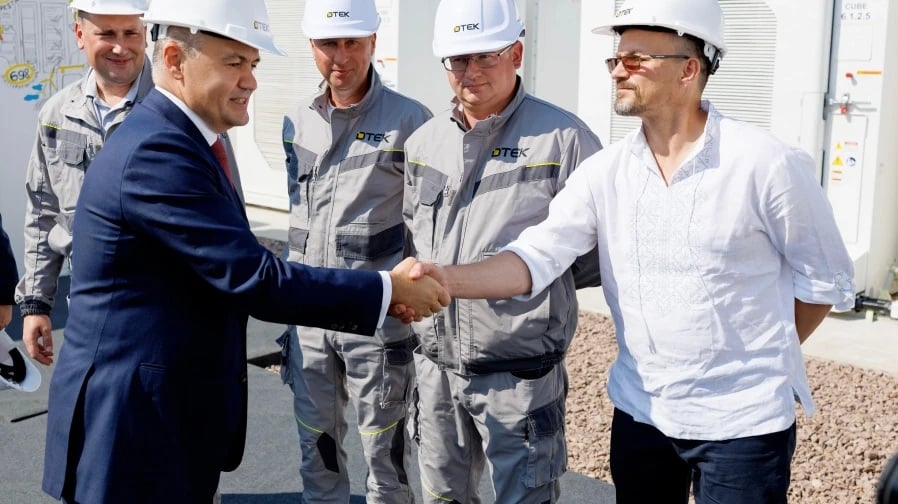
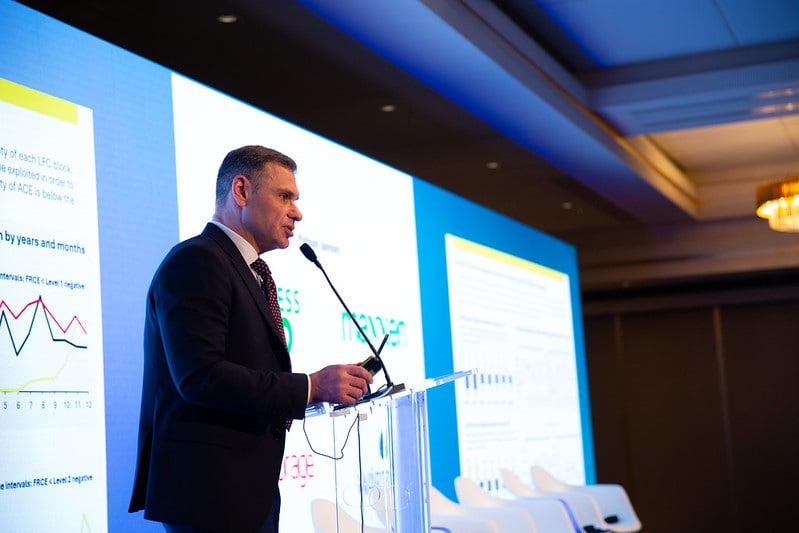
Ukraine’s need for energy storage presents opportunities for brave investors, Energy-Storage.news hears from Vadym Utkin, energy storage lead at DTEK.
“First and foremost, I do believe that the business case for the battery in Ukraine exists right now, but this business case exists only for the investors who are willing to accept the risk, and the risk is obvious,” says Vadym Utkin, energy storage lead at DTEK, a multinational independent power producer (IPP) and Ukraine’s single biggest energy sector investor.
While that “obvious risk” is that Ukraine has been a country at war for four years now, the country has “pretty much the same revenue stack” as its neighbours, Utkin says, in an interview at last month’s Energy Storage Summit 2026, hosted in London by our publisher Solar Media (part of the Informa Group).
That includes the full spectrum of ancillary services available to battery energy storage systems (BESS) in other European markets, including automated Frequency Restoration Reserve (aFRR) and manual Frequency Restoration Reserve (mFRR).
Try Premium for just $1
- Full premium access for the first month at only $1
- Converts to an annual rate after 30 days unless cancelled
- Cancel anytime during the trial period
Premium Benefits
- Expert industry analysis and interviews
- Digital access to PV Tech Power journal
- Exclusive event discounts
Or get the full Premium subscription right away
Or continue reading this article for free
At the same time, there is a strong uptake of new renewable energy capacity, with multiple gigawatts of wind power being built, especially in western Ukraine. Even before the war, Ukraine had reached about 9.7% renewable energy penetration on the grid and begun facing curtailment issues.
Utkin says that while many research papers and studies cite that renewables integration challenges really start to bite at about 20-30% penetration, “we were in trouble at less than 10%.”
“Why? We have a very large base load from nuclear power plants, and these are not French nuclear reactors that can be adjusted within hours. These are very old Soviet machines that were never designed to be flexible,” he says.
“The energy mix in Ukraine is changing, and it will be completely different after the war. We will still have a relatively large portion of nuclear, but most of the generation will come from renewables. It creates huge opportunities for the battery, because if 50% of your generation is inflexible nuclear and the rest comes from variable resources, what’s your buffer? How can you actually make these two different creatures live together? There is no other way than building a battery.”
Ukraine also has a large fleet of existing pumped hydro energy storage (PHES) plants, and Utkin says that before the war, a group of German consultants visited the country and, upon observing that PHES fleet, asked why battery storage would be needed to balance and integrate renewable generation.
“Traditionally, the vast majority of reserves come to the grid from coal and hydro,” Utkin says, but, like the nuclear fleet, the Soviet-era pumped hydro was never designed for flexibility.
The Soviet strategy was to build as much generation capacity in Ukraine and transmit it to its neighbours in the bloc, such as Poland and Bulgaria. Nuclear plants to add generation capacity and pumped storage to mitigate evening peaks in demand and slumps in generation output.
“They’ve never been designed to be flexible and to respond swiftly to the renewables. That’s one of the things which very few people understand, looking at the generation mix in Ukraine.”
Current conditions and European synchronisation add to business case
Ukraine’s government is, therefore, keen to attract investment into energy storage alongside renewables, as highlighted in our recent interview with Serhi Nahorniak, Ukrainian Member of Parliament and chair of the Subcommittee on Energy Saving and Energy Efficiency.
Nahorniak pointed out that the addition of battery storage resources is a “matter of the power system’s survival under wartime conditions,” but was also keen to emphasise that the fundamental drivers and regulatory and market conditions exist to make it a favourable sector for domestic and foreign businesses to invest in.
With the state-owned transmission system operator (TSO), UKRENERGO, forced to load shed to remain flexible when the grid comes under attack, DTEK’s Vadym Utkin says more people are installing rooftop solar PV at their homes and businesses.
That means the TSO sees a sudden drop in demand in the middle of the day. Combined with ancillary services and the balancing market, wholesale arbitrage provides a “very attractive opportunity” for battery storage systems.
Another important point is that, in a move long planned before the start of the war in February 2022, Ukraine’s electricity grid decoupled from the BRELL grid shared previously with Russia and Belarus, with UKRENERGO joining ENTSO-E, the European association of transmission grid operators. The three Baltic states, Estonia, Latvia, and Lithuania, followed in early 2025.
However, while Ukraine is now “technically connected” to the ENTSO-E network, it is not yet in the next phase, market coupling.
“Market coupling means that we have the same product, the same everything on the electricity market as ENTOS-E. What does that mean? We still have 60-minute market time units; the clearing price is every 60 minutes,” Utkin says.
Whereas Europe has recently moved from 60-minute to 15-minute market windows. Ukraine’s shift to those shorter windows will likely happen next year, giving battery storage operators four times the number of trades available today.
Within ancillary services, the aFRR market will also be synchronised to the European model, moving from a pro rata activation based on available megawatts to a daily auction model.
“For the battery owners, it means that we can steer our trading strategy to maximise profit and help the grid,” which is a “win-win situation,” Utkin says.
“So that’s another reform, which is coming to the balancing market in Ukraine. All of these small things are accumulating, making the business case better and better. And let’s not forget about Project Picasso [the project to enable cross-border trading of aFRR].”
Ukraine’s balancing market currently has a price cap of around €300/MWh (US$346.87/MWh). It was put in place in 2019, to help smooth out the transition from the centralised national market to a decentralised European one. With the subsequent Russian invasion, that temporary measure has remained in place.
“Now, compare this with the €15,000/MWh in Europe. I understand that you will never, ever build a solid, financeable business case for batteries on price spikes and anecdotal events, what I call ‘LinkedIn events,’” Utkin says, such as recent ancillary services price spikes in the Baltic states.
But relaxing the price caps on wholesale and balancing markets, which Ukraine must ultimately do as part of its European market coupling process, will also help build the business case for battery storage in Ukraine, he argues.
Batteries needed to bolster ‘exceptional resilience’ of grid
The resilience of the Ukrainian grid has been “exceptional” in the face of Russian attacks, exemplified by the response to the first major aerial assault on thermal power plant infrastructure that happened in October 2022.
Missile attacks on Ukraine’s coal-fired power plant fleet caused a sudden decrease in output of between 3-4GW of generation, as the event triggered a cascading event that disconnected nuclear power plants as relay protection systems kicked in.
This had marked a change in the Russians’ strategy. In the previous months, a carpet-bombing campaign targeting energy infrastructure indiscriminately shifted to a more strategic onslaught on flexible generation.
DTEK is a big company with around 55,000 employees. More than 400 of them have been killed in the conflict already, many of them workers fixing, building and maintaining key electricity infrastructure and some of them Vadym Utkin’s personal friends.
“Basically, Russians are saying, ‘Okay, Vadym, forget about your friends who died during the war, killed in action. Go to the street and say, I could not tolerate 10 hours without electricity in my home, and please stop the war and accept the conditions from the Russians’. I could tolerate 10 hours without power,” Utkin says.
“That’s a very small price to be free.”
Thankfully, the nuclear plants themselves were not attacked because the outcome of that would have been disastrous for Russia and the rest of Europe too, and the Russians realised “they probably could not kill the grid” itself, Utkin says.
Still, he says, “as the Russians started destroying the thermal power plants, the reserves and flexibility reserves problem became a super big problem for the grid.”
Since then, a fleet of around 0.5GW of large-scale batteries has been connected to the grid, including a six-project 200MW portfolio inaugurated by DTEK last year. At least a couple of hundred more megawatts are due to go into operation by the end of this year. While this is still relatively small, they provide a better flexibility option than the disconnection of load that the grid operator was forced into.
“We have the support from the batteries right now in the grid. I know that 0.5GW does not sound very big compared to other countries, but slowly, slowly, but surely, it [the resource] will be there,” Utkin says, adding that battery storage placed at strategic nodes of the grid can be part of the “backbone of grid resilience.”
“We are welcoming any investors who has guts to come to Ukraine,” Utkin says, adding that some foreign investors had shown interest in UKRENERGO’s 2024-2025 ancillary services auctions, before ultimately pulling out.
Anyone building assets in Ukraine will need to consider the extra costs of measures to protect them from physical attacks, whether debris, missiles, or drones; however, Utkin points out that these costs can be offset by low grid connection fees, no double-use taxation levies on grid use, and a relatively easy permitting process.
“Yes, there is the unfortunate situation. We do hope that this war will be over one way or another soon, but if you have some appetite for very good assets, you’re willing to make your first move, I think this is a very right time to go to the market and try to capture this thing, because the future for batteries in Ukraine, I think, is absolutely bright in many ways.”
