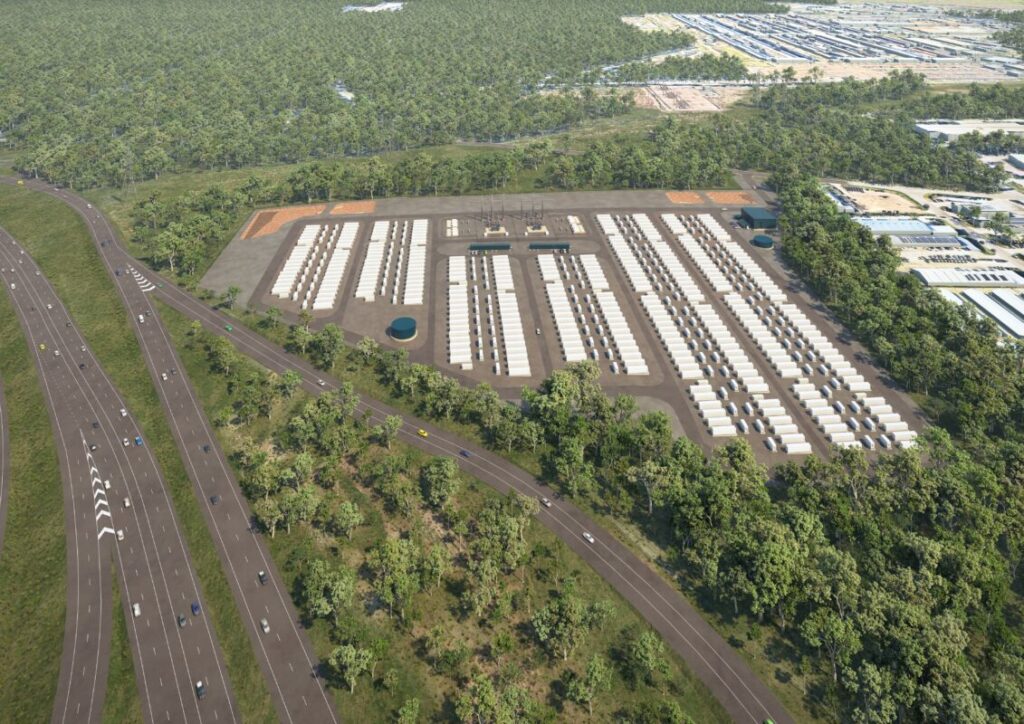
Three battery energy storage system (BESS) developments across Australia have been submitted to the Environment Protection and Biodiversity Conservation (EPBC) Act, representing a combined capacity of 1,220MWh.
- Australian renewable energy developer Tonic Group has submitted a 55MW/440MWh battery storage system paired with a 75MW solar PV power plant in Western Australia’s Kemerton Strategic Industrial Area.
- The Sunshine Estate BESS, being pursued by developer Avenis Energy, is a 120MW/480MWh standalone facility in New South Wales designed to provide 4-hour storage duration and ancillary services to the National Electricity Market (NEM).
- Meanwhile, utility AGL has submitted plans for its Muswellbrook battery storage site, a 150MW/300MWh system, which is proposed adjacent to existing grid infrastructure, focusing on firming capacity to support the integration of renewable energy across the state.
Tonic Group proposes 440MWh system in Western Australia
Tonic Group has submitted plans for a 440MWh solar-plus-storage project in Binningup, Western Australia.
The project, located within the Kemerton Strategic Industrial Area, approximately 130km south of Perth, will occupy an 88.38-hectare site with a disturbance footprint of 12.46 hectares.
The development targets land within the Industrial Protection Zone of the Kemerton Strategic Industrial Area, a state priority project established for strategic and heavy industries in southwest Western Australia.
Try Premium for just $1
- Full premium access for the first month at only $1
- Converts to an annual rate after 30 days unless cancelled
- Cancel anytime during the trial period
Premium Benefits
- Expert industry analysis and interviews
- Digital access to PV Tech Power journal
- Exclusive event discounts
Or get the full Premium subscription right away
Or continue reading this article for free
Environmental assessments identified impacts to habitat for three endangered black cockatoo species and the critically endangered western ringtail possum.
The disturbance footprint includes up to 1.14 hectares of low to moderate quality foraging habitat for Carnaby’s black cockatoo, Baudin’s black cockatoo and forest red-tailed black cockatoo, along with 42 potential nesting trees.
The project will also affect 0.56 hectares of very low-quality habitat for the western ringtail possum.
Tonic Group has designed an avoidance area of 5.40 hectares to retain 2.63 hectares of suitable foraging habitat for black cockatoos and 2.56 hectares of supporting and core habitat for western ringtail possum.
The company proposes revegetation within the avoidance area to improve the quality of the fauna habitat and establish wildlife corridors.
Infrastructure components include 75MW of solar PV modules, battery inverters, a 50 x 30 meter substation, a 7-meter-wide access road, 10 electric vehicle charging bays and office facilities.
The 480MWh Sunshine Estate battery storage system
The Sunshine Estate BESS, which Avenis Energy is pursuing, is a 120MW/480MWh development designed to provide 4-hour storage duration for the NEM.
The project will store electricity during low-demand periods and discharge during high-demand or low-generation periods while providing ancillary services, including system strength, inertia support, frequency control and voltage regulation.
The project area spans approximately 50 hectares, with a disturbance footprint of 12 hectares. However, developers note that this represents a worst-case scenario, which will be reduced following detailed design.
An avoidance area of 38 hectares has been designated to prevent impacts on matters of national environmental significance and other sensitive environmental values.
The facility will be connected directly to the existing Rothbury Zone Substation via either overhead or underground transmission lines, subject to Ausgrid’s requirements.
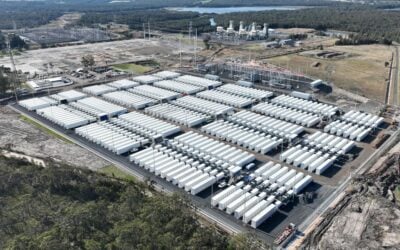
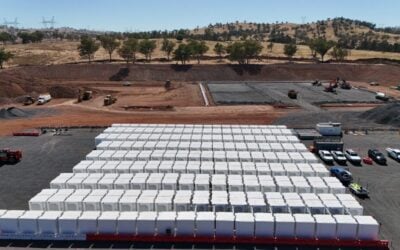
Key infrastructure includes 140 battery containers, each measuring 6.1 x 2.5 x 2.9 meters, housing 40 battery modules and 42 inverters with associated power conversion systems, as per the EPBC Act application.
Supporting infrastructure encompasses a 33kV switch room, 132kV high-voltage switchgear, a 132/33kV high-voltage transformer, a control room, internal access tracks, an operations and maintenance building, auxiliary transformers, underground cables, staff amenities, water tanks, security fencing and landscaping elements.
The project requires upgraded access points from Wine Country Drive for both the main project area and connection to the Rothbury Substation. Construction storage areas and laydown facilities will support the development phase.
AGL advances 300MWh Muswellbrook BESS
AGL has submitted plans for a 150MW/300MWh battery storage system that would be located adjacent to the existing Ausgrid Muswellbrook Substation.
The project operates under State Significant Development consent SSD 29704663 and would occupy approximately 4.874 hectares across multiple land parcels.
The facility will contribute to the provision of renewable energy in New South Wales by providing firming capacity to fill supply gaps when renewable energy sources are not producing.
Key components include enclosed lithium-ion batteries, power conversion systems with associated switchgear and transformers, underground power and fibre optic cabling, grid connection equipment, and 132kV sub-transmission lines connecting to the Muswellbrook substation.
Additional infrastructure encompasses earthing and lightning protection systems, a site office, storage areas, internal access tracks, security fencing, video surveillance and vegetation screening.
Construction is expected to take approximately 12 months. Batteries will be manufactured off-site and delivered ready for installation, following site preparation, including levelling and bench construction.
The project is expected to operate continuously for approximately 20 years before being decommissioned, although infrastructure upgrades may extend its operational lifespan.
The Energy Storage Summit Australia 2026 will be returning to Sydney on 18-19 March 2026. To secure your tickets and learn more about the event, please visit the official website.