Zinc bromide battery startup Gelion has started up manufacturing operations in Australia which lean on many existing production techniques for lead-acid batteries.
Gelion has developed a battery technology which it says is distinct from zinc bromide flow batteries and could provide low-cost energy storage for applications requiring between 6 – 12 hours of discharge duration. Its batteries are made with abundant materials that can be recycled, the company claims.
The company hopes that by leveraging existing techniques and technologies from the lead-acid industry it can accelerate its ramp up of production, partnering with Battery Energy, a manufacturer of lead-acid and lithium batteries in New South Wales.
Gelion also claimed that its manufacturing lines could also provide opportunities for workers in other legacy energy and power sectors like fossil fuel power plants to re-skill, adapt and pivot into new careers.
Try Premium for just $1
- Full premium access for the first month at only $1
- Converts to an annual rate after 30 days unless cancelled
- Cancel anytime during the trial period
Premium Benefits
- Expert industry analysis and interviews
- Digital access to PV Tech Power journal
- Exclusive event discounts
Or get the full Premium subscription right away
Or continue reading this article for free
The UK-Australian company is targeting industrial and off-grid market segments, although it also plans to scale up to provide bulk storage for wind or solar PV power plants. Gelion is a University of Sydney spin-off and has been listed on the London Stock Exchange since late last year.
The new plant, in Fairfield, Western Sydney, has 2MWh of annual production capacity but the company aims to reach gigawatt-scale in future.
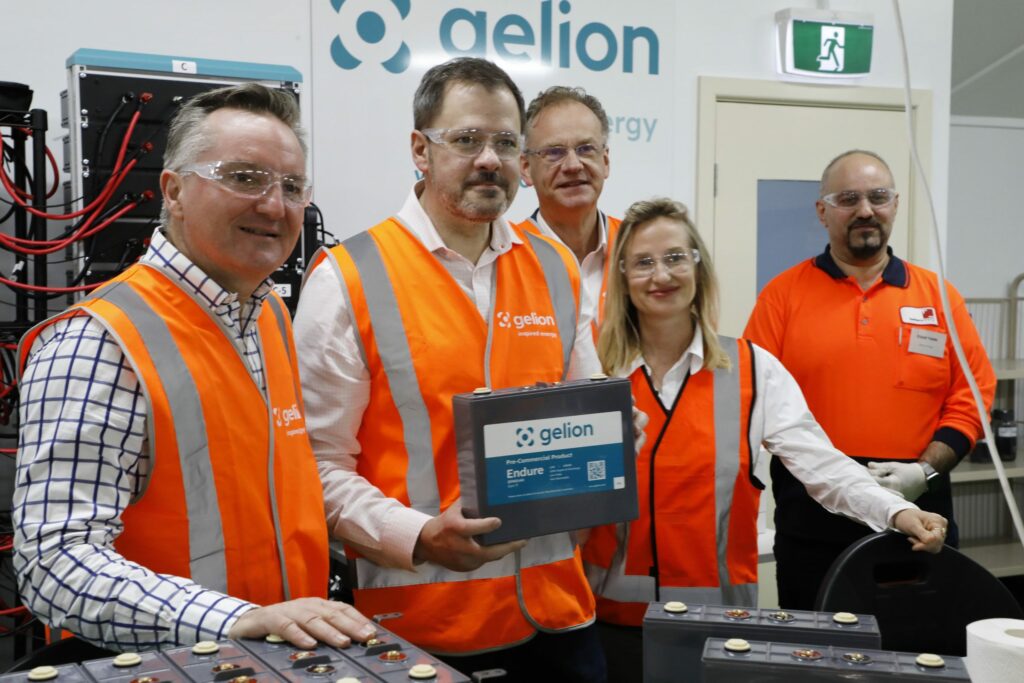
An official opening event was held on 30 September, attended by Australian Federal Minister for Climate Change and Energy Chris Bowen and Federal Minister for Industry and Science Ed Husic.
The Australian government has been keen to support domestic production and supply chain activities across various renewable energy storage technologies, including lithium-ion and vanadium flow batteries.
The new line has been built at Battery Energy’s lead-acid production plant in Fairfield and Gelion claimed that the line uses about 70% of existing lead-acid battery production processes, while the gel-based zinc bromide batteries fit into standard lead-acid battery racks.
The company’s initial batch of batteries made at the pre-commercial demonstration stage have performed well in customers tests, Gelion said.
In February, Energy-Storage.news reported that Gelion’s battery tech is among energy storage technologies being tried out by Spanish multinational infrastructure and renewable energy conglomerate at a solar PV plant site in Northern Spain.
Installation of the 25kW/100kWh system is set to begin in Q3 this year at Acciona’s Montes del Cierzo 1.2MW solar farm and Gelion’s battery, called Endure, could be added to Acciona’s supplier portfolio if the 6 – 12 month-long project proves successful.
“We are delighted to be launching production of our breakthrough battery, proving it can be produced at scale with existing lead-acid battery manufacturing processes,” Gelion CEO Hannah McCaughey said.