6 December 2021: CellCube flow battery storage ‘made bankable’ by insurance provider Munich Re
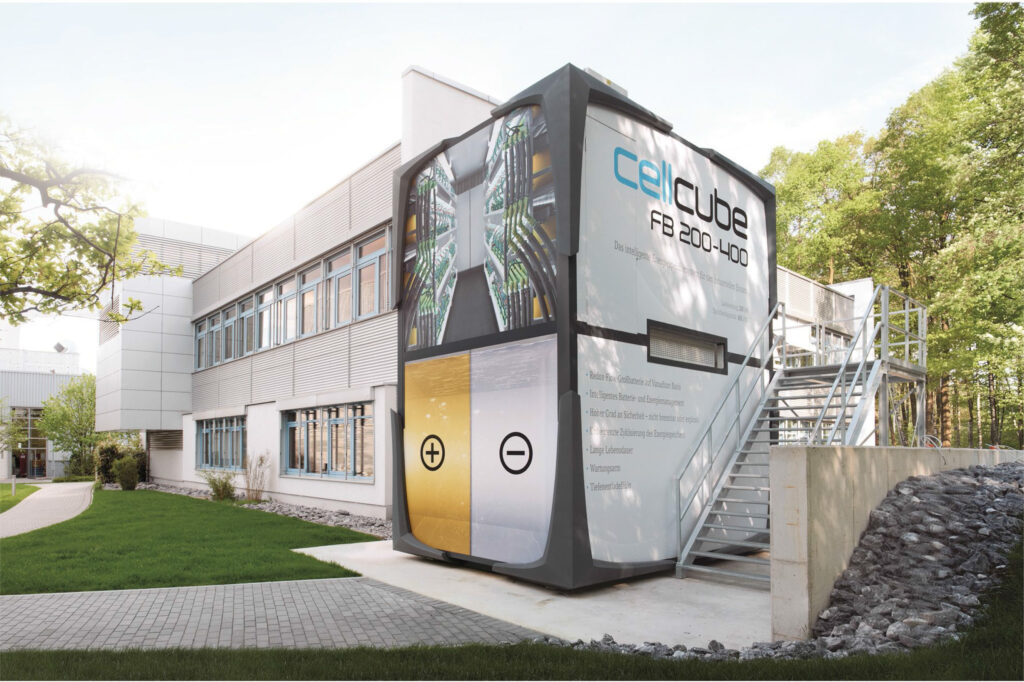
Vanadium redox flow batteries (VRFB) from CellCube will offer its customers an optional performance guarantee for up to 20 years, backed by insurer Munich Re.
The long-term performance warranty covers continuous operation, insurance against malfunction, repair or replacement excess costs and workmanship defects as well as in the event Austrian company Enerox, which trades under the CellCube brand, goes into insolvency.
CellCube said the deal with Munich Re now makes its VRFBs bankable. This has brought a 1MW / 4MWh off-grid solar-plus-storage project at Vametco vanadium mine in South Africa for Bushveld Minerals “over the line” in getting financed, Mikhail Nikomarov, CEO of Bushveld’s energy subsidiary Bushveld Energy said.
Try Premium for just $1
- Full premium access for the first month at only $1
- Converts to an annual rate after 30 days unless cancelled
- Cancel anytime during the trial period
Premium Benefits
- Expert industry analysis and interviews
- Digital access to PV Tech Power journal
- Exclusive event discounts
Or get the full Premium subscription right away
Or continue reading this article for free
“It creates significant comfort around the long-term performance of the VRFB technology in general, and of CellCube’s product in particular. As a result, it has reduced both the risk and the cost of financing this project,” Nikomarov said.
“When it comes to deploying green and long-duration energy storage, securities and guarantees for high upfront investments and planned profits become increasingly important for our clients, specifically when business cases include merchant risks,” CellCube CEO Alexander Schoenfeldt said.
Munich Re has also backed insurance guarantees for another flow battery manufacturer, US-headquartered ESS Inc, which makes batteries using a patented “all-iron electrolyte”.
6 December 2021: ‘Pumped heat storage’ tech company Malta in tie-up with Bechtel
US electro-thermal energy storage startup Malta has announced a partnership with Bechtel Corporation to advance development and deployment of the long-duration technology.
Malta’s technology solution, which the Massachusetts-headquartered company has called “pumped heat storage,” converts electricity into heat which is stored in molten salt. Simultaneously, it produces cold energy stored in liquid form.
The hot and cold energy are converted back into electricity energy using a heat engine. The company has claimed it could be suitable for applications requiring between 10 and 150+ hours of energy storage and discharge. It recently announced it was in talks over a potential 1,000MWh project in Canada.
In the near-term, Malta and engineering and construction services company Bechtel will work on the development of a portfolio of long-duration storage projects, finding opportunities to convert variable solar and wind resources into dispatchable baseload power.
“The lack of long-duration energy storage solutions remains a key challenge for the renewable energy industry,” Bechtel renewables sector lead Scott Austin said.
“There is no silver bullet for decarbonisation, and Bechtel is committed to leveraging our engineering and construction expertise to support the rapid advancement of technology solutions that can meaningfully advance the transition to a net zero environment,” Austin said, describing Malta’s technology as an “innovative and scalable storage solution”.
Like CellCube, Malta is a founder member of the newly-launched Long Duration Energy Storage Council (LDES Council).
6 December 2021: Zinc-bromide ‘non-flow battery’ player Gelion lists on London Stock Exchange
Shares in UK-Australian zinc-bromide (ZnBr2) battery startup Gelion began trading on the London Stock Exchange on 30 November.
The company was spun out of the University of Sydney in 2015 by its founder, Professor Thomas Maschmeyer. Gelion claims its redox battery is simpler in design than zinc-bromide flow batteries, and could be built using lead-acid battery manufacturing technology using low-cost, abundant raw materials.
The IPO raised £19 million (US$25.18 million) and Gelion’s market cap is around £155 million. The company is currently mostly targeting off-grid applications such as agriculture, mining, water management and irrigation but it expects to develop megawatt-hour capacity for larger-scale applications like solar and wind farms.
The money raised through the IPO will be used to commercialise its existing technologies and fund further R&D into energy storage. Gelion is also developing additives for next generation lithium-ion batteries.