- Reversible solid oxide fuel cell technology which the company claims is capable of multiple days’ duration of storage
- Tech allows for decoupling of power and energy
- Noon claims it is up to 20-200 times smaller footprint than flow batteries and pumped hydro respectively, and 2-3x smaller than lithium-ion BESS
- First pilot running successfully for thousands of hours already at system with 200-hour+ duration
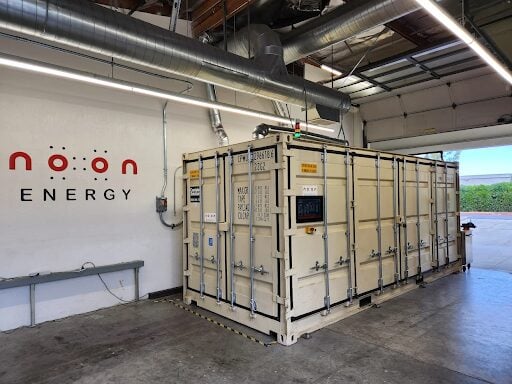
After teasing the capabilities of a new 100-hour+ ‘multi-day’ energy storage technology at trade shows, US startup Noon Energy has unveiled its first operational demonstration project.
Variously describing its battery technology as ‘ultra-long-duration’ and ‘multi-day’ energy storage, the company claims it will be able to bridge extended gaps in renewable energy production, helping energy systems overcome the need for so-called ‘baseload’ energy, typically from coal, gas and other thermal generation.
California-headquartered Noon Energy said yesterday that its reversible solid oxide fuel cell battery has been in successful operation for “thousands of hours.”
Try Premium for just $1
- Full premium access for the first month at only $1
- Converts to an annual rate after 30 days unless cancelled
- Cancel anytime during the trial period
Premium Benefits
- Expert industry analysis and interviews
- Digital access to PV Tech Power journal
- Exclusive event discounts
Or get the full Premium subscription right away
Or continue reading this article for free
While it did not provide many technical details of the project in its release, such as the system’s power output capacity, the company claimed it is capable of 200 hours of discharge at maximum output.
Noon claims that its long discharge duration enables 100% reliable uninterrupted energy supply, while the company claims the battery’s compact design has between 20 and 200 times smaller footprint than other LDES technologies, citing the examples of flow batteries and pumped hydro energy storage (PHES).
The company’s website explains that three key components work together inside the battery:
- A power block: based on reversible solid oxide fuel cell technology, which converts electricity into stored energy
- Charge tank: this converts electricity into a carbon-based storage medium, releasing oxygen to air as it does so.
- Discharge tank: this draws oxygen from air to convert stored energy back into electricity. Noon claims it does this cleanly and efficiently, and the materials used to make it are abundant.
Essentially, like a flow battery, which stores energy in liquid electrolyte tanks separate to the battery’s power stack, the Noon fuel cell battery allows for decoupling of power and energy.
This is what the company claims will make the battery suitable for multi-day applications. Power can be increased by adding more power blocks, while duration can be increased by increasing tank size.
Noon Energy representatives have been seen making teaser presentations and participating in panel discussions at various global trade shows, including RE+ in the US, for some time.
Although it has already broken out of stealth mode, this appears to be the first time it has publicly revealed details of its battery technology. Although it hasn’t yet publicly disclosed specifically what materials are used to make it, besides that the storage media is carbon-based, Noon Energy claims it overall uses only around 1% of critical elements compared with lithium-ion batteries.
Noon Energy co-founder and CEO Chris Graves said the company has built “an even larger, commercial-scale system, being commissioned soon with more details to come,” and claimed Noon’s customer pipeline includes hyperscalers and other industrial load growth, for which its technology can enable “low-cost, clean firm power.”
Noon Energy’s trajectory and addressable market targeting are somewhat comparable to those of another US startup, Form Energy, albeit Noon is still at a much earlier stage in both funding and scaling of production and deployment.
Founded by former Tesla executive Mateo Jaramillo, Form Energy has developed an iron-air battery that is also claimed to be suitable for 100-hour+ multi-day storage applications and built using abundant materials, with the first pilot underway with a utility in Minnesota and others in the works elsewhere in the US; a factory was opened in West Virginia in September 2024. Form Energy teased its tech breakthrough for several months before revealing its battery chemistry basics in 2021.
This article has been amended to reflect that Form Energy’s factory in Weirton, West Virginia, has opened and is undergoing expansion, and not still under construction as originally reported.
The Energy Storage Summit USA will be held from 24-25 March 2026, in Dallas, TX. It features keynote speeches and panel discussions on topics like FEOC challenges, power demand forecasting, and managing the BESS supply chain. ESN Premium subscribers can get an exclusive discount on ticket prices. For complete information, visit the Energy Storage Summit USA website.