In this Energy-Storage.news roundup, FlexGen updates its EMS, LandGate launches a BESS site selection tool, ON.energy and Shoals target AI data centres, and Sunrun has a successful season of dispatching energy with PG&E.
FlexGen announces updated version of HybridOS EMS
System integrator FlexGen Power Systems has announced an updated version of its HybridOS energy management system (EMS).
FlexGen claims the new features will allow battery storage projects to increase participation in grid services, grow revenue opportunities, and support the grid.
The company further highlighted that updates to HybridOS will include a new user interface with real-time and historical data, integrated market prices, and easier access to data through its mobile app.
Try Premium for just $1
- Full premium access for the first month at only $1
- Converts to an annual rate after 30 days unless cancelled
- Cancel anytime during the trial period
Premium Benefits
- Expert industry analysis and interviews
- Digital access to PV Tech Power journal
- Exclusive event discounts
Or get the full Premium subscription right away
Or continue reading this article for free
HybridOS will feature an augmentation prediction and diagnostics dashboard to enable customers to proactively detect hardware problems and improve augmentation planning.
New features such as the charge limit handler and native CAN support will help to enhance battery lifespan, streamline operations, accelerate commissioning, and improve real-time control.
Additionally, the EMS enhances solar control capabilities by unifying solar, storage, and substation assets within a single platform. This includes native capacitor bank control, solar shedding, integrated met station inputs, and solar tracker management.
In August 2025, FlexGen completed its acquisition of most of the assets and all of the IP formerly held by its bankrupt rival, Powin.
That move saw the company supporting over 25GWh of BESS across 10 countries. It also acquired Powin’s spare parts inventory and announced that Powin’s field projects would be connected to FlexGen’s Remote Operations Centre (ROC) and HybridOS.
Earlier this month, FlexGen put two utility-scale BESS projects, totalling 700MWh into operation in Wisconsin and Iowa for utility Alliant Energy.
LandGate launches ‘Battery Storage Analysis’ tool for BESS site selection
Infrastructure and analytics company LandGate has launched its Battery Storage Analysis tool for BESS site selection.
LandGate claims that the tool is a “first-of-its-kind” technology, which provides automated ‘Battery Storage Due Diligence Reports’ instantly.
LandGate highlights that traditional site selection involves coordinating with several consultants for interconnection studies, environmental assessments, and arbitrage forecasting. Its new tool “centralises” this entire process into a single, proprietary workflow.
Key features of the Battery Storage Analysis Tool include ‘Interconnection Intelligence,’ allowing developers to assess target substations for both NRIS (Network Resource Interconnection Service) and ERIS (Energy Resource Interconnection Service). This helps identify physical bottlenecks before submitting a queue request.
‘The Arbitrage Index’ simplifies complex nodal pricing into an easy-to-understand revenue indicator by calculating 4-hour price margins and visualising LMP (Locational Marginal Price) volatility using historical and forecast data.
‘Queue Breakdown’ offers a detailed view of the competitive landscape by displaying both Planning Models (current grid) and Queue Models (future grid), helping to distinguish pending from approved Interconnection Agreements (IA).
‘Infrastructure & Environmental Due Diligence’ provides risk assessments for environmental hazards, terrain suitability for heavy enclosures, and proximity mapping for data centres, solar farms, and wind projects.
Additionally, the company states that locating sites near power plants and behind-the-meter (BTM) resources enables developers to position BESS assets to supply direct power to data centres.
This strategy helps data centre operators avoid grid congestion, maintain reliability during load changes, and reduce costs by discharging during peak hours.
Interconnection can be a difficult process for BESS in some areas of the US. While some regulators have updated interconnection procedures, others are still lacking.
In a 2022 guest blog for ESN, Gwen Brown, communications director for the US Interstate Renewable Energy Council, noted that many of the most valuable features of energy storage are not easily accessible on the distribution grid today. This is because most interconnection rules at the state level—the regulations that determine if and how energy storage can connect to the grid—have not been revised to fully support ESS in a way that enhances customer flexibility and maintains the grid’s safe and reliable operation.
There are additional factors to consider, such as noise, which may be less of an issue when developing in areas already sited for power plants and other generating resources.
In 2025, Idaho Power had to amend a pre-existing conditional use permit associated with a BESS site. Before deciding on the modifications, the Boise Planning and Zoning commission held a public hearing, during which multiple members of the public cited noise as a negative impact of the project.
Applications engineer at Wärtsilä, Sharon Santhosh, has also emphasised to ESN the significance of addressing noise factors when installing BESS in densely populated areas.
ON.energy and Shoals Technologies Group deploying ‘critical power systems’ for data centres
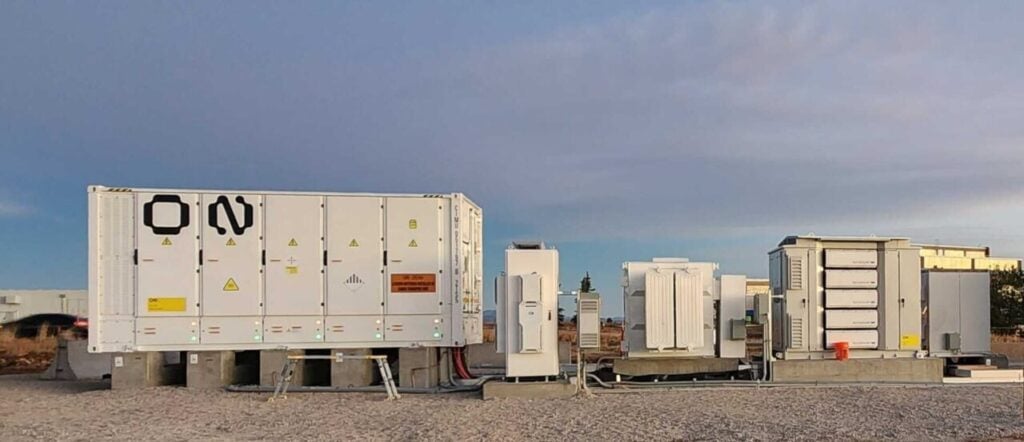
Electrical infrastructure company Shoals Technologies Group and developer ON.energy have agreed to deploy multiple GWs of “critical power systems” into the AI data centre market.
The agreement will see ON.energy pairing its medium-voltage AI uninterruptible power supply (UPS) architecture with Shoals’ DC Recombiner.
Shoals’ DC Recombiner consolidates inputs from solar arrays, BESS, and other DC microgrid sources. It enables charging the BESS using renewable energy and discharging it to supply power to the grid through an inverter.
The companies expect the combination of these two technologies to provide a “simpler, more scalable” method for AI data centres to secure backup power.
That agreement allows ON’s UPS technology to be used at multiple data centre campuses.
Recently, Hugh Scott, CTO of FlexGen, told ESN Premium that the UPS systems, traditionally banks of lead-acid batteries used by data centres, are no longer sufficient to meet increasing uptime demands as scale expands.
“Traditional rack-level UPS systems weren’t designed for the power densities we’re now seeing, which is 120kW per rack today, and heading toward 500–600kW,” he explained. However, moving the UPS function to a campus-level BESS offers data centres with the same ride-through capabilities for faults and outages while maintaining “vastly higher power levels” and creating a smaller footprint.
Other companies, such as startup ZincFive, are also creating their own UPS solutions for AI data cetnres. In 2025, the company announced its BC 2 AI, a nickel-zinc (NiZn) UPS battery cabinet.
In a guest blog for Energy-Storage.news in March 2025, Tod Higinbotham, COO of ZincFive, wrote:
“With much of their services tied to data centres, meeting facility power needs sustainably is a priority. Immediate Power Solutions (IPS) batteries like nickel-zinc boast lifecycle emissions much lower than those of lithium and lead-acid batteries, with reduced water usage and volatile organic compounds as well. Recognising the role of IPS allows for a more holistic strategy of aligning business operations with larger concerns of sustainability and profitability.”
Higinbotham continued, “The increasing demand for data centres will have strong implications on the power value chain. Making the most efficient choices now will have strong long-term implications – and here, adopting new technologies and optimising designs to leverage immediate power solutions can be smart choices leading to efficiency gains.”
US-based balance of plant (BOP) manufacturer Shoals just released its latest financial results, which you can read about on PV Tech later today.
Sunrun’s season of dispatching for PG&E
US residential solar and energy storage installer Sunrun has completed a successful dispatching season of a virtual power plant (VPP) partnership with California utility Pacific Gas and Electric (PG&E).
Through the VPP, over 1,000 Sunrun customers’ solar-plus-storage systems exported energy to ease local grid constraints. This aimed to help PG&E avoid or delay distribution upgrades and produce net savings for all utility customers.
Sunrun’s Local PeakShift Power VPP is part of PG&E’s Seasonal Aggregation of Versatile Energy (SAVE) program. Following tests from April to June 2025, it was dispatched over 50 times between July and October 2025, during periods when local demand approached system capacity, totalling more than 1,200 dispatch hours.
Sunrun customers with solar-plus-storage systems who live near or are connected to more than two dozen constrained power lines and substations in investor-owned utility (IOU) PG&E’s service area were enrolled in the programme.
Demand Side Analytics’ post-season evaluation report showed that Sunrun’s battery configurations accurately followed PG&E’s dispatch instructions, maintaining electrical loads within the operating limits across all power lines and substations.
Each site received different commands based on machine learning, weather forecasts, and daily load predictions. Reportedly, the batteries showed high predictability and consistency in dispatching, delivering electricity “to the correct location at the correct time during nearly 99% of events.”
Due to customer interest, PG&E increased Sunrun’s initial programme participation from 600 to over 1,000 customers during enrollment.
Participants in the Local PeakShift Power programme earned US$150 per battery for sharing stored solar energy with their communities, while Sunrun received compensation for managing the battery dispatches.
In December 2025, Sunrun and energy supplier NRG Energy announced a multi-year partnership to accelerate residential energy storage in Texas.
Through the partnership, Texas residents will have access to a home energy solution that combines Sunrun’s solar-plus-storage systems with “optimised rate plans and smart battery programming,” provided by NRG Energy’s retail electricity provider, Reliant.
The company also took part in California’s Demand Side Grid Support (DSGS) distributed storage programme. During a test on 29 July 2025, DSGS helped lower the net load on California’s grid. However, shortly afterwards, California Governor Gavin Newsom’s office reduced the programme’s funding.
The Energy Storage Summit USA will be held from 24-25 March 2026, in Dallas, TX. It features keynote speeches and panel discussions on topics like FEOC challenges, power demand forecasting, and managing the BESS supply chain. ESN Premium subscribers can get an exclusive discount on ticket prices. For complete information, visit the Energy Storage Summit USA website.