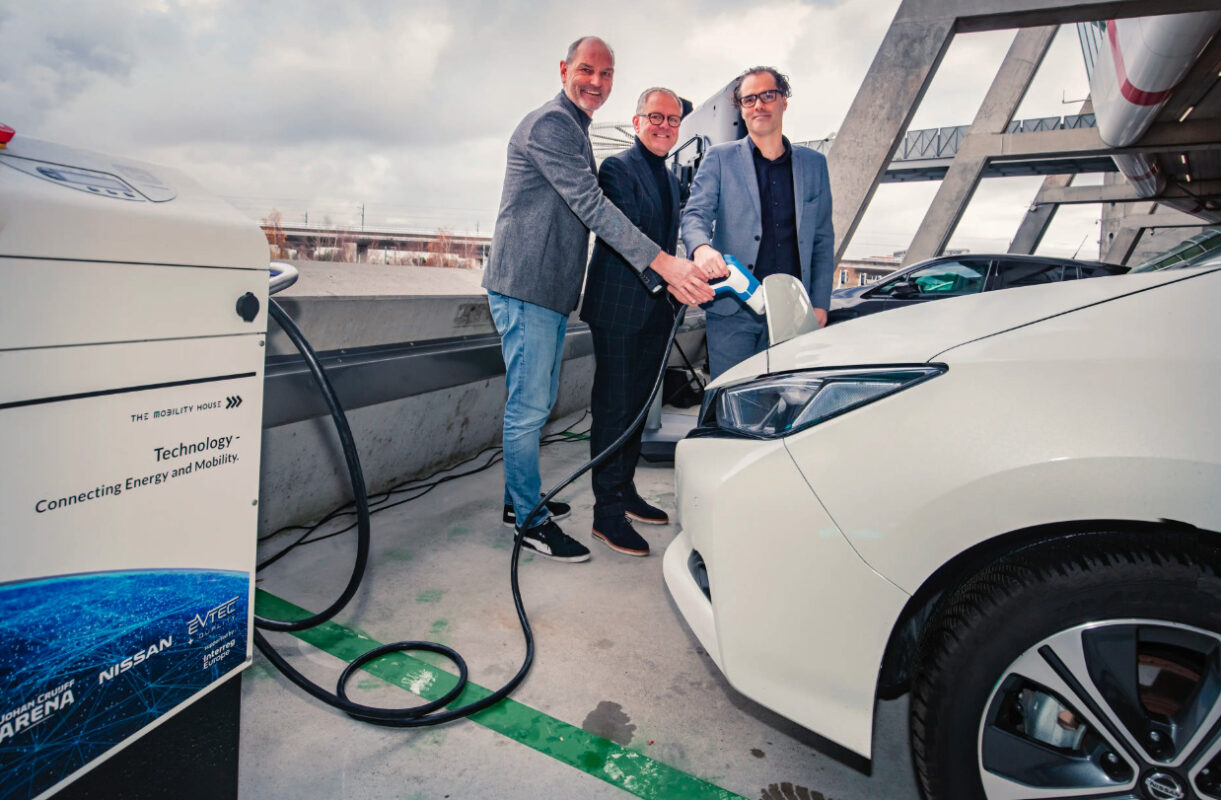
Vehicle-to-grid (V2G) specialist The Mobility House is moving into large-scale BESS project development and optimisation in Germany, starting with a 750MW project.
The firm has partnered with developer Green Energy Storage Initiative SE (GESI) to finance, build and commercialise up to 8GW of battery energy storage system (BESS) projects by 2035. GESI will do financing and project development while The Mobility House will control and commercialise the systems once operational.
Preparations for the first of these are ‘well advanced’, the company said, with a first 250MW phase in ‘concrete planning’ and a later expansion of 500MW also planned. The firm will reveal the location and system integrator in the next few months, but a spokesperson did tell Energy-Storage.news these would be 2-hour projects.
The company is mainly known for its activity in the V2G space, where it provides bidirectional charging solutions and the software to enable electric vehicle (EV) batteries to provide flexibility services in the electricity market. Last year it partnered with Renault to leverage its Renault 5 EV and electric car models in this way.
Try Premium for just $1
- Full premium access for the first month at only $1
- Converts to an annual rate after 30 days unless cancelled
- Cancel anytime during the trial period
Premium Benefits
- Expert industry analysis and interviews
- Digital access to PV Tech Power journal
- Exclusive event discounts
Or get the full Premium subscription right away
Or continue reading this article for free
But, it also optimises stationary BESS including projects using second life batteries re-deployed from their initial EV design or application.
The spokesperson told Energy-Storage.news that the company has been commercialising batteries since 2016 and is co-owner and operator of ‘over 100MW, mostly with 1-hour systems’, in France, Germany and the Netherlands.
However, in its announcement, the company said that it ‘trades over 4,500 electric car batteries with more than 100MW capacity in the European power and energy markets’, so the figure may include both BESS and V2G.
“The learnings generated in designing, building, and operating first and second life systems over the past eight years have paved the way for the ‘build to commercialisation’ of large-scale BESS,” the spokesperson told Energy-Storage.news.
One of its stationary projects in Lünen in 2016 was the largest second life BESS in the world at the time, at 13MWh. That was in partnership with Mercedes-Benz Energy, whose CEO Energy-Storage.news interviewed about second life last year (Premium access).
“Based on our experience as one of the largest second life storage operators we build substantial battery analytics capabilities regarding controlling ageing drivers. The model outcomes are ingested in real time into our optimisation algorithms to ensure the costs of warranty penalties and degradation are always considered,” the spokesperson said.
Elements Green grid connection for 800MWh BESS project
In related news, developer Elements Green this week announced that it has secured the grid connection for a project combining 35MWp of solar PV and a 400MW/800MWh BESS project in Germany. The project is in Alfstedt, Lower Saxony.
However, as with its announcement for a similarly sized project in Elsfleth a few months ago, also in Lower Saxony, it didn’t provide a target commercial operation date (COD).