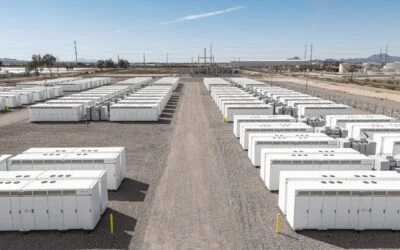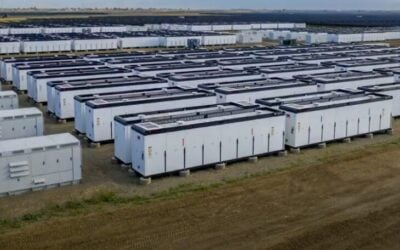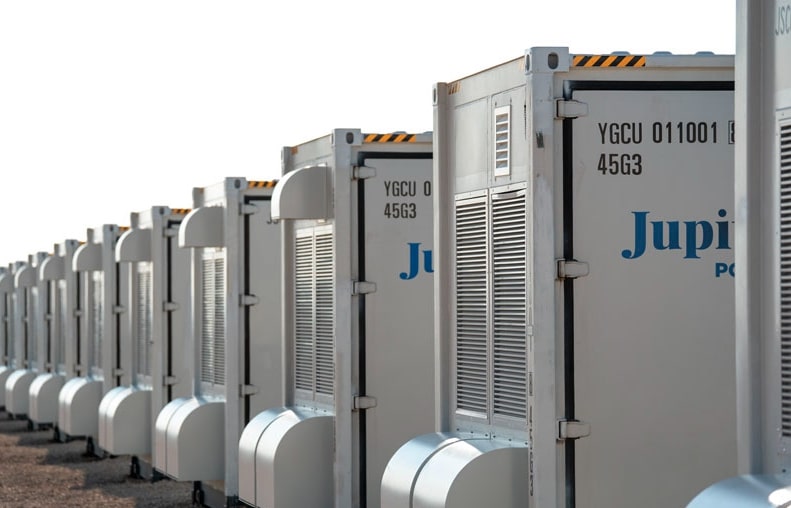
The issue of ensuring reliability of BESS resources in the Texas electricity market has not gone away for grid operator ERCOT, despite the state regulator’s recent quashing of proposed minimum state-of-charge (SOC) rules.
As reported by Energy-Storage.news in January this year, the Public Utility Commission of Texas (PUCT) ordered ERCOT to rescind NPRR (Nodal Protocol Revision Request) 1186, a rule which forced battery energy storage system (BESS) resources to hold additional capacity when providing ancillary services.
ERCOT’s reasoning was to ensure that BESS resources could fulfil their ancillary service duties, with some units occasionally failing to provide the power they were contracted to provide. The state’s main ancillary services are ERCOT Contingency Reserve Service (ECRS), Reg-Up and Reg-Down and Responsive Reserve Service (RRS), which form the vast majority of revenues for BESS in Texas today.
Issue is ‘not dead’ for ERCOT
Speaking to Energy-Storage.news at our publisher Solar Media’s Energy Storage Summit USA 2024 in the capital Austin last week, optimiser Gridmatic’s VP business development David Miller explained that the issue is not over.
Try Premium for just $1
- Full premium access for the first month at only $1
- Converts to an annual rate after 30 days unless cancelled
- Cancel anytime during the trial period
Premium Benefits
- Expert industry analysis and interviews
- Digital access to PV Tech Power journal
- Exclusive event discounts
Or get the full Premium subscription right away
Or continue reading this article for free
“There is a perception that yes, it’s done and dusted, but we would say ‘not exactly’,” Miller said.
“ERCOT feels like some of the batteries are not operated with the level of reliability that they want. They’re worried that, moving forward, batteries are going to be providing all ancillary services, so in their mind it being a less reliable resource is a problem. NPRR 1186 is dead, but the issue is not.”
ERCOT can and will continue to penalise BESS – and any type of resource for that matter – with financial penalties for not providing an ancillary service when contracted to (‘failure to provide’). However, the penalties are not very high and BESS resources are better off having ‘failure to provide’ penalities from time to time. This is not what ERCOT wants, Miller said.
Adding: “We expect to see some kind of new solution. I’m not sure exactly what, it could be changing the way penalties work for ‘failure to provide’ or non-financial penalties like kicking out a poorly performing BESS out of the ancillary service market altogether. It’s not totally clear, but they have to be thinking about what tools they have to get there.”
The PUCT shot down NPRR 1186 because it was discriminatory against BESS, with no other type of resource forced to maintain minimum supplies of energy.
Thermal power plants are the other main type of ancillary service provider, and the only company that publicly argued for NPRR 1186 was oil and gas major Shell (where incidentally, Miller worked prior to spending five years at Greensmith Energy, the US energy storage pioneer which was acquired by Wartsila in 2017, before Miller then joined Gridmatic).
Miller added that the risk of a ‘failure to provide’ penalty is a big part of Gridmatic’s modelling when managing both its own and other client’s BESS units in the market.
The ERCOT, Texas market is the leading US one for BESS deployments along with California. California was set to reach around 8.5GW of BESS by end-2023 according to the California Energy Commission (CEC, the equivalent to Texas’ PUC) while ERCOT expects to have 9.5GW of BESS online by October 2024.