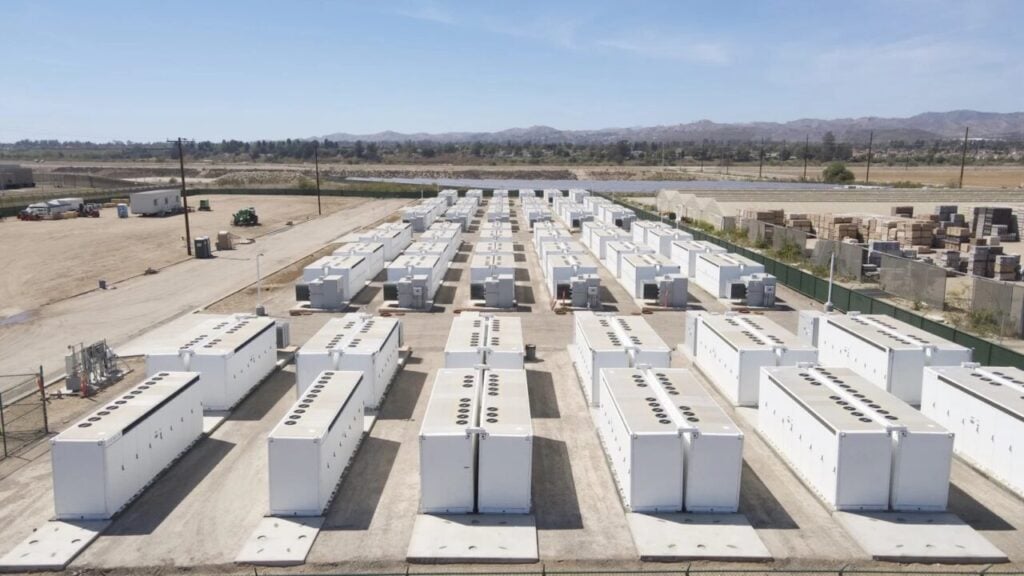
Tesla has reported record quarterly and full-year deployment figures for its Megapack and Powerwall battery storage products in its latest financial results.
The Texas, US-headquartered electric vehicle (EV), storage and solar manufacturer announced its Q4 and full-year 2024 earnings this week (29 January). It deployed 11GWh of energy storage in the fourth quarter, and 31.4GWh throughout the year.
That represented a 244% growth year-on-year on a quarterly basis from 3.2GWh deployed in Q4 2023 and 114% growth year-on-year for the full year, from 14.7GWh deployed in 2023, when Tesla hit its previous yearly record by more than doubling deployments from 2022’s 6.5GWh figure.
For comparison, research firm Wood Mackenzie said in December that it forecast the entire US energy storage sector’s deployment figures for 2024 to add up to 34.4GWh.
Try Premium for just $1
- Full premium access for the first month at only $1
- Converts to an annual rate after 30 days unless cancelled
- Cancel anytime during the trial period
Premium Benefits
- Expert industry analysis and interviews
- Digital access to PV Tech Power journal
- Exclusive event discounts
Or get the full Premium subscription right away
Or continue reading this article for free
Elon Musk said that Tesla is “trying to ramp output of the stationary battery storage as quickly as possible,” as the CEO took time out from his various other commitments to participate in an earnings conference call after markets closed on Wednesday.
Musk noted that Tesla’s second Megapack factory after its Lathrop, California, facility, in Shanghai, China, is now up and running ahead of a ramp to 40GWh annual production capacity and said the company is “building a third factory.” The Lathrop ‘Megafactory’ is already fully ramped to 40GWh annual production capacity.
The CEO said while Tesla faces a challenge in deciding whether battery cells go to its automotive or stationary storage businesses, “overall, the demand for total gigawatt hours of batteries, whether mobile or stationary; that will grow in a very, very big way over time.”
In reporting its Q3 2024 results last October, Musk claimed the stationary storage business was “growing like wildfire,” as the company recorded 6.9GWh of quarterly deployments.
In the company’s Form 10-K filed with the US Securities and Exchange Commission (SEC), Tesla said that it is dependent on the supply of lithium-ion cells from suppliers such as Panasonic and CATL for both cars and storage and “will require substantially more cells to grow our business according to our plans.”
Tesla has “fully qualified only a very limited number of such suppliers” and has “limited flexibility in changing suppliers,” the company noted in the Risk Factors section of the 10K, although in the long-term it intends to supplement third-party cell supply with in-house manufactured cells.
Biden’s IRA tax credits ‘partially offset’ rising cost of revenue
Tesla does not break out the financial numbers for its energy storage business, instead including it along with solar in its energy generation and storage segment. It also no longer gives deployment figures for its solar rooftop, which is thought to comprise the bulk of its solar PV sales.
However, solar deployment numbers had been in the low dozens of megawatts per quarter when the company did still provide figures—for instance, when our colleagues at PV Tech last reported on Tesla’s financials for Q2 2023, PV deployment was at 66MW, a 38% year-on-year decline from the equivalent period of 2022.
In other words, storage is doing the heavy lifting for the segment’s fortunes, and a gross profit margin of 26.2% for the generation and storage segment and gross profit of US$2.64 billion was closely linked to performance of Megapack and Powerwall.
Full year 2024 revenue for the generation and storage segment was US$10.086 billion, against cost of revenue for of US$7.446 billion. Tesla noted in its 10K that its energy generation and storage revenue “benefits from manufacturing credits earned, amounting to US$756 million and US$115 million for the years ended 31 December 2024 and 2023, respectively.”
The manufacturing credits referred to are US Federal government tax credits for clean energy equipment production, and Tesla noted that the increase in the level of credits available since the passing of Joe Biden’s Inflation Reduction Act (IRA) served to partially offset a 52% increase in the cost of revenue for generation and storage.
Musk has previously said that energy contributes the highest profit margin among Tesla’s business segments, and this was again the case for 2024. Total automotive gross margin was 18.4% last year, for the total automotive and services and other segment margin 16.9%, with total gross margin at 17.9% for the year.
Indeed, total automotive gross margin declined from 28.5% in 2022 and 19.4% in 2023, while energy generation and storage gross margin had been just 7.4% in 2022 and 18.9% in 2023, with 2024’s numbers marking a 7.3% year-on-year increase.