Energy storage firm Guoxia Technology (02655.HK) has released its first full annual report since listing on the Hong Kong Stock Exchange late last year.
For its 2025 fiscal year, Guoxia posted operating revenue of RMB2.057 billion (US$301 million), marking a 100.6% year-on-year increase. Net profit reached RMB103 million, surging 109.5% from the previous year.
Amid fierce industry price wars and mounting margin pressure, Guoxia doubled its revenue and net profit and moved from being a pure equipment manufacturer into an AI computing power infrastructure and energy solutions provider.
Revenue and profit double; operating cash flow skyrockets 40-fold
The company’s full-year 2025 revenue breached the RMB2 billion milestone, hitting RMB2.057 billion—doubling the RMB1.026 billion reported in 2024. From 2022 to 2025, revenue catapulted from RMB142 million to RMB2.057 billion, representing nearly 15-fold compound growth over four years, establishing Guoxia as one of the fastest-growing newly listed companies in Hong Kong over the past three years.
Try Premium for just $1
- Full premium access for the first month at only $1
- Converts to an annual rate after 30 days unless cancelled
- Cancel anytime during the trial period
Premium Benefits
- Expert industry analysis and interviews
- Digital access to PV Tech Power journal
- Exclusive event discounts
Or get the full Premium subscription right away
Or continue reading this article for free
Goxia also delivered strong profitability. The annual net profit attributable to parent company shareholders hit RMB103 million, up 109.5% year-on-year. Most strikingly, net cash from operating activities exploded from RMB 3.73 million in 2024 to RMB 145 million—an almost 40-fold increase.
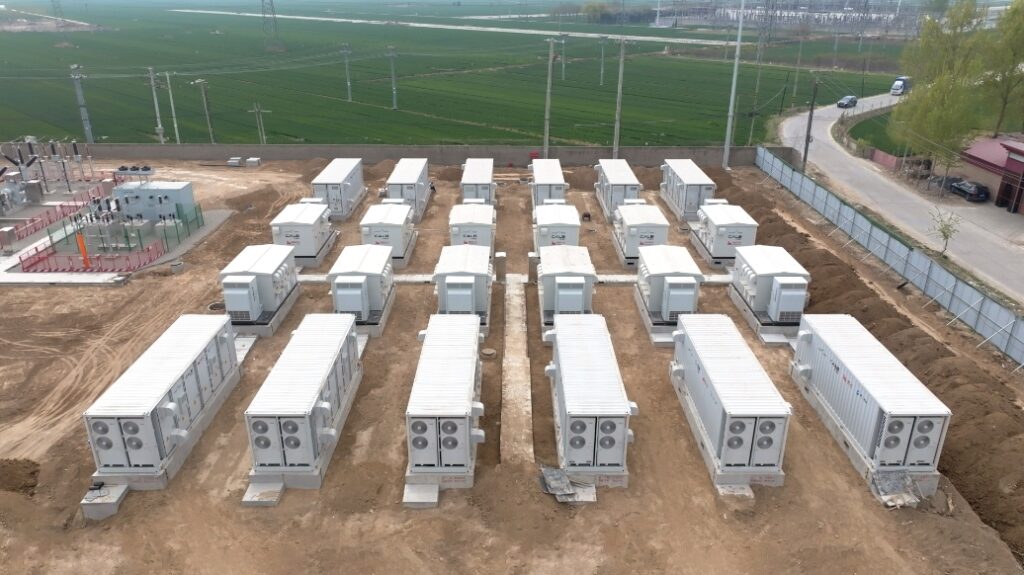
The company’s grid-scale solutions are primarily marketed under its ‘Hanchu ESS’ brand.
Financial summary (for the year ended 31 December)
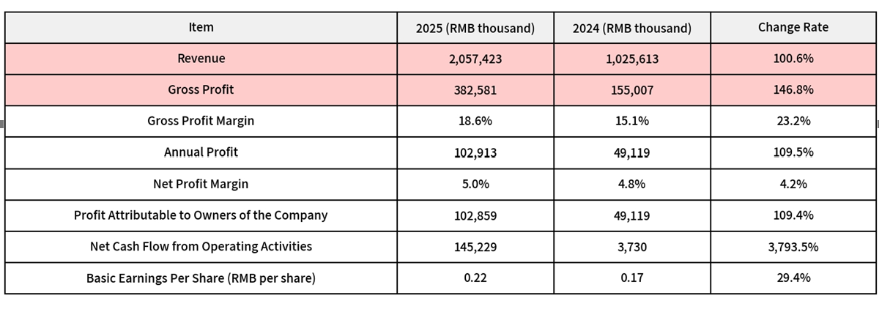
On the gross margin front, despite widespread industry price-cutting, Guoxia lifted its overall gross margin from 15.1% to 18.6%—a 23.2% improvement—via agile cost controls. Its core energy storage system solutions segment delivered a gross margin of 20.1%, underscoring strong cost discipline and pricing power.
Business restructuring: utility-scale storage becomes the cornerstone
Revenue mix shifts reveal a successful strategic pivot from overseas residential storage to utility-scale storage as the core business.
Energy storage system solutions remained the primary revenue pillar, generating RMB1.814 billion in 2025—88.2% of total revenue. Large-scale/utility energy storage systems contributed RMB1.568 billion, soaring from 12.2% of total revenue in 2022 to 76.6% in 2025, cementing its status as the largest revenue driver.
By contrast, the European residential storage market—once the mainstay—fell slightly to 11.2% of total revenue, while Mainland China’s share remained stable around 79.27%.
Revenue by Geography (for the year ended 31 December)
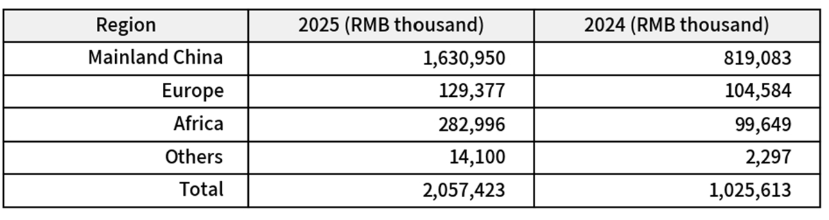
The company is capitalising on policy tailwinds in China’s booming large-scale storage market. As China rolled out supportive renewable energy and storage policies, Guoxia swiftly repositioned itself, establishing dedicated teams to develop domestic utility-scale project markets and deliver sustained growth.
Meanwhile, engineering, procurement and construction (EPC) services emerged as a powerful new growth engine. In 2025, EPC revenue hit RMB174 million—soaring 790.3% year-on-year—lifting its revenue share from 1.9% to 8.4%.
To match explosive order growth, Guoxia accelerated capacity expansion. Annual energy storage system manufacturing capacity jumped from 1.56GWh in 2024 to 4.80GWh in 2025—a massive 207.5% increase. This scale-up ensures delivery capability for gigawatt-scale utility storage projects.
Looking ahead, the company plans to add multiple new production lines and testing systems, targeting an extra 6.0GWh of annual capacity for utility and C&I storage systems and 240,000 additional residential storage units (≈900 MWh) by the end of 2027.
This aggressive expansion supports current demand and prepositions Guoxia for the “AI + Energy Storage” boom. As AI data centers demand ultra-stable power, energy storage firms with large-scale delivery capacity will become critical, scarce partners.