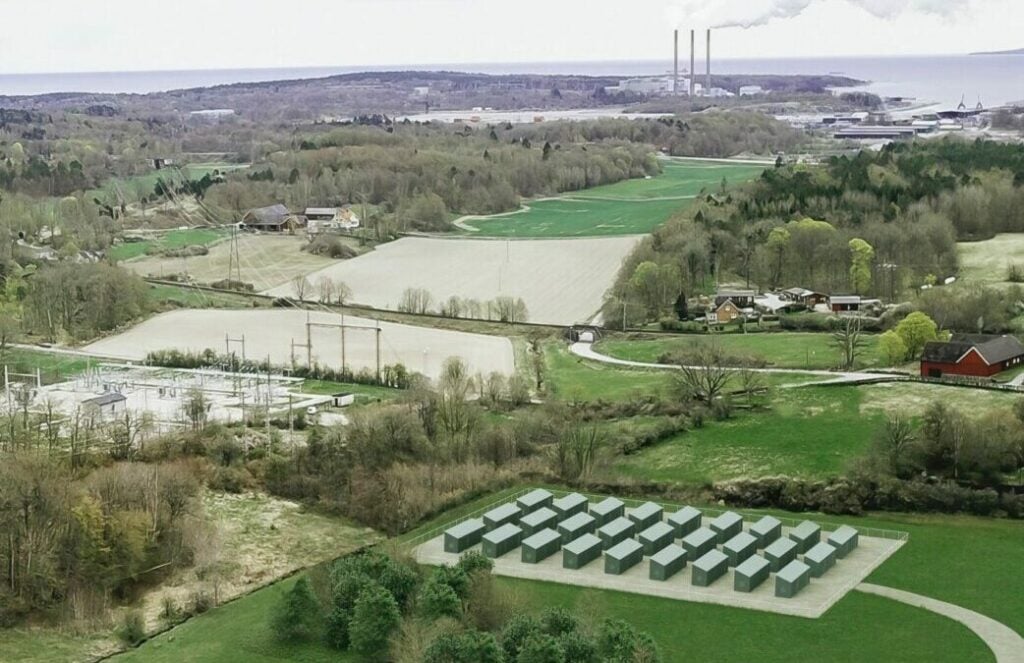
Some 100-200MW of grid-scale battery storage could come online in Sweden this year, local developer Ingrid Capacity told Energy-Storage.news.
In an interview conducted at the Energy Storage Summit a fortnight ago, chief strategy officer (CSO) Nicklas Backer of local developer Ingrid Capacity said there was around 70MW online by the end of last year, meaning the market could as much as quadruple in size this year.
The country’s balancing needs have historically been provided by its hydroelectric capacity.
“But due to a number of factors including electrification of society you now have big problems, especially in the south of Sweden,” Backer said.
Try Premium for just $1
- Full premium access for the first month at only $1
- Converts to an annual rate after 30 days unless cancelled
- Cancel anytime during the trial period
Premium Benefits
- Expert industry analysis and interviews
- Digital access to PV Tech Power journal
- Exclusive event discounts
Or get the full Premium subscription right away
Or continue reading this article for free
“A lot of the turbines for hydro in Sweden are old and are not built or optimised for some of the fast response services needed in today’s system. Overall the relative amount of hydro is decreasing too – the absolute amount is flat, maybe even falling slightly. Some small-scale hydro are getting stopped because of environmental permitting,” he added.
Finland-based system integrator Merus Power pointed to a similar driver for the battery storage market there during an interview also done at the two-day event in London, published last week.
Ingrid Capacity is a much newer company having been founded just last year. But it has already grown to have the “leading project pipeline within the Nordics as far as we know”, Bäcker said. The company was born from the idea that the “grid isn’t very smart,” as he explained.
“In the Nordics, you have a binary situation where you have DSOs (distribution system operators) that are more or less doing fine on capacity and then you have just one or two industrial users all of a sudden causing capacity constraints.”
“There are so few hours when there are problems so you don’t need more baseload in the system – maybe in 10 years, but for now you just need flexibility. Storage can do the fast balancing but also the long-term balancing stuff.”
Evolving the value stack for storage in Sweden
A big part of Bäcker’s role as CSO is to look at the long-term revenue picture for battery storage in Sweden, as he explained.
“The frequency markets are paying quite well right now though it is clearly a saturable market, and we have been looking at long-term profitable markets and how to help the Swedish market develop along those lines. Ancillary services prices have increased around 200% since 2020.”
“We have one site online and it does mostly ancillary services, along with some arbitrage. It’s a pilot size project so we’re experimenting, but if we optimised purely on price it would just do ancillary services. The prices on Frequency Containment Reserve (FCR) will have to drop for arbitrage to become as profitable.”
“Long-term the revenue stack will move to arbitrage, capacity markets and optimisation for grid owners and industrial processes. The ancillary services market in Sweden is around 600MW for FCR-up and FCR-down, each.”
Ingrid is deploying a 70MW project in Karlshamn and a 20MW system in Vimmerby. Various reports said the Karlshamn project is due for completion in 2024 but Ingrid Capacity has not yet given a fixed date for its operation, Bäcker said.
The market in Sweden is picking up in pace as Energy-Storage.news recently wrote, with DSO Ellevio Group ordering 70MW of projects from Alfen announced at the start of 2023. Two of those, 15MW units totalling 30MW, are set to be completed as early as this Spring.
Ingrid Capacity mainly goes for LFP, 1C systems, and typically uses the biggest European system integrators for its projects which are taking about 12 months to get to the ready-to-build stage. The main bottleneck for now is components, Bäcker said.
“The market structure here is relatively fragmented so the projects are quite small for now, meaning we pay a bit more per MWh compared to UK for example,” he added.
The firm has projects over 100MW in size but Bäcker said they will be several years before being ready-to-build, mainly due to grid capacity constraints.
Grid connectivity issues were a huge talking point at the Energy Storage Summit, as reported by our sister site Current± in its rolling coverage of the event’s second day. In some markets, like the Netherlands, huge grid fees for storage are holding the market back while in Sweden it’s a bit better.
“Grid fees as a percentage of opex are in the low single-digit figure range, but it’s complex and depends on where the storage asset is, Bäcker said.
Ingrid Capacity claims an overall energy storage project pipeline of 500MW in Sweden and a total target for the Nordics of 2GW. Its shareholders include property developer Engelbrekt Utveckling and investment firms Springbacka and Neptunia.