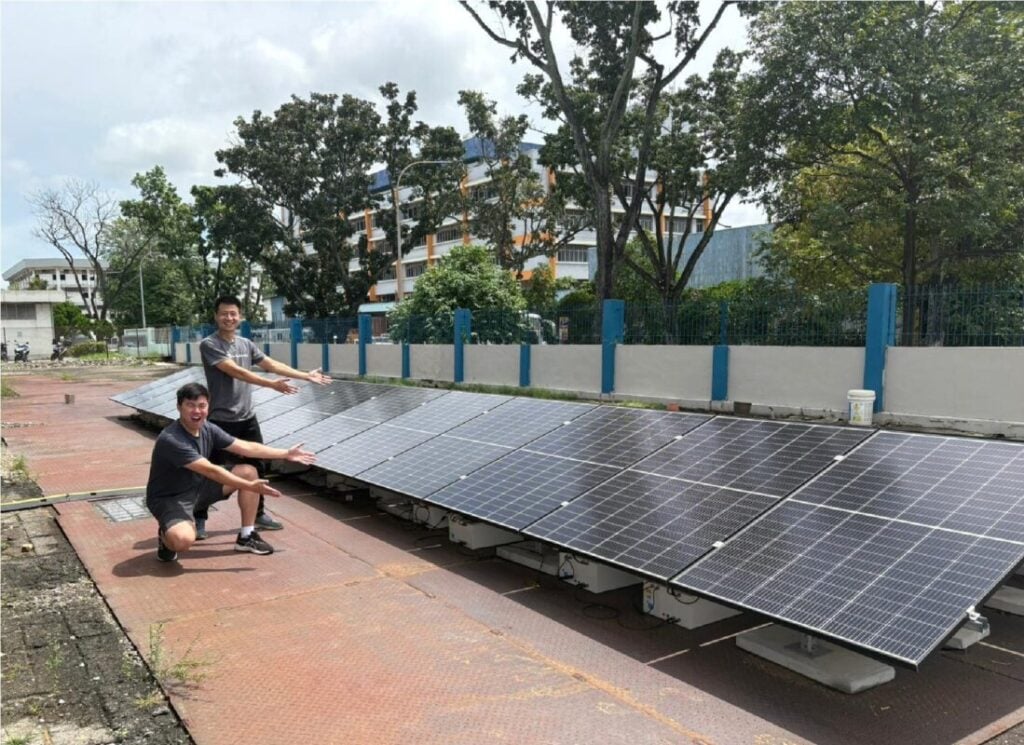
A new partnership aims to deploy an integrated solution combining solar PV with sodium-ion batteries at commercial and industrial (C&I) sites in Southeast Asia.
Singapore-headquartered virtual power plant (VPP) company Blue Whale Energy announced earlier this week (24 June) that it is partnering with US sodium-ion (Na-ion) battery startup Unigrid.
As adoption of solar PV for businesses and industrial facilities increases in the region, the pair hope to capitalise on the accompanying need for energy storage, claiming to have identified an addressable market for behind-the-meter (BTM) C&I systems in densely populated urban environments.
Blue Whale Energy’s answer to fitting batteries into tight project layouts is to mount batteries directly underneath solar PV modules, in a somewhat similar way to the short-lived wave of ‘microstorage’ PV panels that were mostly seen on the residential market a few years ago.
Try Premium for just $1
- Full premium access for the first month at only $1
- Converts to an annual rate after 30 days unless cancelled
- Cancel anytime during the trial period
Premium Benefits
- Expert industry analysis and interviews
- Digital access to PV Tech Power journal
- Exclusive event discounts
Or get the full Premium subscription right away
Or continue reading this article for free
However, one main difference between the PV modules that had back-mounted batteries seen in the past is the choice of technology.
“With Unigrid’s sodium-ion platform, we can deploy energy storage directly where energy is needed—on commercial and industrial rooftops throughout urban cities where space constraints previously made installations unfeasible,” Blue Whale Energy founder and CEO Gabriel Lim said.
Lim described Na-ion chemistry batteries as a “gamechanger” that could enable his company to “turn every roof into a dispatchable grid asset.”
While less energy-dense than lithium-ion (Li-ion) batteries, sodium-ion batteries can operate at a wider temperature range without active thermal management. This means they could be more manageable from a fire safety and risk management perspective while also requiring less space for balance of system (BOS) components.
The VPP company also claimed the combination of solar PV with modular battery packs allows for less complex design and engineering of sites than having to accommodate Li-ion battery storage units in specialised enclosures and with minimum safe distance clearing from equipment or buildings.
So far, however, the challenges for sodium-ion commercialisation have been that in addition to their lower energy density, cycle life is typically lower than Li-ion cells, while lithium’s big head start in mass production makes the incumbent technology much cheaper.
Part of the reason there is so much interest in sodium-ion is that the materials used are more abundant and readily available than for lithium-ion, while many of the same manufacturing processes could be used.
So, if sodium is adopted on a grand scale, there is scope for dramatic cost reduction. Mainstream interest in the battery chemistry did pick up during the COVID-19 pandemic as lithium prices spiked, but it cooled again as the prices came back down.
California-headquartered Unigrid recently signed a deal in India with engineering, procurement and construction (EPC) firm Indexel, targeting the deployment of 50MWh of systems at sites including industrial parks, renewable energy integration projects and microgrids.
The battery maker claims its products can charge at rates over 10C and achieve energy density at more than 450 Wh/L, capable of up to 10,000 cycles.
It received a US$2.9 million award from the California Energy Commission (CEC) to support construction of a pilot production line in the US state earlier this month, and its investors include LG Technology Ventures.
Blue Whale Energy said its initial plan is to deploy 8MWh of Na-ion solar-plus-storage in Southeast Asia by the end of this year.