Update 19 February 2021: Yann Dumont, president of the Spanish Energy Storage Association (ASEALEN), said publication of the strategy is already contributing to the take-off of the storage sector in Spain. “This document publicly presents the importance of energy storage in our country and shows several clear paths and courses of action to address it.” Dumont, who is also CEO of renewables consulting firm Reolum, welcomed how the strategy aims to address good governance in environmental, social, and research and innovation areas, adding: “The document serves as a knowledge base for anyone who wants to approach this sector, describing technologies, challenges, barriers and risks.”
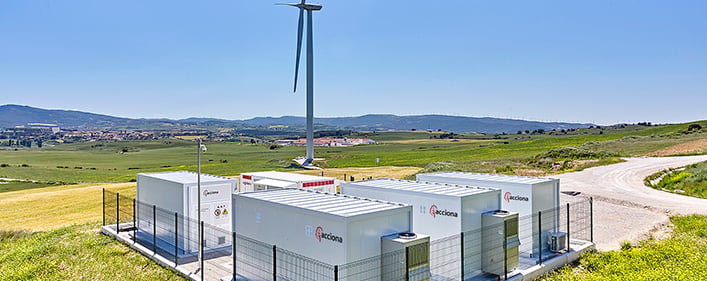
Spain’s government has approved an energy storage strategy that it says will put the country “at the forefront” of what is being done in Europe and help it move towards its 2050 climate neutrality target.
The roadmap foresees the country ramping up its storage capacity from the current 8.3GW level to 20GW by 2030 and then 30GW by 2050.
Try Premium for just $1
- Full premium access for the first month at only $1
- Converts to an annual rate after 30 days unless cancelled
- Cancel anytime during the trial period
Premium Benefits
- Expert industry analysis and interviews
- Digital access to PV Tech Power journal
- Exclusive event discounts
Or get the full Premium subscription right away
Or continue reading this article for free
The strategy includes policies to remove administrative barriers to facilitate new projects, the promotion of green hydrogen, the creation of new business models to support areas such as the second life of batteries as well as new research and development efforts.
Ecological Transition Minister, Teresa Ribera, said storage “allows the perfect integration” of renewables in the system, adding that “Spain is an energetic island, which compels us to have to go ahead to fulfil our commitment to climate neutrality.”
Noting the potential for batteries in self-consumption systems for homes and businesses, the strategy targets the deployment of 400MW of behind-the-meter battery storage by 2030. The government said the deployment of batteries on a large-scale by paring with renewable projects is also “relevant”. The strategy includes efforts to boost thermal storage deployment, renewable hydrogen and pumped hydro plants.
The roadmap follows the recent publication of Spain’s Integrated National Energy and Climate Plan 2021-2030 (PNIEC), which foresees the staggered introduction of battery storage installations into the system to maximise the capacity of non-dispatchable renewable technologies. It is hoped these batteries will have a capacity equivalent to approximately 2.5GW by 2030.
While participants in Spain’s renewable energy auction last month were permitted to include bids with energy storage, the technology didn’t feature. According to consultancy Clean Horizon, this was in part due to a short timeline to submit bids as well as a condition that winning storage plants would be limited to charging from the renewable project they are paired with, excluding the possibility of charging from the grid.
With 19.4GW of renewables capacity to be assigned through Spain’s new auction system by 2025, calls have been made to alter the mechanism to encourage the participation of energy storage in future tenders.