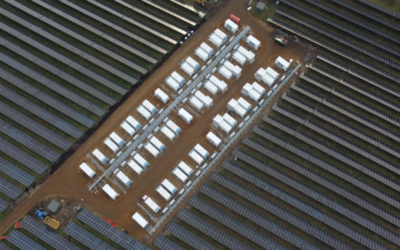
Storage and solar together, can deliver affordable flexibility to Europe’s electricity grids – but the regulatory framework to accommodate for this needs to be revamped, according to Solar Power Europe. Source: Flickr/Glyn Lowe
SolarPower Europe is calling on the European Commission (EC) to address both solar power and energy storage in its upcoming Energy Union Package. In light of this, the association’s Task Force on solar & storage has created 10 policy priorities that will need to be considered to develop an appropriate framework for those technologies.
“The industry is being very successful in bringing down the cost of stationary battery storage and in improving its ability to provide efficient services and solutions to the market. Today we need European policy makers to put in place stable regulatory conditions including clear definitions and an appropriate market design to ensure a level playing field among competing solution providers. Such conditions will allow for further innovations and corresponding market growth,” said Ricardo Amoroso, chief innovation officer of Enel Green Power and vice president of SolarPower Europe.
The importance of the two technologies in tandem cannot be underestimated in order to achieve 2030 RES targets. But to adequately cater to such dynamic technology developments, SPE is asking for a corresponding regulatory framework that contains the following ten priorities:
An EU-wide definition of ‘electricity storage’ to be introduced in the revised Electricity Directive
Clarifying the definition and rights of active consumers regarding storage: the REDII should enshrine the right for consumers to self-generate and consume renewable energy
An appropriate reform of the intraday markets is crucial for enabling large-scale solar plants to better take on balancing responsibilities
A real market for selling and procuring flexibility services to be developed, both at transmission and distribution levels
A clear basis regarding rules and circumstances under which TSOs and DSOs may operate storage solutions must be developed
Targeted solar tenders to incorporate as a weighting selection criteria the co-location of solar and storage
The exchange of electricity on a community scale via collective self-consumption schemes must be possible for active consumers. Third party intermediaries should be allowed to operate active consumers’ electricity storage devices via pooling platforms, such as virtual power plants or peer-to-peer mechanisms
Clear rules regarding data transparency and access for all stakeholders are required
Active consumers should be remunerated fairly for providing their devices to deliver services that support the electric grid. To achieve fair remuneration and service provision, tariffs must provide consumers and service providers with price signals to be able to act upon market developments and system needs
Distribution and grid tariffs must be ‘fit for the energy transition’
Try Premium for just $1
- Full premium access for the first month at only $1
- Converts to an annual rate after 30 days unless cancelled
- Cancel anytime during the trial period
Premium Benefits
- Expert industry analysis and interviews
- Digital access to PV Tech Power journal
- Exclusive event discounts
Or get the full Premium subscription right away
Or continue reading this article for free
“If the regulatory environment for solar & storage is set effectively, solar power will strongly contribute to reaching the 27% target for renewable energy in 2030 in the current draft RE directive,” said Michael Schmela, executive advisor at SolarPower Europe. “Implementing our 10 policy priorities for solar & storage in the Energy Union Package would already go a big part of the way to achieving the realistic 35% target SolarPower Europe would like to see in the new REDII 2030 directive.”