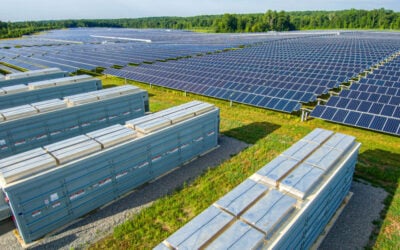
Green Mountain Power’s Hartford Solar facility. Image: Green Mountain Power Facebook page.
A solar power plant owned by Vermont utility Green Mountain Power has saved the utility’s quarter of a million customers US$200,000 in one hour by drastically reducing peak demand.
The Stafford Hill solar facility in Rutland, responds quickly to fluctuations of power going to the grid using 3.4MWh of energy storage paired with 2MW of solar. Built on a former landfill site, the array also powers an emergency shelter at a nearby high school and can be disconnected from the grid if necessary.
In mid-August, Green Mountain Power hit its annual peak of power usage. Using the solar-plus-storage system, the utility, which like others in the five-state US region of New England is charged its annual fees based on the percentage of regional demand during that peak window, reduced its overall power demand enough during that peak hour on 12 August to save its customers US$200,000 overall.
“GMP is helping customers generate power from clean, affordable energy sources closer to where it is used, and when paired with battery storage that energy can be used during outages and to help reduce peak energy demand, reducing costs for all customers,” Mary Powell, CEO and president of Green Mountain Power, said.
Try Premium for just $1
- Full premium access for the first month at only $1
- Converts to an annual rate after 30 days unless cancelled
- Cancel anytime during the trial period
Premium Benefits
- Expert industry analysis and interviews
- Digital access to PV Tech Power journal
- Exclusive event discounts
Or get the full Premium subscription right away
Or continue reading this article for free
“Through careful planning, we anticipated when the New England peak load would occur, and worked tirelessly to ensure that control technology would enable us to draw down the power from Stafford Hill providing significant benefit to customers.”
Green Mountain Power made Energy-Storage.News headlines in December last year when it started offering Tesla Powerwalls in a no-money-upfront package to customers by asking them to share the benefits of their batteries with the utility. As analyst Cosmin Laslau of Lux Research blogged for our site at the time, peak reduction using Powerwalls could cover about 60% of the battery system’s cost in a strategy Laslau said was a clever way for the utility to stay relevant.