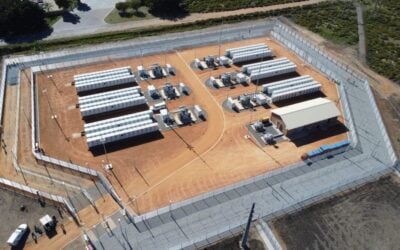
Developer Rolwind has won a favourable environmental impact assessment (EIA) result for a 200MW/800MWh BESS in Spain, the first standalone one to do so and the largest in the country, it claimed.
The company has received the positive EIA result from the Ministry for the Ecological Transition and the Demographic Challenge (MITECO) for its ST Palmosilla project, according to a local news report reposted by the company.
It is the first favourable EIA for a standalone energy storage project in Spain from MITECO, Rolwind CEO Domingo Estepa said.
The ST Palmosilla project will have a power rating of 200MW and an energy storage capacity of 885.294MWh, an overbuild to ensure 4-hours of energy storage discharge capability (800MWh).
Try Premium for just $1
- Full premium access for the first month at only $1
- Converts to an annual rate after 30 days unless cancelled
- Cancel anytime during the trial period
Premium Benefits
- Expert industry analysis and interviews
- Digital access to PV Tech Power journal
- Exclusive event discounts
Or get the full Premium subscription right away
Or continue reading this article for free
The report also claimed that the battery energy storage system (BESS) project is the largest presented in Spain to-date. It wil be in the Cadiz town of Tarifa, in southern Spain.
It will connect to the high-voltage grid of Spain via the Puerto de la Cruz 220kV node and will comprise BESS units with lithium iron phosphate (LFP) batteries. It will be made up of 63 ‘energy islands’, arrays of 12 DC blocks, each of which will have 24 modules inside. That implies a little over 1MWh in each DC block, at a time when the industry has increasingly moved to 5MWh DC blocks.
Rolwind has other BESS it has submitted for EIAs in Spain, including the 200 MW ST Grandas de Salime project in Asturias and the 100MW ST Solorzano project in Cantabria, both located in northern Spain.
Spain is targeting 22.5GW of energy storage on its grid by 2030 and is supporting the deployment of projects via programmes like the PERTE tender which saw 1.8GWh of co-located projects win long-term financial support in December 2023. A separate scheme is seeing 829MW of grid capacity for renewables and storage to replace coal plants being auctioned out, launched in July.