Smartphone interface for Moixa home storage. Image: Moixa Technology.
One UK energy storage company has compared its latest venture to the energy trading markets of California ISO, as it prepares to pay its customers for providing vital grid services through their residential systems.
Moixa Technology, a maker of lithium-ion battery-based storage systems said the scheme will allow system owners to make a combined payment and savings of up to £200 per year on their energy bills. The saving portion will come from allowing the household to self-consume onsite generated solar PV power, or to arbitrage by storing off-peak energy where applicable. Meanwhile the rest of the revenue stream from which the customer will be recompensed will come from the householder making some of the battery’s capability available “for a range of network demand and balancing service revenues”.
The company’s MD, Simon Daniel, recently blogged for PV Tech Storage on how energy storage could help Britain’s embattled solar PV industry to survive in the face of widespread expected cuts to financial support from the UK government at the end of this year.
Daniel emailed PV Tech Storage this week about MASLOW Gridshare, named after Maslow, the Moixa brand of storage systems. He said the project came about as a direct result of the company’s deployments on a trial basis over the past couple of years in tandem with the Department of Energy and Climate Change. Through DECC, Moixa has demonstrated the ability of small-scale storage systems to act in concert through what is known as “aggregation”- sometimes also referred to as the “virtual power plant” concept, analogous or similar to demand response programmes where electricity supply and demand by individual users is controlled by a central agent to balance grids.
Try Premium for just $1
- Full premium access for the first month at only $1
- Converts to an annual rate after 30 days unless cancelled
- Cancel anytime during the trial period
Premium Benefits
- Expert industry analysis and interviews
- Digital access to PV Tech Power journal
- Exclusive event discounts
Or get the full Premium subscription right away
Or continue reading this article for free
Earlier this year one US provider, Stem Inc, started up a project to aggregate energy storage into the real-time energy market of the California Independent System Operator (Cal ISO), which oversees operation of the state’s transmission system. Meanwhile companies such as Sonnenbatterie in Germany have started similar programmes.
“Sharing storage as a service” in this way, Daniel said, Gridshare is operating on a commercial basis- albeit at an early stage, initial launch, which Moixa wants to expand as “market mechanisms ease here (in the UK)”.
This combination of end user value and grid services has become more and more an attractive prospect for storage providers. A recent report from US sustainability group Rocky Mountain Institute highlighted that combining multiple uses for batteries, or “benefits stacking” was key to realising the true value and potential of storage. As Simon Daniel of Moixa pointed out, Gridshare will do that both in front of (at network level, controlled by the network operators) and behind-the-meter (customer sited).
According to Moixa, Gridshare “will typically pay £75 a year in addition to solar savings, with renewal available after 5 years linked to battery upgrade offers or enhanced income streams as UK market mechanisms and regulations become more accessible”.
Belectric in UK large-scale frequency response project
PV Tech Storage also spoke briefly today with Paul Camp, in business development and finance at the UK arm of German technology company Belectric, who talked between sessions about the company’s involvement with National Grid’s Smart Frequency Control project.
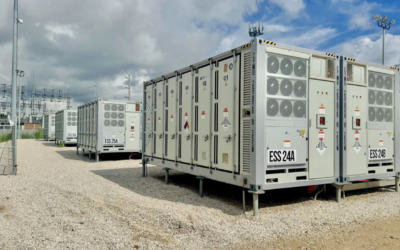
Belectric was successful earlier this year in gaining the necessary pre-qualification to participate in providing grid frequency response through its containerised storage project at Alt Daber, a large-scale solar farm in Germany.
The company won a competitive process to carry out a similar project in Britain. Frequency response is traditionally provided by thermal generation, using power plants that must run constantly, even though they are only called upon when needed to balance the grid frequency. As has been seen in some parts of the US already, this can be done more quickly and more efficiently through battery-based storage. According to many industry sources, this is also a quick-win way of taking some fossil fuels offline and replacing them with renewables, paired with energy storage.