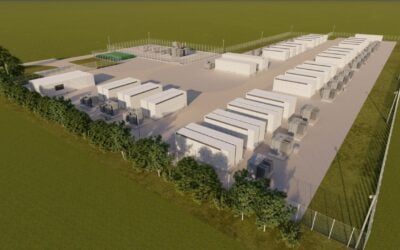
A double-header of big news from Germany, with construction starting on a ‘Grid Booster’ BESS from TransnetBW and Fluence and the EU putting €58 million towards a project that will combine green hydrogen and iron flow battery storage at scale.
Editor Andy Colthorpe speaks with Yann Brandt, chief commercial officer at FlexGen, a solar industry veteran who saw the rising potential of the energy storage industry and jumped on board.
The EV charging and energy solutions arm of Volkswagen Group is entering the large-scale BESS market, with individual projects up to 350MW/700MW in size and the first, in Germany, planned for next year.
Real estate investor Montea will put €30 million (US$33 million) to installing 56MWh of distributed battery energy storage systems (BESS) at logistics sites in Belgium and the Netherlands.
Trade association EASE has urged policymakers to recognise the vital role energy storage can play in solving energy sector challenges as European Union (EU) elections take place.
While short-duration BESS has flourished in Ireland, a ‘policy vacuum’ threatens the long-duration energy storage (LDES) rollout required for its renewables goals, research firm Cornwall Insights said.
Cumberland Council in England, UK, has granted planning permission for a 200MW/400MWh BESS project from developers Recurrent Energy and Windel Energy which, unless a new grid connection date is agreed, won’t start construction until 2029.
Utility Octopus Energy will pay Gresham House Energy Storage Fund (GRID) a fixed fee to use half of its UK BESS portfolio, at a price which it said is ‘above the current merchant revenue stack’.
Invinity Energy Systems, a technology company that develops vanadium redox flow batteries (VRFB), plans to expand its manufacturing footprint in Scotland, UK.