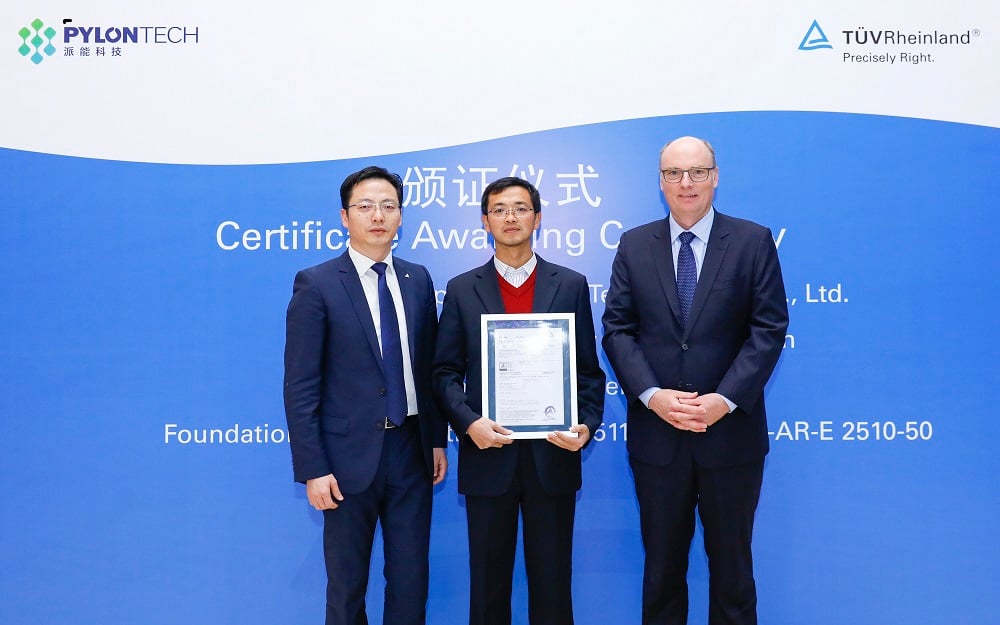
Shanghai-headquartered energy storage system maker Pylontech has become the first company to receive certification from TUV Rheinland that its lithium battery storage devices are suitable for use in Germany.
The company (Pylon Technologies) announced today that it had been awarded the VDE-AR-E 2510-50 certificate at an awards ceremony last week, for its PowerCube-H1-48 product series. The high voltage devices are based around lithium iron phosphate battery chemistry, designed to deliver high power and a long cycle life. PowerCube-H1 has three levels of battery management system (BMS) which can manage and monitor information about the cells including voltage, current and temperature. Each device is 36kWh of energy storage, made up of 2.4kWh battery modules.
Tech and science institution VDE created VDE-AR-E 2510-50 as a set of specifications for safety requirements for stationary battery energy storage systems based around lithium batteries. The certificate is one of a number of application standards which TUV Rhineland tests energy storage systems for. Pylon Tech’s PowerCube also met 2Pfg 2511, an energy storage standard devised by TUV. Together the certifications can be considered the first to comprehensively review the safety, technical requirements and optimal testing conditions for stationary energy storage products.
“Energy storage is the foundation of energy interconnection. The future of energy is in energy storage. My congratulations to Pylontech on receiving the first certificate in the world for the latest German energy storage standards,” TÜV Rheinland Shanghai managing director Lutz Frankholtz said.
Try Premium for just $1
- Full premium access for the first month at only $1
- Converts to an annual rate after 30 days unless cancelled
- Cancel anytime during the trial period
Premium Benefits
- Expert industry analysis and interviews
- Digital access to PV Tech Power journal
- Exclusive event discounts
Or get the full Premium subscription right away
Or continue reading this article for free
TÜV Rheinland Greater China’s general manager for solar and fuel cells, Li Wei-Chun, said Pylon Tech is, “the first company in the world to achieve both 2Pfg 2511 and VDE-AR-E 2510-50 energy storage system certification, and the first energy storage company to pass the most rigorous certification standard in the world. What this means is that Pylontech has now formally overcome the most demanding energy storage market entry threshold in the world.”