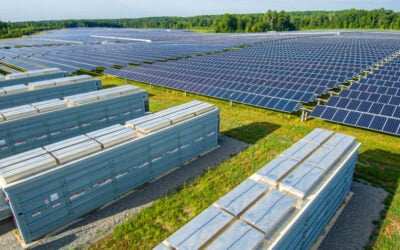
The project is located with 20MW of solar and 210MW of wind power.
Invenergy has brought a 31.5MW energy storage facility online to provide frequency regulation for the grid, near to 230MW of renewable energy generation assets.
The renewable energy and energy storage developer has begun commercial operations at it Grand Ridge Energy Storage project in La Salle County, Illinois, connecting it to a 20MW solar array, a 210MW wind farm and an existing 1.5MW energy storage unit.
The new facility joins the fast responding frequency regulation market for grid balancing provided in the service area of PJM, the regional transmission organisation (RTO) which allows battery-based energy storage to compete on an hourly basis to provide ancillary services. Service providers assist in matching generation and load to keep the grid operating at optimum frequency to avoid power outages and other problems.
Invenergy has selected lithium-ion battery storage systems from the US division of Chinese EV and battery manufacturer BYD for this, and another project to come online this year. BYD has supplied its containerised storage units which use a proprietary lithium iron phosphate chemistry. It was recently reported that BYD intends to scale up its battery production with ambitions plans to rival Tesla’s.
Try Premium for just $1
- Full premium access for the first month at only $1
- Converts to an annual rate after 30 days unless cancelled
- Cancel anytime during the trial period
Premium Benefits
- Expert industry analysis and interviews
- Digital access to PV Tech Power journal
- Exclusive event discounts
Or get the full Premium subscription right away
Or continue reading this article for free
Kris Zadlo, VP of regulatory affairs and transmission at Invenergy, said the technology has the potential to be a “transformative force” for renewable energy and the US electric grid.
“As we expand our storage project portfolio, Grand Ridge Energy Storage reflects our company’s commitment to, and belief in, the future of this revolutionary technology. We look forward to continuing to work with our customers to provide innovative storage solutions for their needs,” he said.
Grand Ridge is the first of two 31.5MW storage facilities Invenergy is to bring on line this year with the Beech Ridge Energy Storage project, located in West Virginia, also due to complete in 2015.
The facility takes Invenergy’s operational storage capacity to more than 100MW, adding to its 9GW renewable energy portfolio throughout the US.
On Wednesday, NEC Energy Solutions also revealed that it will provide 60MW of energy storage systems to the PJM frequency response market, for projects that are in late stage development by Amergin Energy. NEC ES has already provided several systems to developers in the PJM service area.
Perhaps better known as an EV maker in China, BYD America has supplied lithium iron phosphate battery systems to Invenergy’s latest 31.5MW projects. Image: Image: wikimedia user: Navigator84.