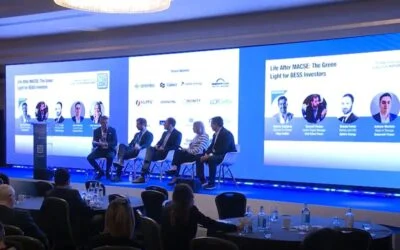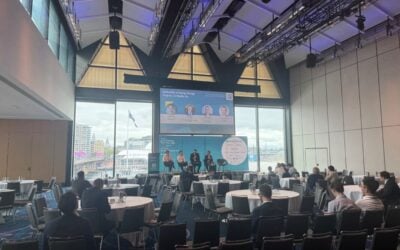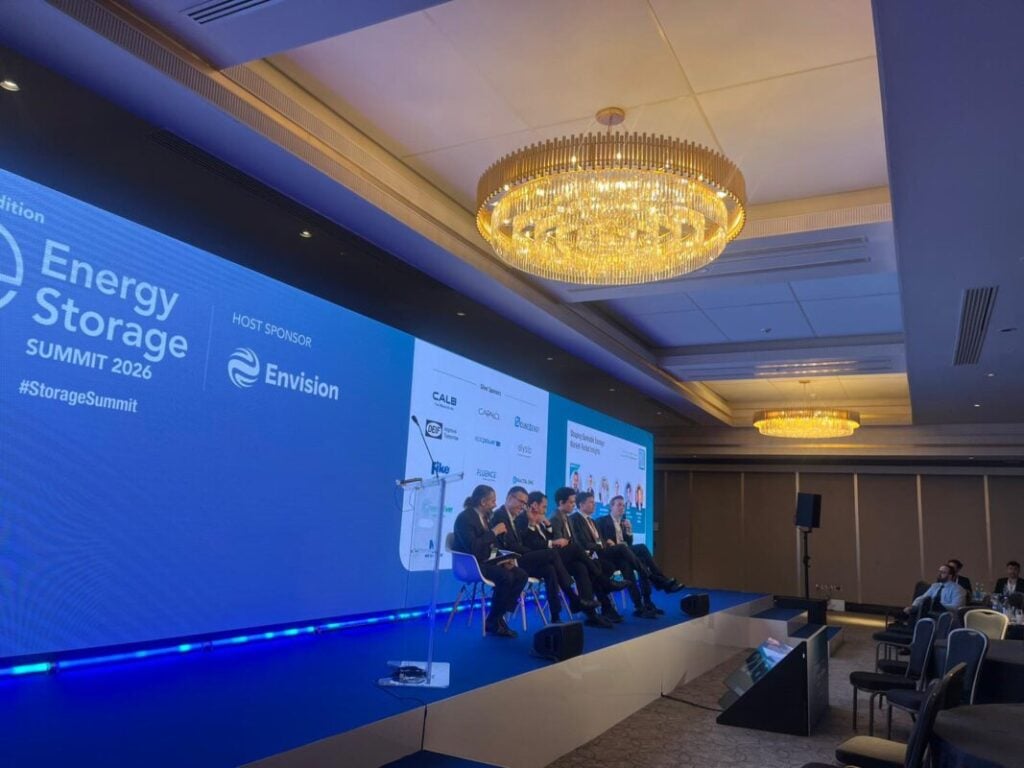
How to enable bankability for large-scale battery energy storage system (BESS) projects was the main topic of the opening panel discussion at the Energy Storage Summit 2026, which kicked off today (24 February) in London, UK.
The two-day event is put on by our publisher Solar Media, part of Informa Markets, and is in its 11th year, and after a series of keynotes and presentations, panellists took to the stage for the ‘Shaping Bankable Storage: Market-Tested Insights’ discussion.
Volatility driving need for certainty
“Volatility makes it very hard to underwrite investment case for projects in line with private equity and private investment requirements,” Semih Öztreves, chief commercial officer BESS of UK owner-operator Zenobē.
Roughly 80% of UK capacity is underwritten with some kind of toll or floor, he said. “No project above 100MW is fully merchant, in the context of the UK at least.”
Try Premium for just $1
- Full premium access for the first month at only $1
- Converts to an annual rate after 30 days unless cancelled
- Cancel anytime during the trial period
Premium Benefits
- Expert industry analysis and interviews
- Digital access to PV Tech Power journal
- Exclusive event discounts
Or get the full Premium subscription right away
Or continue reading this article for free
The firm is one of the UK’s pioneers in large-scale projects, with its Blackhillock project in Scotland the first to provide stability services to the National Energy System Operator (NESO) and this week signing an industry-first 15-year toll for a 4-hour BESS, also in Scotland.
“It’s probably one of the longest tolls signed in the market,” Öztreves said. “And I don’t think it will be a one-off.”
In Italy, there is currently a ‘perfect storm’ of schemes that in theory provide revenue certainty that help bankability, like the MACSE and Capacity Market auctions, but in reality actually make long-term revenue forecasting less clear. That is because their rules can change and distort the market, according to Eliano Russo, CEO Italy for renewables and storage independent power producer (IPP) Zelestra.
“To fully exploit things like MACSE and the CM, you need to remove all the uncertainties and not have auction parameters changed last-minute,” he said.
Headquartered in Spain, it has been notable for driving new types of offtake deals involving BESS, including in Chile, Spain and Italy, which Russo discussed with ESN Premium recently.
The number of banks that have financed BESS projects has gone from something like around 10 to something like 60, said Erik Strømsø, CEO of BW ESS, the BESS investor-operator platform of shipping and oil & gas firm BW Group. It has built up large portfolios in the UK, Sweden and Australia and is also expanding into Italy, Germany and Spain.
In a conversation with Energy-Storage.news earlier in the day, Strømsø discussed the imbalance in the demand and supply of tolls in the BESS industry, and said it was a fairly natural step in the evolution of a new market, and would change over time.
That imbalance means the power lies with the toll providers, particularly if the toll is needed to get a project to final investment decision (FID).
Elaborating on this topic, Ruben Valiente, managing director of Switzerland-headquartered BESS manufacturer Maxxen, said: “The tolls are being applied at such a discount, I think it’s disadvantaging the sponsors. Money is being left on the table for them.”
Panellists agreed that BESS tolls are largely bespoke and still are not standardising, though there is an element of new ceilings, features, lengths or sizes agreed which then informs the next deal signed, making new structures possible.
A question from the audience then asked the panel how warranties play into the topic of bankability.
Zelestra took part in MACSE but was not awarded a contract, which had terms of 15 years. Russo said that the firm discussed with its suppliers and the price of extending warranties’ capacity guarantees beyond the 10-year standard was ‘very high’, in some cases potentially jeopardising project economics.
Valiente and Strømsø both said that, although this was obviously key, it made choosing a supplier and project configuration even more important.
“Above all we need to make warranties simple,” Valiente added, pointing out that really warranty lifetimes are on cycles and not time.
Henry Xu, head of UK energy storage for China-headquartered inverter and BESS manufacturer Sungrow, added that as a supplier the nature of tolls didn’t particularly affect it’s strategy.
In January, we published an article rounding up the views of numerous other event speakers on the topic of financing large-scale BESS in Europe in the lead-up to the Summit event. That piece was also included in a printed publication, The Energy Storage Report 2026, which has been distributed at this week’s event.