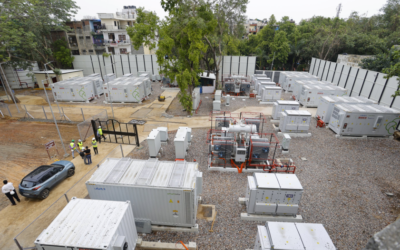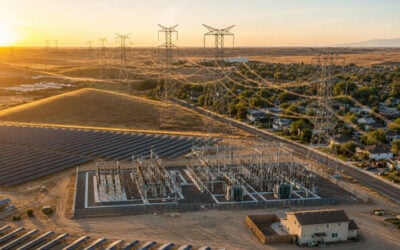
Public sector hydroelectric power generator and utility company NHPC India has launched a tender for solar-plus-storage, aiming to secure 1.2GW of solar PV capacity alongside 600MW/2,400MWh of storage.
Applicants will have until 24 April to submit bids, and successful bids will enter into a 25-year power purchase agreement (PPA) to sell the power generated at the winning projects to NHPC India. Projects are required to have a minimum solar capacity of 50MW, with a minimum storage component of 25MW/100MWh. The tender specifies the ratio of solar PV output to storage as 2:1 in megawatt terms with energy storage capacity to enable 4-hour duration of discharge at full rated power.
The only exception to this is in north-eastern states and ‘special’ category states that are already earmarked to receive greater government subsidies to cover the cost of rooftop PV additions. In these states, the minimum project size is 30MW of solar, plus 15MW/60MWh of batteries.
However, NHPC India notes that its tender process would be “technology agnostic”. It said crystalline silicon and thin-film solar PV technologies can be used in bids, and the only technical requirement is that the proposed technology is “commercially established”, as this is an initiative that seeks to deliver large-scale renewable electricity quickly, rather than be a testing ground for emerging solar technologies. Applicants are also welcome to submit bids with or without trackers.
Try Premium for just $1
- Full premium access for the first month at only $1
- Converts to an annual rate after 30 days unless cancelled
- Cancel anytime during the trial period
Premium Benefits
- Expert industry analysis and interviews
- Digital access to PV Tech Power journal
- Exclusive event discounts
Or get the full Premium subscription right away
Or continue reading this article for free
Individual bidders will be required to complete much of the administrative work for their projects, including securing approvals and permits from local government for their construction. Successful bidders will also be responsible for building the “dedicated transmission network” to connect their projects to India’s Inter State Transmission System (ISTS).
A lack of available grid capacity looms large in the Indian renewable power sector, with the government expecting to invest US$29.2 billion into grid expansion work by the end of the decade.
According to Mercom India Research, India added a record 25.2GW of new PV capacity in 2024, a 204% year-on-year increase, and close to three-quarters of all new power capacity additions last year. With the government looking to add 500GW of non-fossil fuel generation capacity by 2030, significant solar capacity is expected to come online in the coming years, and the Indian grid will need to be expanded to accommodate these projects.
This story first appeared on PV Tech.