
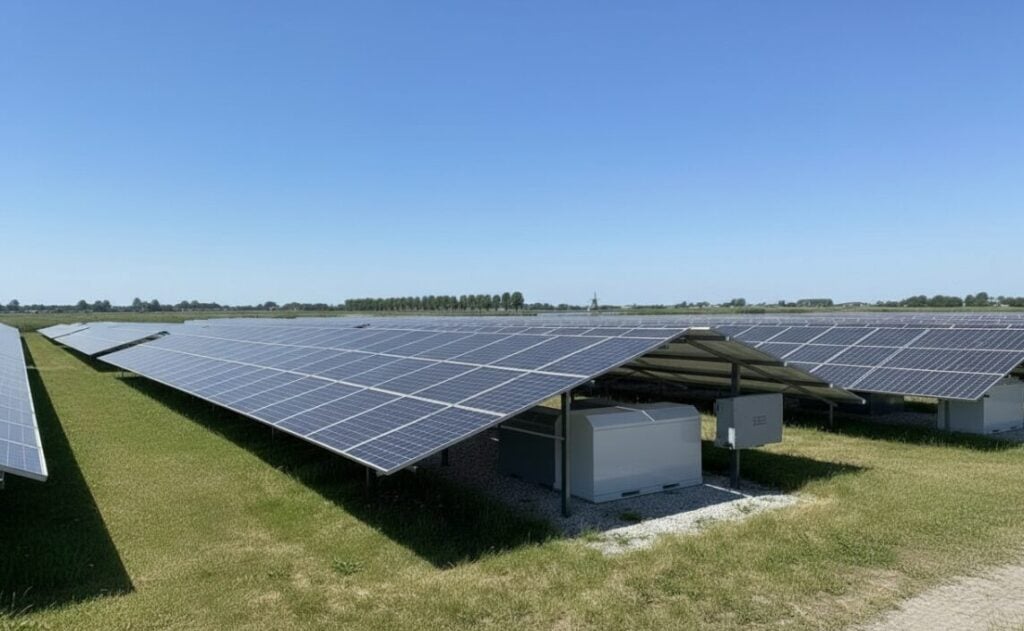
We hear from Netherlands-based ‘distributed hybridisation’ sodium-ion BESS startup Moonwatt, as it announces its first project 18 months after being founded and around a year after executives introduced its tech and strategy to Energy-Storage.news.
The firm announced in January that it would deploy its first project in 2026 at the Cleantech Park Arnhem in the Netherlands, in partnership with site owner IPKW and waste management firm Veolia. It added that the Dutch Business Agency (RVO) awarded the company a €1.15 million (US$1.35 million) grant to accelerate its development.
‘Bringing to BESS the same disruption that string inverters did in solar’
CCO Valentina Rota and CEO Zukui Hu gave us an interview this time last year, and gave us more details on the new project in email responses.
“The project is at a moderate scale for now, but thanks to our string‑based topology, it is built from the same modular building blocks that will power our double digit‑MWh, ultimately triple digit MWh‑scale, plants,” they said.
Try Premium for just $1
- Full premium access for the first month at only $1
- Converts to an annual rate after 30 days unless cancelled
- Cancel anytime during the trial period
Premium Benefits
- Expert industry analysis and interviews
- Digital access to PV Tech Power journal
- Exclusive event discounts
Or get the full Premium subscription right away
Or continue reading this article for free
Its sodium‑ion BESS delivers over 12,000 cycles, even in harsh climates, they said. Commissioning and inauguration on the initial project will happen later this year, at which point they’ll reveal the size.
“Our modular design mirrors the advantage that solar string inverters had when they displaced bulky centralised solar inverters from the market. We aim to bring that same level of disruption and scalability to the BESS sector,” they said.
Higher cost at DC block level, BOP savings claimed
“The battery DC enclosure cost is only slightly higher than a comparable lithium‑ion BESS,” they said.
“However, we generate meaningful savings at the balance‑of‑plant level (because of DC coupling, and system modularity) and during operations (because our system has no moving parts and uses a simpler, more rugged design, it requires less maintenance and leads to less downtime compared to lithium‑ion systems),” they claimed.
They also said that sodium-ion cell prices are falling rapidly while lithium-ion prices are ‘trending upwards’.
That is alluding to recent increases in the price of underlying raw materials like lithium carbonate, although that has not yet translated into recorded increases in industry-wide prices for batteries or BESS.
Moonwatt claims that, compared to conventional solar-plus-storage with large-scale BESS units, its system offers:
- 3-7% more solar revenues
- 15% cheaper capex per kWh
- 30% cheaper annual opex per kWh
- 80% fewer O&M defects
- no noise emission
- ‘unprecedented’ fire safety
- and retrofit capable
Manufacturing: cells from China, system integration in Asia
“We currently source our cells from China and carry out system integration in Asia. This enables us to secure orders in 2026 and begin delivering systems as early as Q1 2027, while remaining competitive from day one,” the team said.
Moonwatt is also trying, like a lot of companies, to diversify its cell supply beyond China, including from Europe and the US and has medium-term plans to nearshore or onshore integration in Europe.
“The timing for this will depend largely on economics and customer procurement requirements, and may also be influenced by new EU regulations mandating local content. We are monitoring these developments closely and will adapt our manufacturing footprint accordingly,” they added.
Sodium-ion maturation
“We launched the company in 2024 precisely because we saw how fast the sodium‑ion roadmap had accelerated, and how much potential was still ahead. A key catalyst has been the emergence of the NFPP sub‑chemistry,” they said.
In sodium-ion, NFPP plays a role similar to LFP in lithium‑ion: lower energy density, but significantly cheaper, safer, and with very good cycle life.
“Since our company’s inception, we’ve been testing and integrating NFPP cells from different vendors, and the pace of performance improvements and cost reductions continues to exceed our expectations.”
“In our view, the market has been consistently underestimating how quickly sodium‑ion is arriving, just as it underestimated the rise of LFP in stationary storage. For stationary ESS specifically, NFPP is proving to be a highly compelling fit: cost‑effective, durable, thermally stable, and well‑suited for long cycle life applications,” concluded Rota and Hu.