
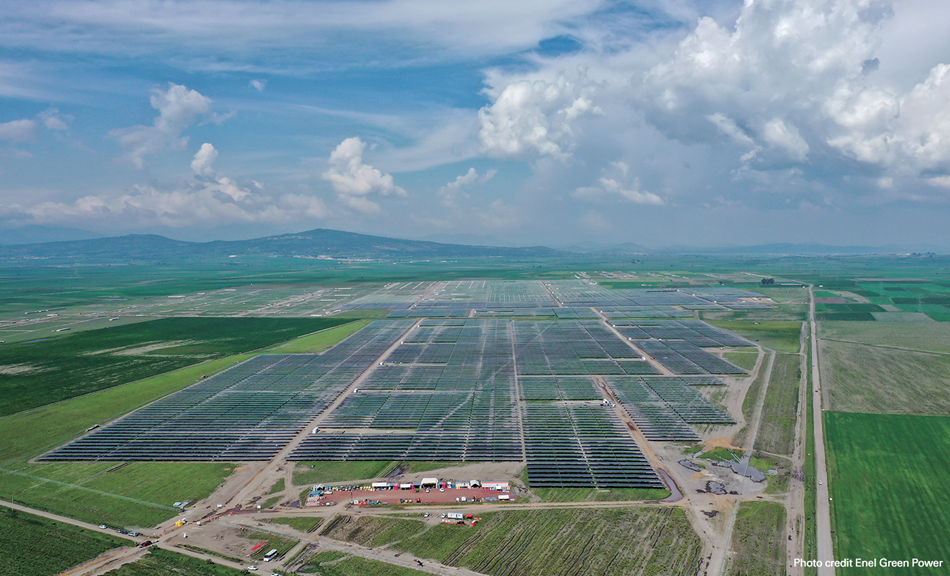
Mexico aims to support the scaled deployment of renewable energy and battery storage through a mix of public and private investment, writes Jonathan Tourino Jacobo.
The change of presidency in Mexico two years ago has brought an increased interest towards renewable energy and energy storage. In the past twelve months, Claudia Sheinbaum’s government has held several auctions for renewable energy, with most of the projects awarded being co-located with battery energy storage systems (BESS).
And earlier this year, Sheinbaum unveiled the country’s Renewable Energy Growth Plan by 2030, which aims to increase the installed renewable energy capacity. So far, in Mexico, the growth of renewable energy and energy storage seems to go hand in hand, with many solar PV projects being hybridised or co-located with BESS.
However, Mexico has the particularity that the recent auctions comprised a mix of public-private participation, through Mexico’s state-owned electric utility, the Federal Electricity Commission (CFE) will supply 54% of newly contracted electricity and private entities will supply the remaining 46%.
Try Premium for just $1
- Full premium access for the first month at only $1
- Converts to an annual rate after 30 days unless cancelled
- Cancel anytime during the trial period
Premium Benefits
- Expert industry analysis and interviews
- Digital access to PV Tech Power journal
- Exclusive event discounts
Or get the full Premium subscription right away
Or continue reading this article for free
“There is such strong interest in promoting renewable energy projects that the mixed-investment model involving the CFE and private entities provides investors with certainty. What this mixed-investment scheme entails is that the investor covers the project’s CAPEX, while the CFE guarantees the purchase of at least 70% of the energy produced,” explains Josué Alberto Valenzuela, Director of Strategic Productive Investment Projects at the Secretariat of Economy and Innovation of Baja California.
Valenzuela adds that this financial guarantee covers more than half of a project’s capacity, and that the remaining 30% can either be sold in the electricity market or supplied to the state-owned utility. “The federal government’s interest [in renewable energy] is clearly there.”
Baja California’s energy demand from industry
Moreover, in the case of the northern state of Baja California, which borders the US state of California, there is high energy demand due to the state being predominantly an industrial state, says Valenzuela. Adding to the fact that the state’s operates as an energy island that is isolated from the rest of the country’s national electric grid, there is a need for the state to build its own capacity to meet its demand, with the possibility to import energy from California.
“There are significant projects involving photovoltaic energy, which naturally go hand in hand with storage systems,” adds Valenzuela.
And Baja California is no stranger to the global data centre boom that has been happening in most of the world. This sector represents “an attractive market for all stakeholders,” says Valenzuela, as energy companies are looking for offtakers to buy the generation from their renewable energy power plants, while hyperscalers are looking to secure clean energy to power their facilities.
“It is, in short, a complex ecosystem that is currently taking shape.”
The role of distributed generation and self-consumption driving renewables growth
According to Valenzuela, there is also a growth of solar PV and BESS installations in distributed generation, both from the residential and commercial and industrial (C&I) segments, that are driving energy generation up in Baja California.
“Homes and businesses often have surplus energy during peak daytime hours that they feed into the grid. In light of this—and with the obvious aim of preventing such disruptions—there is also an effort to incentivise “unassociated” storage systems. These are systems that are interconnected with the grid but are not linked to any specific power generation plant.” Valenzuela adds that there are several favourable components associated with regulated standalone BESS projects, including basic tools such as peak shaving.
When asked about said regulation for energy storage, Valenzuela replied that in Mexico, there were existing regulatory frameworks depending on the type of permit required for a project and this goes for distributed generation projects, for self-consumption projects that are between 0.7MW and 20MW that include energy storage. Valenzuela emphasises that the current administration puts the focus on the system’s power capacity.
Valenzuela said there is no doubt that the conditions are in place for the growth of renewable energy throughout Mexico. This includes not only the regulatory level but also the “Ventanilla única,” a platform for self-generation projects between 0.7MW and 20MW, and the mixed investment scheme government auctions with participation split between CFE and private entities.
Josué Alberto Valenzuela will be a speaker at the upcoming Energy Storage Summit Latin America in Santiago, Chile, on 26-27 October 2026. For more information about the event, including ticket booking, click the link above. Use our discount code ESN20 for 20% off tickets.
