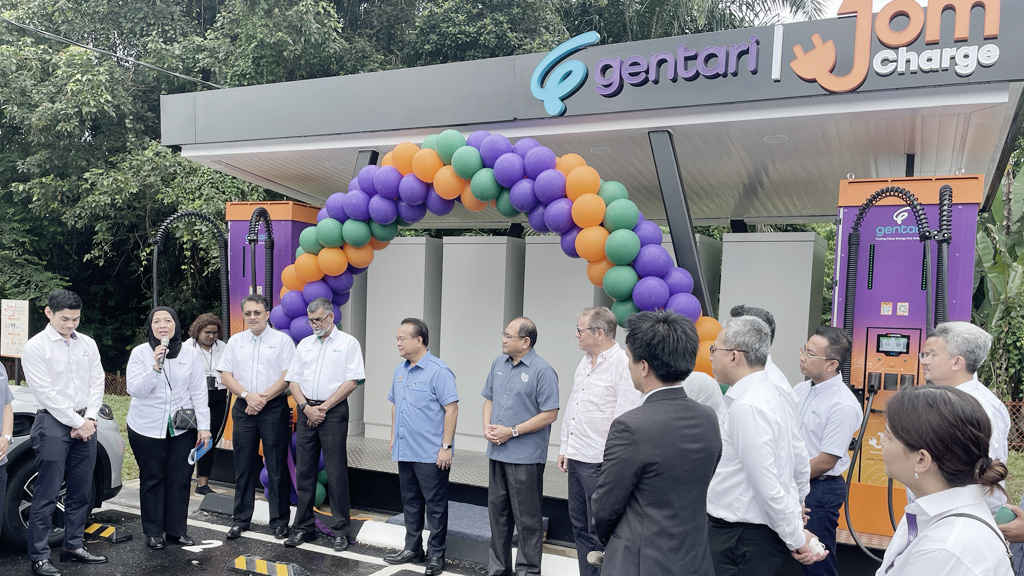
Malaysia’s minister of works has celebrated the inauguration of the country’s first-ever battery energy storage system (BESS) supplied to an electric vehicle (EV) charging station.
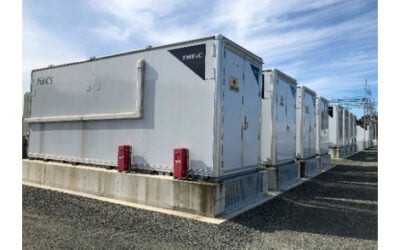
The 300kW/300kWh unit was designed and supplied by Norwegian energy storage tech company Pixii and has been installed along Malaysia’s main highway, the North-South Expressway. Pixii said it has signed a deal to install a further seven units of the same size, bringing the total order to 2.4MW/2.4MWh.
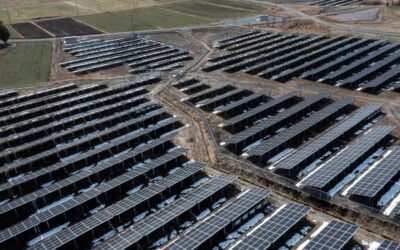
The units will also be paired with onsite solar PV arrays, although generation capacity of the array at the completed site was not given.
EV charging solutions company EV Connection ordered the units, and they will be operated in partnership with Gentari, which is a renewable energy company owned by Petronas, a Malaysian state-owned business also known as National Petroleum Limited.
Try Premium for just $1
- Full premium access for the first month at only $1
- Converts to an annual rate after 30 days unless cancelled
- Cancel anytime during the trial period
Premium Benefits
- Expert industry analysis and interviews
- Digital access to PV Tech Power journal
- Exclusive event discounts
Or get the full Premium subscription right away
Or continue reading this article for free
Towards national targets
Minister of works Alexander Nanta Linggi, whose department is responsible for public works, attended the inauguration event pictured above, as did other dignitaries, including Norway’s ambassador to Malaysia, Morten Paulson.
Malaysia’s government is seeking to rapidly increase the number of charging stations available to EV drivers. At present there are around 1,200 in the country, far short of a national goal set in 2025 to reach 10,000 by 2025.
The country is targeting net zero emissions by 2050, and minister of international trade and industry, Zafrul Tengku Aziz, earlier this year attended a launch event for a 1MW prototype of the first end-to-end BESS product created in Malaysia, by two domestically-headquartered companies, Citaglobal and Genetec Technology.
The role of battery storage within charging networks, meanwhile, is to serve as a buffer between the electric grid and expected demand from vehicles. When multiple EVs need to charge at the same time, it can put constraints on the local grid and as might be expected, those constraints are amplified with fast-charging.
For example, the first BESS-integrated EV charging project in New York, US, will feature a 5MW/15MWh BESS to provide buffering for 18x 350kW fast-DC EV chargers, with utility Con Edison awarding the project to Centrica Business Solutions in 2021.
Also in 2021, the UK’s government committed to investing around US$15 million in deploying 20 storage systems at roadside service stations at locations where grid supply is insufficient to support rapid charging infrastructure.
Then, last year, a number of companies in the space raised funding, with US$125 million raised by Freewire Technologies from investors including BlackRock perhaps the single biggest raise, while the growing activity around BESS-integrated EV charging in the German market was the topic of an Energy-Storage.news blog in July 2022.
“Charging stations is an area where our systems create immense value. The usage of charging stations varies widely, and managing demand peaks directly through the grid is challenging,” Pixii CEO Kenneth Bodahl said.
“This has especially been a concern in Malaysia. Our energy storage systems provide a buffer to handle these peaks, enabling a power boost that allows for fast charging.”
Pixii said its systems are based on the company’s proprietary power electronics module called PixiiBox. The bi-directional AC/DC converter is designed to be adaptable for various market segments and applications. Other projects from Pixii reported on by Energy-Storage.news include providing battery storage to telecommunications companies and community-level ‘neighbourhood batteries’ in Australia.
Energy-Storage.news’ publisher Solar Media will host the 2nd Energy Storage Summit Asia, 9-10 July 2024 in Singapore. The event will help give clarity on this nascent, yet quickly growing market, bringing together a community of credible independent generators, policymakers, banks, funds, off-takers and technology providers. For more information, go to the website.