
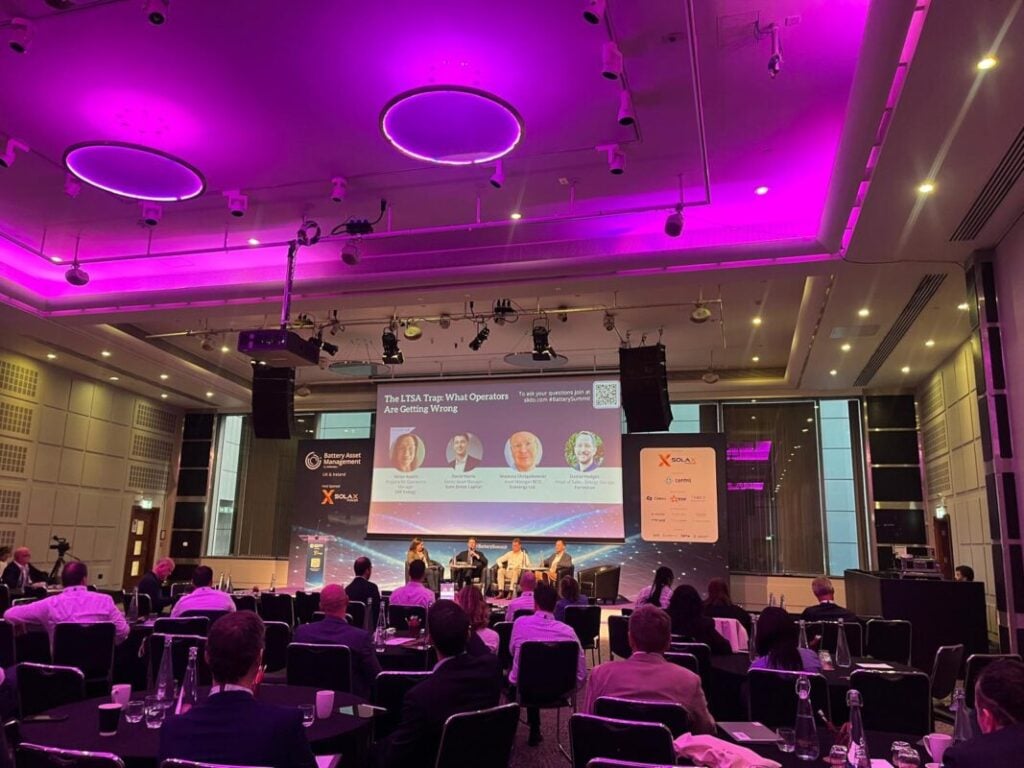
A panel of BESS industry experts discussed the ins and outs of long-term service agreements (LTSAs) at the Battery Asset Management Summit UK & Ireland 2026 yesterday.
Speakers from battery energy storage system (BESS) owner-operators Gore Street Capital, Econergy and EDF Power Solutions, as well as battery intelligence firm Elysia, discussed all on ‘The LTSA Trap: What Operators Are Getting Wrong’ panel discussion.
The panel took place at the Battery Asset Management Summit UK & Ireland 2026, put on by our publisher Solar Media, which concludes today (14 October).
What is an LTSA?
The literal definition of an LTSA is a long-term agreement between BESS buyer and BESS provider for the latter to manage, maintain, and guarantee the performance of the product over a long-term period.
Try Premium for just $1
- Full premium access for the first month at only $1
- Converts to an annual rate after 30 days unless cancelled
- Cancel anytime during the trial period
Premium Benefits
- Expert industry analysis and interviews
- Digital access to PV Tech Power journal
- Exclusive event discounts
Or get the full Premium subscription right away
Or continue reading this article for free
Daniel Hodges, head of energy storage sales for Elysia, which is part of metals group Fortescue, said that an LTSA is a mechanism that, combined with a warranty, transfers risk from the owner to the LTSA provider.
Mateusz Chrząstkowski, asset manager BESS for independent power producer (IPP) Econergy, explained that a warranty is primarily for asset defects, an O&M contract is a wide-ranging agreement that could include grass-cutting all the way to BESS and balance of plant (BOP) services.
An LTSA, on the other hand, is a “security that when something goes wrong the supplier or integrator will be on time, on-site with a solution. It could be something like new battery management system (BMS) software”.
David Harris, senior asset manager for Gore Street Capital, said that a lot of O&M and LTSAs have evolved from the wind and solar industry and have tried to combine lots of things into one contract. Where it gets complicated is having different providers, which is common in BESS.
“You might have a DC block LTSA, and a power conversion system (PCS) LTSA, and others, and that’s where you see difficulties arise,” he said.
Gore Street Capital is the manager of UK and EU-focused BESS funds, and was one of the early movers in the UK market.
Bringing LTSA capabilities in-house
Hodges said that he is seeing some larger IPPs, or those with a lower cost of capital, taking a long-term view on only signing short-term LTSAs, say five years, after which they look to bring that LTSA capability in-house.
“We see a shift in thinking in some geographies from operators on how they are going to take on more of that risk themselves,” he said.
Chrząstkowski has seen it too, but more out of necessity than ambition: “There have been problems with companies that have deployed loads of projects but have very small local teams to manage assets effectively. It meant that, as an owner, to manage it effectively you needed your own in-house team.”
Hodges agreed, saying: “The rollout of BESS is continuing to accelerate, and there will be a tipping point where it makes more sense to do that management in-house.”
Gore Street’s Harris added that an internal asset manager will always have the owner’s interests at heart whereas a BESS supplier will only be focused on hitting the metrics and KPIs of the LTSA. And often, that does not translate to commercial success for the project.
“Think about availability and capacity guarantees. A site could be online 99% of the month but be offline for the key revenue moments,” he explained. “Excellent availability does not guarantee excellent commercial performance.”
Defining availability upfront
How do you then ensure that an LTSA works for you as the project owner?
Harris said that the key thing is to define things like availability in the contract, including availability of individual components and separate availabilities for power and for energy.
He also envisaged a future where you could have more sophisticated LTSAs that take into account the conditions of the electricity market in which the BESS project operates.
“What about a day-ahead price weighted availability? You could incentivise your OEM to target maintenance around the important revenue periods,” he said, acknowledging that the idea is for now quite wishful thinking.
Hodges agreed that the principle made sense: “Being aware and mindful of the market you operate is important. In the CAISO market [in California], for example, Resource Adequacy is very penal if you don’t deliver the energy when you are meant to.”
Making a related point, EDF Power Solutions UK & Ireland’s PFO (prepare for operations) manager Helen Austin said: “Most LTSA metrics have been based on power and not energy. So you could have good availability based on the LTSA, but not have enough energy to provide what you need to.”
The company is the IPP arm of the French-headquartered power firm EDF.
Bridging the gap between LTSA provision and what is needed
Harris said that you can use independent analytics to bridge a gap between what the LTSA ensures and what the project needs in reality, citing state of charge (SOC) as one example.
“We had an Accure SOC figure put into our EMS and used for trading decisions. If we hadn’t put that in, there’d be a gap where sites would be imbalanced, especially if they are doing a stacked strategy,” he said.
Hodges said that “the whole SOC accuracy thing is not going away. We see operators increasing their operational buffers at the top and bottom to mitigate this, but it means you are not pushing your cells, and your imbalance might get worse,” he added.
Hodges also noted that a full site charge and discharge cycle every two months, as required under some LTSAs, could take out six days of the year—raising the question of who bears responsibility for that downtime.
Hodges observed that OEMs “initially drafted these in a way that was very friendly to themselves,” but suggested the balance of power is shifting: “We now see asset managers drive outcomes more aligned to their own commercial incentives as the industry matures.”
He called for more standardisation around this issue and suggested third-party analytics could help provide independent verification.
Harris picked up on the tension between enforcing strict terms and maintaining a workable OEM relationship, noting that “you want to work with OEMs, you don’t want to force them into a capacity test which might make them pay damages.”
He pointed out that OEMs naturally prefer to run capacity tests “on the site’s best day,” and proposed an alternative: define a window within which the test must occur, with a lower-bound damages rate applying until testing is completed, regardless of actual availability.
He acknowledged this was somewhat aspirational—“this is living in a dreamworld as it would be really difficult to negotiate into an LTSA”—but suggested it could work in a short-term O&M contract. “Ideally you should be able to call a capacity test at any time in the year.”
State of charge
Hodges then asked Harris if he saw meaningful guarantees around accurate state of charge (SOC). He said they are uncommon, but offered a mitigation strategy: defining precisely how the capacity test itself is conducted.
Harris explained that at the point of interconnection (POI), the site should be providing energy at 99% of rated power—“if not, technically your site is not performing to what you purchased.” He also flagged a recurring problem in the market: sites that perform poorly in practice can still technically pass their capacity guarantee, exposing a gap between contractual compliance and real-world performance.
Hodges added that there is a meaningful opportunity to improve existing assets by working with specialist firms to achieve better balance across battery racks, describing this as an underused lever for performance improvement.
Chrząstkowski shared a concrete example reinforcing this concern: an asset that degraded 8% in its first year, which caused challenges for performing in Poland’s capacity market (CM).
The lesson, in Chrząstkowski’s view, is that degradation needs explicit attention within the LTSA, since “there is so much stuff that can go wrong and the LTSA might not be a stick for the OEMs.”
What about using LTSA as a carrot, not a stick?
Austin posed a question to the panel: what about using the LTSA as a carrot—paying more for better performance—rather than only as a penalty mechanism?
Harris responded that incentivised LTSA contracts are not currently standard practice, though they were very interesting as an idea.
“It is nice to see OEMs have enough faith in their tech to be prepared to go above and beyond,” he said. “But in practice the terms weren’t the best compared to other proposals,” and getting favorable incentive terms embedded in an LTSA remains difficult.
Harris speculated that as competition in the market grows, OEMs confident in their technology may have more opportunity to win business this way, but acknowledged that “at the moment it is quite difficult to offer that.”
LTSA pricing already varies by guaranteed availability tier (95%, 96%, 97%), which demonstrates that OEMs can and do calibrate effort levels when there’s a commercial reason to, he added.
Hodges observed a broader industry trend toward performance-based contracts and outcome metrics with pricing tied directly to results, framing this as fundamentally about aligning supplier incentives with actual outcomes.
Contractual alignment: LTSA, PPA, and EPC Interfaces
Austin suggested that LTSAs should ideally be signed at the EPC contract stage, though acknowledged this isn’t always achieved in practice.
The discussion then turned to the interface between the LTSA and the power purchase agreement (PPA)—specifically the challenge of ensuring the two are properly aligned.
Chrząstkowski identified this as an area with real room for improvement, noting that “often your availability or capacity guarantee in reality might not comply with the PPA/RTM terms.” He attributed this partly to a knowledge gap that can exist within one team, which ideally should be caught and corrected by another team with visibility across both contracts.
Harris closed this theme by emphasising alignment and clarity as the ultimate priorities: “You need everyone pulling in the same direction, everyone aware of what the site can do.” He acknowledged that outcomes depend heavily on definitions and the specifics of each project, but offered a clear takeaway for the industry: define as much as possible directly in the contract, including the use of worked examples to remove ambiguity.
