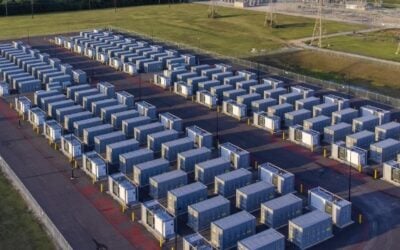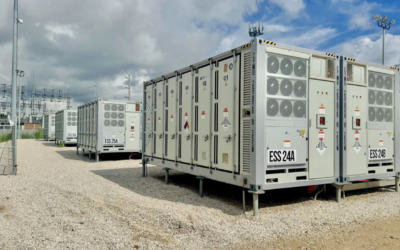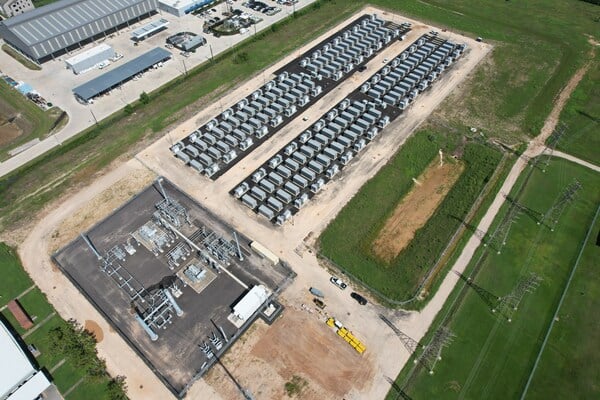
Developer Jupiter Power has begun operating a battery storage project in Houston, which CEO Andy Bowman claimed is “the first of its scale” in the Texas, US city.
Jupiter Power said earlier this week (19 August) that its 200MW/400MWh Callisto I Energy Center lithium-ion (Li-ion) battery energy storage system (BESS) has gone into commercial operation. The BESS dispatches stored energy into the Electricity Reliability Council of Texas (ERCOT) market.
It is built around ten miles from the busy Houston Ship Channel at the city’s port, on the site of H.O. Clarke, a now-closed fossil fuel plant owned by Houston Lighting & Power (HL&P). The Greater Houston monopoly utility also no longer exists, having been dissolved and split into separate entities as the Texas energy market was deregulated.
As such, Callisto I is in an important strategic location for helping manage energy supply and demand imbalances in the metropolitan region and could, in the future, be expanded to add another 400MW/800MWh of battery storage, Jupiter Power said.
Try Premium for just $1
- Full premium access for the first month at only $1
- Converts to an annual rate after 30 days unless cancelled
- Cancel anytime during the trial period
Premium Benefits
- Expert industry analysis and interviews
- Digital access to PV Tech Power journal
- Exclusive event discounts
Or get the full Premium subscription right away
Or continue reading this article for free
In December 2023, the company closed a US$65.2 million financing agreement with First Citizens Bank’s Energy Finance business towards the project’s construction.
That followed up collaboration between the two the previous summer, for two Jupiter Power ERCOT projects totalling 160MW/320MWh, in which First Citizens acted as Lead Arranger for a US$70.4 million loan financing.
At the time, Jupiter Power CEO Bowman said Callisto I “answers the call from the Texas Legislature to build more dispatchable power in ERCOT and near major load centres where consumers need it the most.”
It is the Blackrock-owned developer’s ninth ERCOT BESS project to date, and the first outside of West Texas. As with the other assets in Jupiter Power’s 1,375MWh ERCOT fleet, it will play into the ERCOT wholesale market to earn revenues for its role in helping balance the grid and manage demand.
ERCOT has around 5GW of battery storage connected to it, and that installed base continues to go up rapidly, with the US national Energy Information Administration (EIA) recently publishing data forecasting 6.4GW of new additions during 2024.
Senator Schwertner: ‘Essential that Texas has a diversified energy portfolio’
“Callisto I is the first energy storage project at this scale in the City of Houston and will help meet Houston’s growing power needs while also increasing resiliency from extreme weather events,” Bowman said this week.
It comes as Texas and much of the US Southwest face some of the hottest periods of the year, which means peaking electricity demand and market volatility.
In an interview for Energy-Storage.news Premium in late July, market intelligence firm Modo Energy’s ERCOT market lead Brandt Vermillion noted that “pretty extreme” weather last summer contributed to high energy storage revenues in the grid operator’s service area, which averaged around US$200,000/MW for 2023. Meanwhile, volatility in the market is likely to increase, with revenues becoming “more concentrated into a small number of days.”
“That means an increase in volatility where prices are either going through the roof or batteries aren’t making much money at all,” Vermillion said.
Jane Stricker, VP of Greater Houston Partnership, the city’s biggest chamber of commerce, and executive director of its Houston Energy Transition Initiative (HETI), noted that as Houston’s first large-scale transmission-connected BESS, Callisto I “will help address peak power demand and is another great example of our region’s leadership in scaling and deploying impactful solutions for an all the above energy future.”
State senator Charles Schwertner offered a similar sentiment, adding that “it is essential that Texas has a diversified generation portfolio.”
“Batteries play an important role within that portfolio to help address demands in times of need,” said Schwertner, who is also chairman of the Senate Committee of Business and Commerce.