
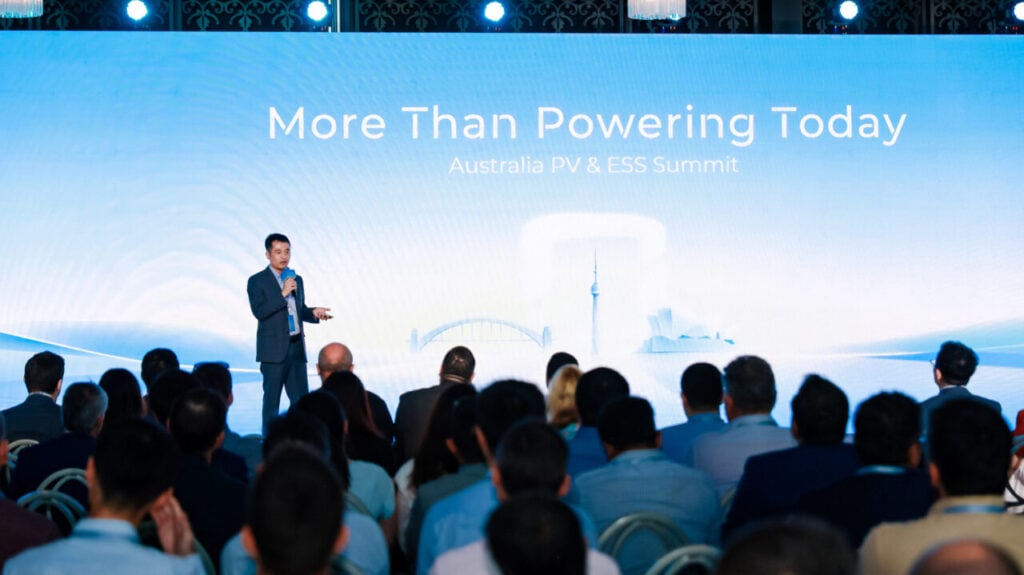
Sungrow has unveiled its latest innovations, PowerTitan 3.0 with AC block design and a hybrid solution, at its PV & ESS summit in Sydney, the event attracting over 300 partners and industry experts to explore emerging technologies and market trends shaping Australia’s energy transition.
With the country’s utility-scale renewable energy sector expanding rapidly, driven by federal CIS incentives, state targets and strong investor confidence, developers are increasingly prioritising integrated, grid-supportive projects aligned with stricter technical standards and long-term value. However, the sector still faces challenges including system strength shortfalls, voltage instability, complex grid connection processes and lengthy approval timelines, alongside rising requirements for grid-forming capability and advanced modelling.
The PowerTitan 3.0 is a next-generation utility-scale energy storage solution designed to address weak-grid conditions, advanced grid-forming requirements and the operational realities of Australia’s evolving energy landscape. Among product highlights are high-density architecture, a compact, scalable design, high efficiency and reliability, rapid deployment and durability and environmental readiness.
At the summit, Sungrow also introduced its hybrid solution, featuring the 1+X modular inverter series with DC coupling and AC coupling solution showcase, the company’s DC-coupling technology solution outperforming traditional designs in cost, functionality and performance. Key advantages include single-platform design, flexible, high-performance operation and cost and efficiency optimization.
Sungrow Australia technical expert Dr. Dan Xiao highlighted the essential role of GFM in supporting renewables-rich grids and meeting evolving Australian standards, with the company’s expertise encompassing voltage/frequency support, oscillation damping, GW-level black start and system strength enhancement. As renewable penetration continues to accelerate, he pointed out, grid-forming (GFM) technology is becoming increasingly critical to ensuring stable and resilient power systems.
The summit also featured a panel discussion, with industry experts sharing insights on energy transition pathways and real-world project experiences and saw Sungrow launch an Energy Storage Safety White Paper with TÜV Rheinland.
APAC VP Joe Zhou concluded: ”In Australia, Sungrow has built a strong foundation over the past 13 years, expanding from early market entry to delivering large-scale utility and energy storage projects across the country. Key projects such as the Cunderdin DC-coupled project and Templers BESS are in full operation and the Pelican Point BESS is currently under construction, demonstrating our capability to deliver at scale. Meanwhile, our pipeline continues to grow, including multiple projects expected to reach financial close in 2026 and landmark developments such as the Halys BESS, with a planned capacity exceeding 3GWh.”