
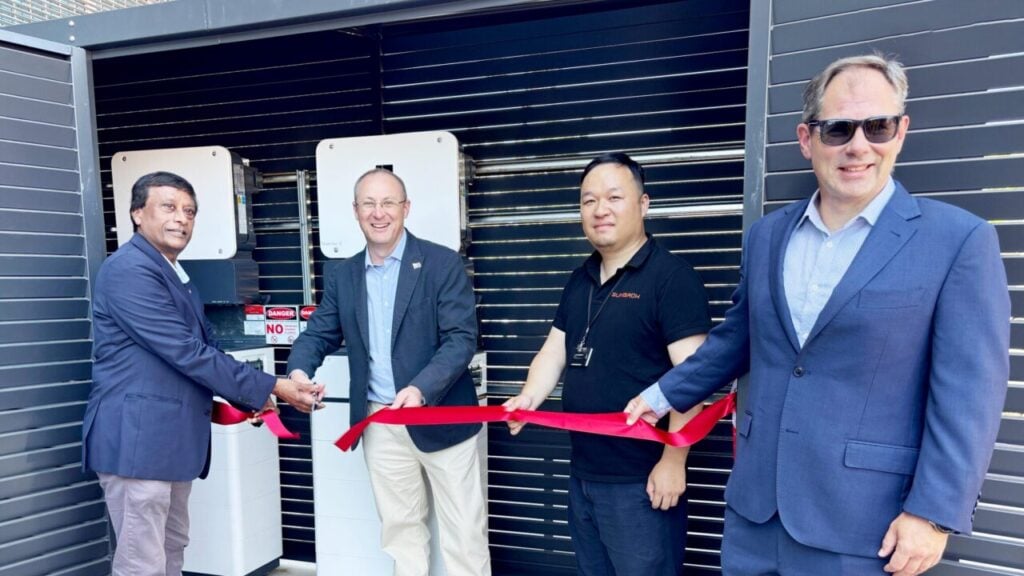
Sungrow has announced the successful delivery of a hybrid battery energy storage solution in collaboration with the University of New South Wales (UNSW) and Dubbo Regional Council, supporting advanced research into Energy Management Systems (EMS) and Virtual Power Plant (VPP) technologies.
The project provides a dedicated product and system platform for the UNSW Energy Team to test, validate and industrialise next-generation EMS and VPP algorithms. Integrated with energy assets at the Dubbo Regional Council Building, the system also contributes to the Council’s broader sustainability, energy efficiency and resilience objectives.
Sungrow was selected as the exclusive equipment supplier, UNSW acted as the engineering lead for the project, with Dubbo Regional Council as the system owner. The project was funded through TRaCE (Trailblazer for Recycling and Clean Energy), an initiative under the Australian Department of Education designed to accelerate the translation of university research into real-world applications. The project commenced in Q1 2025 and has now been successfully completed.
System Composition: The solution consists of two Sungrow SH15T/SBH300 hybrid energy storage systems coordinated through a Logger1000.
Integration Method: The system is AC-coupled to the building’s existing solar PV installation, enabling seamless integration without disrupting the operation of the existing solar array.
Control and Coordination: UNSW’s Energy Management System (EMS) controls the entire setup via a single logger, while Sungrow’s battery systems operate in a coordinated manner to ensure stable, efficient and reliable performance.
Advanced Functions: The platform supports advanced capabilities such as load monitoring, demand-side management and predictive energy optimization based on weather and occupancy data.
This project represents a significant milestone in bridging academic research with practical energy solutions for Australian communities. From UNSW, Scientia Professor Deo Prasad AO served as project leader, with Associate Professors Huadong Mo and Lan Ding leading the technical development of the TRaCE Battery system.
By integrating Sungrow’s hybrid battery systems with UNSW’s EMS, the solution enables both behind-the-meter (BTM) and front-of-the-meter (FTM) functionality. This delivers operational value to Dubbo Regional Council by optimising energy use and reducing costs, while providing UNSW with a live, real-world “living lab” to validate and refine its research outcomes using real-time data.
Dubbo Regional Council Mayor Josh Black commented: “The system will allow us to save money directly for our community. Financial sustainability is one of the areas we are very focused on at the moment, and a real challenge for Councils right now, and this project will allow us to reduce our operating costs, which in turn reduces the costs for our community.”
Project leader Prasad added: “By combining Sungrow’s expertise with UNSW, the commitment of Dubbo Regional Council and the support of TRaCE, we are developing a solution that not only enhances energy efficiency today, but also paves the way for scalable, sustainable energy management in buildings across Australia.”
The successful delivery of the project was underpinned by close collaboration with experienced local partners. Diverse Electrical, Sungrow’s long-term installation partner in the Dubbo region, delivered high-quality installation and commissioning services, working closely with UNSW and Council stakeholders throughout the project, SolarJuice also supporting the deployment through local product distribution, ensuring timely access to equipment and logistical support.
Sungrow and UNSW will continue to strengthen their collaboration on hybrid battery systems and energy management research. Future enhancements to the system are expected to include electric vehicle (EV) integration, National Electricity Market (NEM) trading capabilities and backup power functionality, utilising Sungrow hardware and managed by UNSW’s EMS.
Beyond this installation, Sungrow’s Commercial & Industrial teams and UNSW are also progressing additional projects under the TRaCE initiative, further supporting the transition of Australian energy research into scalable, real-world solutions.