
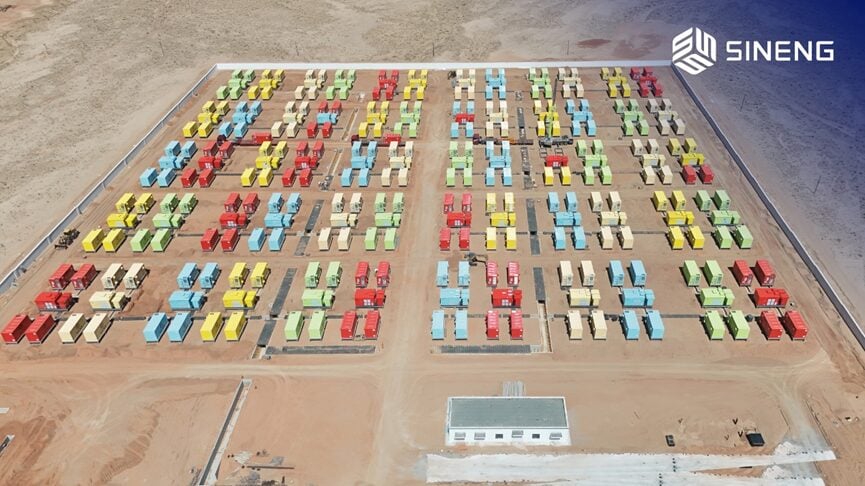
A landmark 300MW/1,200MWh standalone energy storage project powered by Sineng Electric is now in commercial operation in northwest China, marking a significant advancement in facilitating high levels of renewable energy integration while strengthening grid stability and underscoring the strategic role of large-scale energy storage in modern power systems.
Located in Zhangye City, an area rich in wind and solar resources, the project directly addresses structural challenges associated with high renewable penetration, including intermittency, grid congestion and limited transmission capacity. Persistent imbalances between daytime photovoltaic generation surplus and evening peak demand have historically led to renewable energy curtailment, with the deployment of utility-scale energy storage providing a critical pathway to mitigate these constraints by enabling temporal energy shifting and enhancing grid flexibility.
The project is equipped with Sineng’s 1,250 kW central PCS, designed to deliver high-efficiency energy conversion and superior system adaptability. With a peak efficiency of 99%, the PCS ensures optimized performance across a wide operating voltage range, while minimizing conversion losses. It reduces the number of parallel battery clusters by 50%, effectively increasing system charge and discharge capacity by 0.75% and improving overall lifecycle energy utilization.
Engineered for deployment in harsh environments, the PCS is equipped with an IP65 protection rating to withstand sand and dust conditions in the Gobi Desert. In addition, the solution offers millisecond-level dynamic response capability, enabling rapid and precise support for grid ancillary services, including frequency regulation and power balancing.
As a four-hour long-duration energy storage system, the project can store up to 1.2 million kWh of renewable electricity per charge-discharge cycle. On an annual basis, it is expected to reduce curtailed wind and solar generation by more than 79 million kWh, thereby significantly enhancing renewable energy utilization and grid absorption capacity in Gansu Province.
Following commissioning, the project will play a critical role in peak shaving, load shifting, frequency regulation and renewable output smoothing, contributing to improved grid reliability and operational efficiency.
