
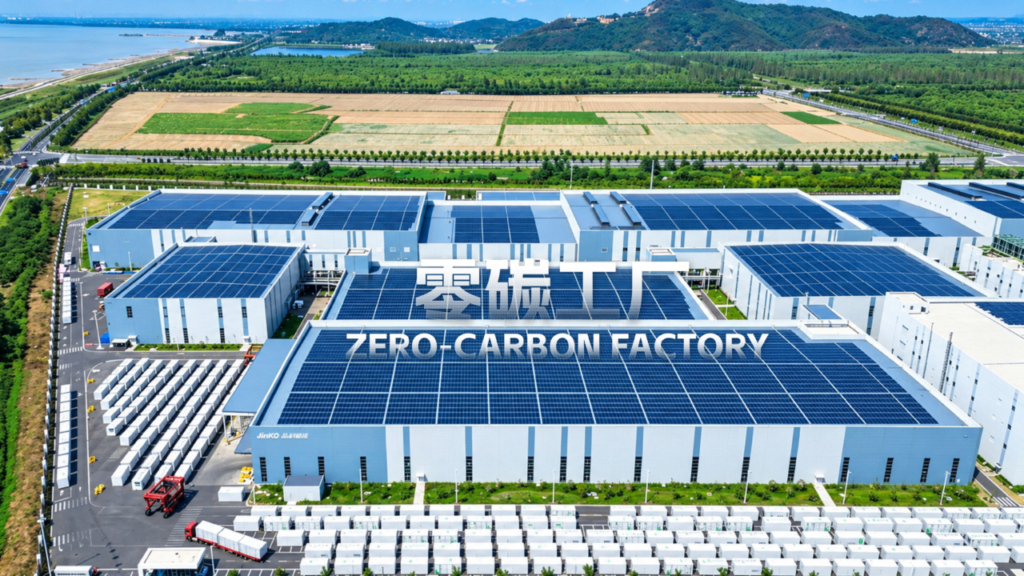
Jinko ESS has announced that its Haining factory in Zhejiang has successfully passed the zero-carbon verification carried out by TÜV Rheinland, receiving a Type I Three-Star rating. Conducted in accordance with T/CECA-G 0171-2025, the verification comprehensively assessed the factory across zero-carbon management, infrastructure, energy and resource utilization, intelligent management, greenhouse gas reduction and carbon offsetting, showing that it achieved a 100% renewable electricity consumption ratio during the reporting period, marking further progress in Jinko ESS’s green manufacturing and low-carbon operations.
To meet the requirements for zero-carbon factory development, Jinko ESS has established a zero-carbon management system covering strategic planning, organizational governance, target management and continuous improvement. The company has also established a climate governance structure led by its Sustainability Management Committee and supported by cross-functional teams, together with short-, medium- and long-term zero-carbon plans and 17 zero-carbon measures. In response to the requirements for intelligent and digital approaches to energy saving and emissions reduction, the factory leverages an Energy Management System (EMS) and a carbon management platform to digitally collect, dynamically monitor and analyze energy consumption and greenhouse gas emissions data, supporting energy optimization, carbon accounting and emissions reduction management.
For energy decarbonization, the company has developed a 12 MW rooftop solar power plant across the factory site, covering approximately 80,000 square meters, or 66.44% of the total rooftop area of the factory’s structures. In 2025, renewable electricity, including solar power, accounted for 18.97% of the factory’s total electricity consumption, while renewable energy accounted for 10.13% of total energy consumption, exceeding the 10% threshold specified by the standard. The factory further increased its use of renewable electricity through green power trading and green certificates, achieving 100% renewable electricity consumption during the reporting period. Meanwhile, the factory has continued to implement energy-saving measures, including waste heat recovery and cooling tower-based cooling alternatives, saving 466 tonnes of steam and 92,691 kWh of cooling electricity in 2025, while achieving 100% adoption of energy-efficient lighting equipment.
In advancing resource efficiency and supply-chain collaboration, Jinko ESS continues to promote the use of recycled and reusable packaging materials, green procurement and low-carbon supplier management. In 2025, it reduced the use of 7,488 cartons and 2,496 wooden pallets through packaging optimization and reuse, while encouraging major suppliers to advance carbon accounting, emissions reduction and green manufacturing. For the remaining greenhouse gas emissions after its own reduction efforts, the factory further implemented carbon offsetting. In 2025, its Scope 1 and Scope 2 greenhouse gas emissions totaled 26,133.63 tCO2e, with 13,068 tCO2e offset, equivalent to 50% of the total emissions. The Type I Three-Star rating demonstrates the company’s systematic low-carbon practices spanning energy transition, energy efficiency, digital carbon management, resource circularity and supply-chain collaboration.
