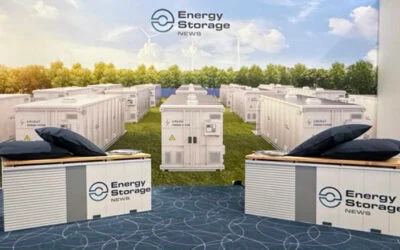
Independent power producer (IPP) ACME Solar has commissioned just over 480MWh of battery storage in Rajasthan, India, following the recent signing of several storage-backed renewable energy deals.
On 13 March, the company, which has its corporate headquarters in Haryana, North India, announced the commissioning of 143MW/481.48MWh of battery energy storage systems (BESS) in a letter to the Bombay Stock Exchange (BSE) and National Stock Exchange of India (NSE).
ACME Solar said the undisclosed number of systems, deployed by various special purpose vehicle (SPV) project subsidiaries, form part of a 585MW/2,011.24MWh buildout of battery storage by the SPVs.
They mark the first BESS projects for the IPP, to go alongside its 2,966MW of operational contracted solar PV and wind projects, while its total portfolio, including pipeline Firm Dispatchable Renewable Energy (FDRE) and hybrid assets, is just over 8GW.
Try Premium for just $1
- Full premium access for the first month at only $1
- Converts to an annual rate after 30 days unless cancelled
- Cancel anytime during the trial period
Premium Benefits
- Expert industry analysis and interviews
- Digital access to PV Tech Power journal
- Exclusive event discounts
Or get the full Premium subscription right away
Or continue reading this article for free
The Rajasthan BESS projects are connected to India’s national Inter-State Transmission System (ISTS). Although ACME Solar plans to integrate them with FDRE projects in the future to run with those projects’ 25-year power purchase agreements (PPAs), their initial market operation will be merchant arbitrage, trading energy by charging during off-peak times and discharging during peak times.
The company, which executes engineering, procurement and construction (EPC) and operations and maintenance (O&M) through in-house teams, said its portfolio requires a total of 17GWh of battery storage additions.
In July 2025, ACME Solar signed 3.1GWh of BESS supply deals with Chinese companies Trina Storage and Narada Power for projects to be commissioned across various Indian states over the next 18 months.
ACME Solar secures ‘complex’ FDRE contracts
So far this year, ACME Solar has announced nearly a gigawatt of FDRE and peak power supply deals with national and state government-run entities.
Firm Dispatchable Renewable Energy is an approach whereby variable renewable energy (VRE) sources are combined with energy storage technologies, including BESS and pumped hydro energy storage (PHES), to create continuous supply of clean energy.
First introduced in 2023 by the Ministry of Power’s Solar Energy Corporation of India (SECI), FDRE tenders were described by climate think tank Ember as representing “the most advanced stage in India’s renewable energy procurement evolution, requiring developers to match hourly demand profiles with up to 25% relaxation annually.”
Within that, there are various types of FDRE contract structures, including those that require 4-hour blocks of energy to be delivered at specified times, such as evening peaks, and others that require full round-the-clock (RTC) delivery.
In late January, ACME Solar subsidiary ACME Urja One Private Limited signed a 25-year PPA with government power company NHPC for an ISTS-connected 250MW FDRE project.
The IPP said the PPA included a 40% minimum annual Capacity Utilisation Factor (CUF) and an obligation to meet peak power requirements for four hours per day on a monthly basis. The project’s expected CUF is over 60%.
The location of the project was not disclosed in ACME Solar’s announcement to the stock exchanges, but the company said ISTS substation connection approvals had been granted and 40% of the land required had been secured by that time. ACME Solar estimated the project’s capex requirement at about INR37 billion (US$400 million).
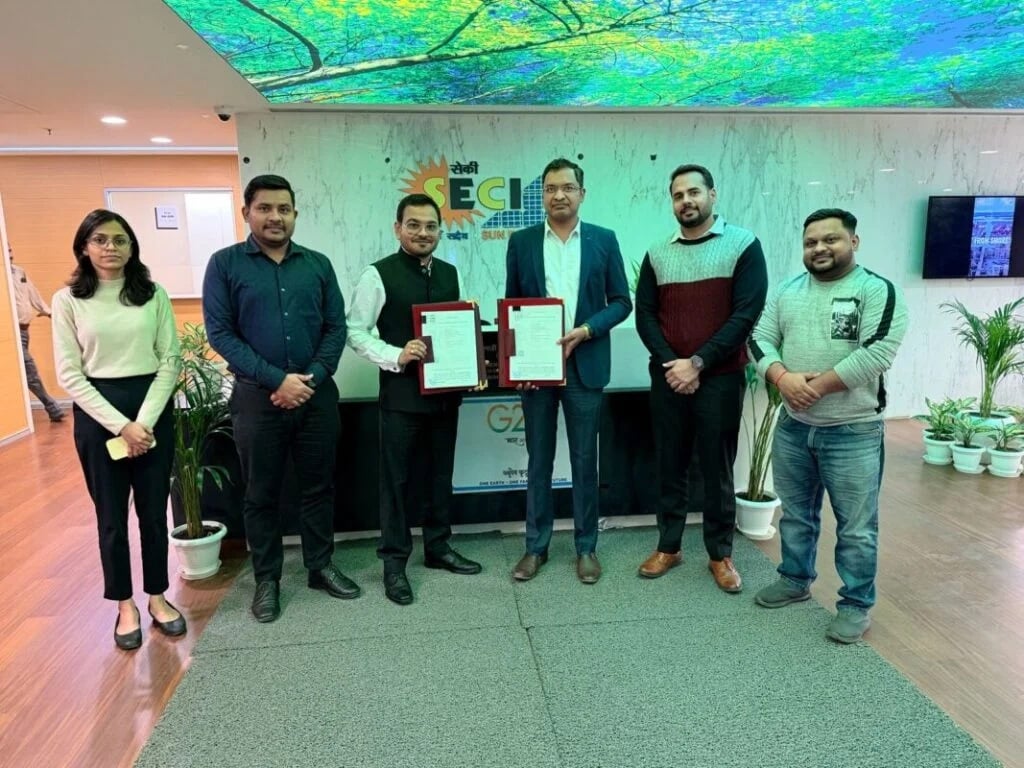
In early February, the company announced the signing of a 301MW/1,204MWh peak supply FDRE contract with SECI, following success in a reverse auction.
Again, while project details were not disclosed in a stock exchange letter, ACME Solar said the contract requires the supply of 4MWh per megawatt of contracted capacity for any 4-hour period of each day during non-solar generation hours, using BESS technology. ACME Solar must also guarantee availability of 70% and 85% on a monthly basis.
Then, on 12 March, a day before the BESS projects’ commissioning announcement, ACME Solar said another subsidiary, ACME Greentech Seventh Private Limited, had signed two PPAs with SJVN, a hydroelectric power generation company part-owned by the Indian government (59.92%) and the state government of Himachal Pradesh (26.85%).
The 25-year PPAs, signed 2 March 2026, cover a total 450MW/1,800MWh capacity from ISTS-connected projects in Rajasthan.
The agreements were signed following an SJVN solicitation under Tariff-Based Competitive Bidding (TBCD) frameworks. ACME Greentech Seventh Private Limited must supply peak power for four hours during non-solar generation hours and guarantee 90% availability on a monthly and annual basis.
In a January 2026 Guest Blog for Energy-Storage.news, Debmalya Sen, president of the India Energy Storage Alliance (IESA), noted that during 2025, 11 projects totalling 5.5GWh of BESS and 4.3GW of FDRE capacity received tariff approvals.
Although Sen wrote that FDRE activity was relatively “muted” in 2025, he noted that a round-the-clock FDRE model saw tariffs awarded by SJVN at INR4.82-4.91/kWh and by SECI at INR 5.06/kWh. Meanwhile, a peak-specific FDRE tender held by SJVN awarded a tariff of INR6.74/kWh. However, in an August 2025 blog for the site, Charith Konda of the Institute for Energy Economics and Financial Analysis (IEEFA) said that the complex nature of hybrid renewables-plus-storage project contracts, including FDRE, was causing delays in developers and IPPs securing PPAs.