The Ministry of Energy in Hungary will provide grants for the deployment of energy storage projects, with some 1GWh targeted by 2025.
From June, system operators and distribution companies will be able to apply for subsidies to build energy storage facilities by the summer of 2025 at the latest, the Ministry said. The €155 million (US$171 million) tender amount can be applied for in June 2023 and the winners will be chosen during the summer.
The statement said that the Ministry is aiming for 146MWh of energy storage to be built by May 2025.
However, the statement added that a separate request for proposals was published in March, open to all types of companies. The document of that request indicates a much larger target of 885MWh by May 2025.
Try Premium for just $1
- Full premium access for the first month at only $1
- Converts to an annual rate after 30 days unless cancelled
- Cancel anytime during the trial period
Premium Benefits
- Expert industry analysis and interviews
- Digital access to PV Tech Power journal
- Exclusive event discounts
Or get the full Premium subscription right away
Or continue reading this article for free
The two targets appear to be separate figures, together totaling around 1GWh (1,031MWh to be precise).
That document (available here, in Hungarian) said that a 1MW/2MWh storage unit in the regulation capacity market would be expected to provide 4,000MW of negative aFRR (automatic frequency restoration reserve) and 4,000 MW of positive aFRR regulation capacity per year.
For the same size system in the ‘regulation energy market’, the discharge of 1.6MWh per day would be expected.
“The developments promote the implementation of a low-carbon energy economy, the green and digital transition, and the establishment of Hungary’s energy sovereignty. By installing battery energy storage, the natural power fluctuations of weather-dependent renewables can be partially compensated. The program can therefore make a meaningful contribution to the increased utilisation of clean energy carriers,” the statement from the Ministry said.
A translation of the document indicates part of the funding will come from the Recovery and Resilience Plan, the EU-wide scheme aiming to mitigate the negative economic effects of the Covid-19 pandemic.
In April this year, Invinity Energy Systems secured a 1.5MWh order for its vanadium redox flow battery (VRFB) from STS Group, for an installation at solar-plus-storage project in central Hungary.
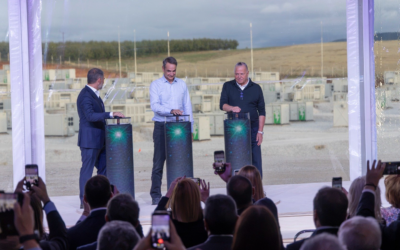
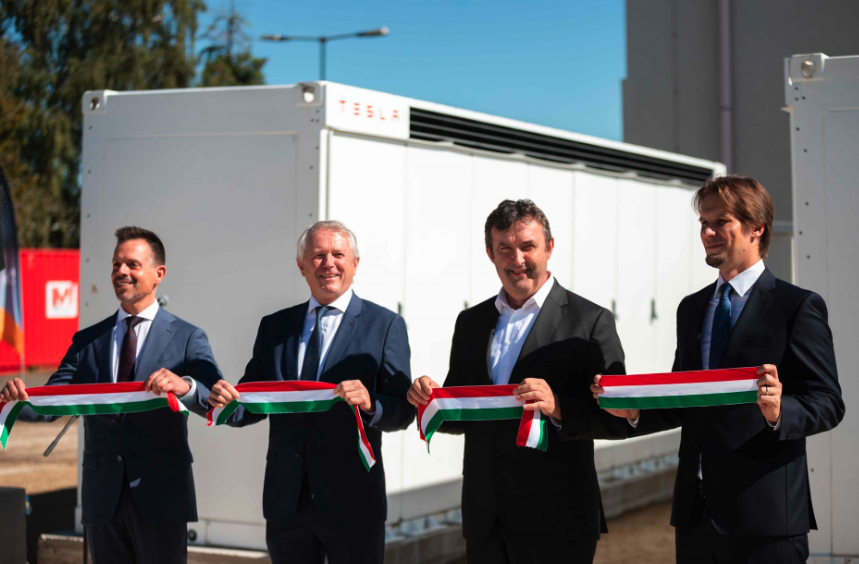
In September last year, the first project in Hungary to use Tesla Megapacks began installation, a 7.68MWh system from MET Group (pictured above).