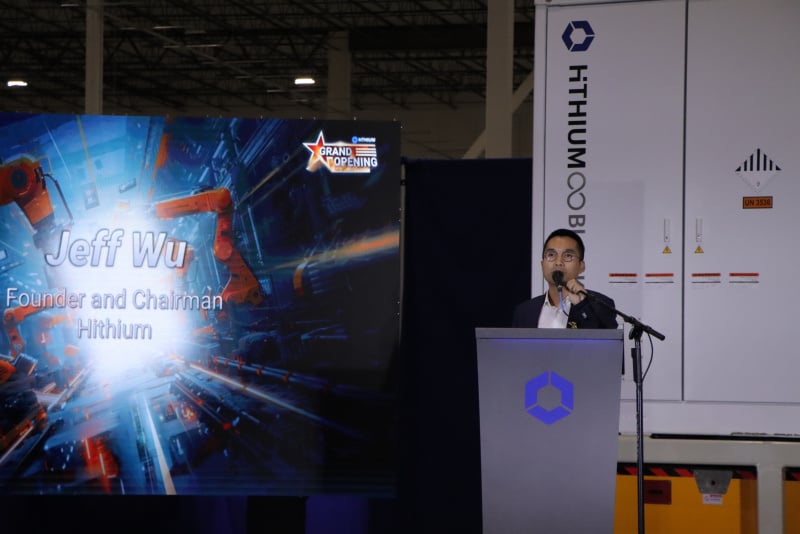
Hithium has opened a 10GWh battery module and system factory in Texas, while LG Energy Solution has begun mass-producing cells in Michigan.
Hithium, headquartered in Xiamen, China, will produce modules and complete battery energy storage systems (BESS) with a combined annual production capacity of 10GWh at its 484,441-square-foot facility in Mesquite, Texas.
Mequite’s mayor, Daniel Alemán Jr., welcomed the company’s investment in the local area and Hithium’s collaboration with “40 school districts and Dallas College, ensuring our workforce leads the energy transition.”
The company announced its factory in July last year, noting that it would invest an initial US$100 million. In its announcement of the inauguration on 29 May, Hithium put that investment figure closer to US$200 million.
Try Premium for just $1
- Full premium access for the first month at only $1
- Converts to an annual rate after 30 days unless cancelled
- Cancel anytime during the trial period
Premium Benefits
- Expert industry analysis and interviews
- Digital access to PV Tech Power journal
- Exclusive event discounts
Or get the full Premium subscription right away
Or continue reading this article for free
Hithium factory opens amid policy uncertainty for US BESS sector
When the factory’s construction was revealed less than a year ago, the US was in the thick of a wave of investment in clean energy manufacturing and deployment, including batteries and energy storage systems.
The Biden-Harris administration introduced 10% bonuses to investment tax credit (ITC) incentives for BESS projects that used a minimum portion of US-made content and production tax credit (PTC) incentives for domestic manufacturing of battery modules and cells.
At the same time, tariffs due on battery products imported from China were set to rise from 7% to 26% in 2026, designed to encourage further reliance on domestically made products or products imported from other countries.
Of course, with the start of current president Donald Trump’s second term in January this year, the fate and future of both the ‘carrot’ of incentives and ‘stick’ of tariffs is undetermined.
Tariffs on Chinese goods stand at 30% during a 90-day ‘pause’ in a US-China trade dispute, which itself has caused a slowdown in investment in new battery manufacturing, particularly for smaller players, according to Anjali Joshi, an analyst with Clean Energy Associates (CEA) who wrote about it in a Guest Blog for this site in April.
Further, the budget reconciliation bill passed by the House of Representatives on 22 May and currently in the Senate for deliberation, could see the tax credits rapidly eliminated. The industry’s hope is that Senators will amend and pass a more moderate version of the bill. John Curtis, a Republican Party senator in Utah, recently visited Fluence’s BESS module factory in his state and praised the positive impact of energy tax credits on his jurisdiction’s economy and communities.
LG ES begins LFP mass production in Michigan
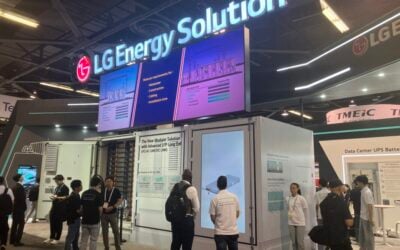
Meanwhile, South Korean battery manufacturer LG Energy Solution said on 1 June that it has begun mass production of lithium iron phosphate (LFP) cells from production lines in Holland, Michigan.
LG Energy Solution (LG ES) had originally planned to open a dedicated factory in Arizona for LFP cells destined for stationary storage applications.
Instead, it opted to retool production lines for electric vehicle (EV) batteries at its existing plants in Michigan in a “strategic rebalancing” of production capacity, investing around US$1.4 billion in the process.
The process of retooling and the strategic thinking behind it were discussed by Jaehong Park, CEO of LG ES’s US system integrator subsidiary LG ES Vertech, in an interview with ESN Premium a few months ago.
Park said three energy storage system (ESS) cell production lines are being established at the Holland complex, each with an annual production capacity of 5.5GWh.
The CEO also said that whatever policy changes come, growing demand for electricity in the US from sources including AI data centres was a fundamental driver for investment in battery storage that will remain.