Romania has emerged as one of the busiest grid-scale BESS markets in Europe in the past 6-12 months. Huge financed projects, portfolios and partnerships have been announced recently, by IPPs Enery, Mass Group, Electrica, Eurowind Energy and PPC Group.
Large-scale battery energy storage system (BESS) deployments in Romania are benefiting from various country-specific drivers, alongside the global fall in BESS prices and increasing familiarity among investors with the technology.
The country’s active solar PV installations have led to a ‘duck curve’, creating a strong business case for solar load shifting.
There are also numerous subsidies available for energy storage, including for renewable co-located projects, and it was recently reported that ten standalone BESS are likely to benefit from €150 million (US$174 million) in funding from the European Union’s Modernisation Fund, via the Ministry of Energy.
Try Premium for just $1
- Full premium access for the first month at only $1
- Converts to an annual rate after 30 days unless cancelled
- Cancel anytime during the trial period
Premium Benefits
- Expert industry analysis and interviews
- Digital access to PV Tech Power journal
- Exclusive event discounts
Or get the full Premium subscription right away
Or continue reading this article for free
On the regulatory side, renewable projects with storage can benefit from an accelerated grid connection date. And the government of Romania recently ended the ‘double taxation’ of energy storage on the grid, by exempting it from transmission tariffs and green certificates. Those in the German market are currently grappling with a similar issue.
Project financings in Romania are subsequently now coming thick and fast.
IPP Enery finances solar and BESS in Romania
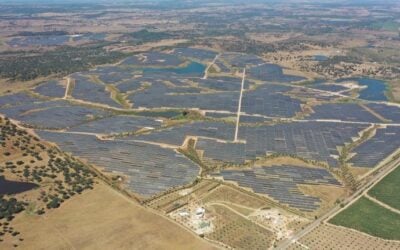
Independent power producer (IPP) Enery has closed a €460 million syndicated green project financing for its 761MWp solar, 1GWh-plus BESS Ogrezeni project in Giurgi County, Romania.
Ogrezeni will be among the largest hybrid projects in Europe once operational, Vienna-headquartered Enery said.
The lenders that participated in the financing are UniCredit, Intesa Sanpaolo Group, ING Bank, Banca Transilvania, the National Bank of Greece (Cyprus), Exim Banca Românească and Alpha Bank. It includes term loan facilities, a revolving facility, a VAT facility and ancillary facilities and an accordion feature of up to €79 million, allowing for a potential further increase of the BESS capacity.
The financing was structured under Enery’s newly-adopted Sustainable Financing Framework, developed as a standardised approach aligned with various green and sustainability financing frameworks and principles. It is the first of possibly many under the framework, Enery said.
Sebastian Staicu, head of financing at Enery, commented: “This transaction reflects strong lender appetite for well-structured hybrid renewable projects and strong sponsors. The oversubscription and flexible financing package, including the accordion feature, provide a solid capital structure and positions the project for long-term optimisation and value creation.”
Eurowind Energy building 116MWh BESS
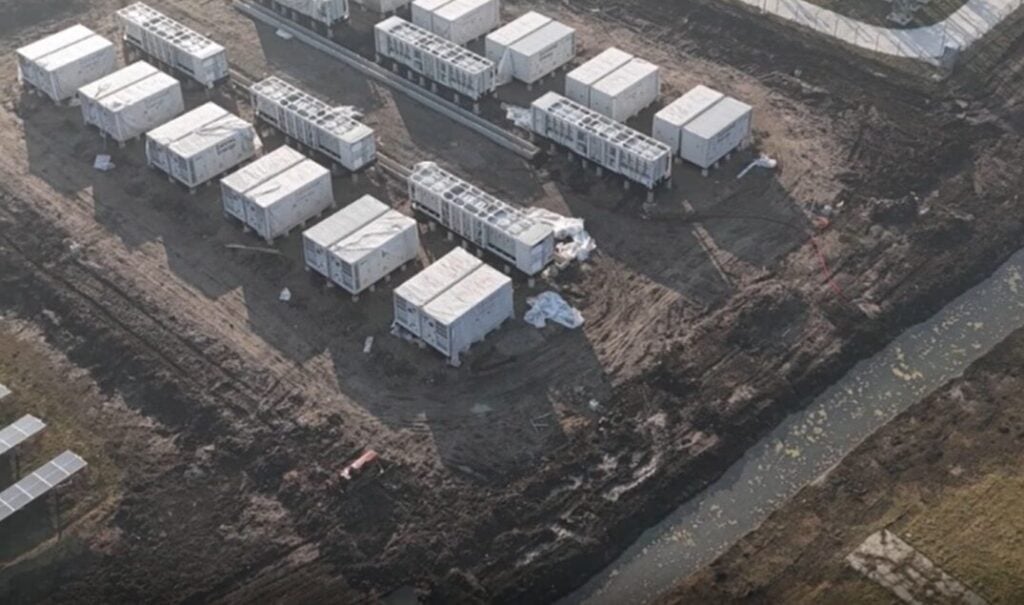
IPP Eurowind Energy has started construction on a BESS being added to its Teiuș solar park in Romania. The lithium iron phosphate (LFP) BESS containers have arrived on site (pictured above), with installation and integration now underway.
The project benefits from a €21 million grant under Romania’s portion of the EU-wide National Recovery and Resilience Plan (NRRP) funding programme.
“At Teiuș, we are building an investment that delivers system value, flexibility and stability for the grid, at a time when integrating renewable energy increasingly depends on modern storage capacity,” said Adrian Dobre, Country Manager, Eurowind Energy Romania.
Eurowind has developed and invested in BESS projects we’ve reported on in Bulgaria, Denmark and the US.
Electrica and steel firm target 500MW renewables and storage
Power and utility firm Electrica has signed a memorandum of understanding (MoU) with steel plant operator Liberty Galati to deploy renewables and BESS of up to 500MW in capacity on land plots owned by the latter.
The proposed operating model aims to maximise self-consumption and power supply reliability, while optimising energy costs over the long term, Electrica said. The chosen structure allows for leveraging the strategic complementarities between the two entities.
Alexandru-Aurelian Chiriță, Electrica’s CEO, said: “Final partnership terms are to be defined following feasibility studies and will be implemented once all corporate approvals are secured.”
Electrica is already deploying BESS in Romania independently.
Metlen and PPC target 3GWh in Romania, Bulgaria and Italy
Engineering, procurement and construction (EPC) firm Metlen and Greek state-owned power firm PPC Group have partnered to develop up to 1.5GW/3GWh of BESS projects in Romania, Bulgaria and Italy.
The projects will utilise 2-hour, LFP-based BESS technology and combine the pair’s experience in development, construction and energy management, Metlen said.
The co-operation will be via a 50:50 joint venture (JV) entity, and 1GW of the portfolio is expected to be ‘implemented’ in the next 12 months.
PPC has an existing presence in all three countries while Metlen has more experience elsewhere in the world. Metlen has also developed projects as well as build them.
The co-operation appears to be focused more on renewable co-located systems.
PPC’s BESS activities have so far mainly been in its home market of Greece.
Mass Group to invest €1 billion in 2.5GW of storage in Romania, government claims
Jordan-based developer Mass Group Holding plans to invest €1 billion euros in 2.5GW of BESS capacity across central Romania, the Romania government said last month according to a Reuters report.
The statement did not say when construction would start. The company is currently building a 1.7GW gas power plant, which is replacing a coal plant in the Romanian town of Mintia.