
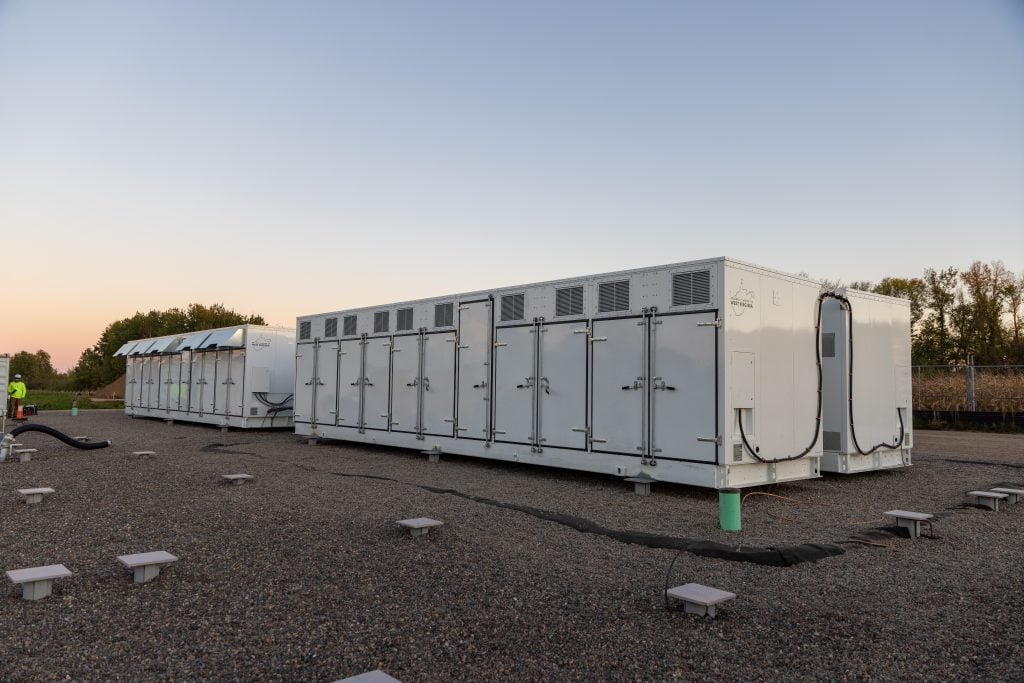
Recently, utility Xcel Energy announced it would install 30GWh of US startup Form Energy’s iron-air batteries at a data centre in Pine Island, Minnesota, owned by tech giant Google.
A representative for Form Energy told ESN Premium, that “For this project, Xcel Energy and Google were looking for a solution capable of storing energy for multiple days at a time in order to support reliable, around-the-clock power on a grid with growing renewable penetration and exposure to extreme weather events. Form Energy’s 100-hour battery system is designed specifically for that challenge.”
The 300MW/30GWh project is a significant milestone for all the players involved, as well as for the energy storage industry, particularly in advancing multi-day energy storage. Multi-day energy storage extends beyond the concept of long-duration energy storage (LDES) by offering storage capabilities that span several days of discharge at full rated power.
At the time of the announcement, Form’s co-founder and CEO, Mateo Jaramillo, noted the project as “the largest battery system by energy capacity ever announced globally.”
Try Premium for just $1
- Full premium access for the first month at only $1
- Converts to an annual rate after 30 days unless cancelled
- Cancel anytime during the trial period
Premium Benefits
- Expert industry analysis and interviews
- Digital access to PV Tech Power journal
- Exclusive event discounts
Or get the full Premium subscription right away
Or continue reading this article for free
This is not the first time Xcel and Form Energy have collaborated on a project in Minnesota. In 2023, Xcel received approval from Minnesota state regulators to develop a 1GWh project using Form’s BESS technology. The project will span five acres and be constructed alongside Sherco Solar, Xcel’s 710MW solar farm.
The company also has a pilot project with electricity supplier Great River Energy in Cambridge, Minnesota, which broke ground in 2024.
Form Energy’s representative said of this project, “In Q4 last year, we reached a pivotal milestone by shipping, installing, and operating our first commercial iron-air battery system to a pilot site in Minnesota, in partnership with Great River Energy. Under sub-zero winter conditions, essential iron-air battery functionality was successfully demonstrated.”
They added about the 100-hour battery, “In a fully fielded system, we validated more than 100 hours of continuous discharge at nameplate power, along with the core performance characteristics required for a reliable multi-day storage product.”
Round-trip efficiency
A potential concern for aqueous iron-air batteries, such as Form’s, is round-trip efficiency (RTE).
As market research company Energy Solution Intelligence noted in a January 2026 report, RTE for iron-air batteries is “approximately 40-50%, compared to 85-90% for lithium-ion. This means for every 10MWh you put in, you only get 4-5MWh back.”
This does raise the question of why Form’s technology would be chosen over other LDES technologies.
Dr Helen Fischer from engineering, procurement, and construction (EPC) firm Kiewitt, stated in a 2023 presentation at the RE+ renewable energy trade conference that there are six different factors affecting the viability of energy storage technologies:
- Technology and performance
- Equipment and materials
- Overall economics
- Geographic requirements
- Whether some or all elements are based on existing, common industry experience
- How readily they can get regulatory backing.
Fischer stated that in the realm of technology and performance, RTE is “the factor that matters when it comes to storage”.
Form Energy might also contend that even though their RTE falls in the 50%–60% range and they have relatively low energy density, their products can be produced cost-effectively using abundant raw materials, potentially outperforming in other metrics.
Further, as Energy Solution Intelligence noted of 100-hour storage, “It’s not about daily arbitrage. It’s about the Dunkelflaute (Dark Doldrums),” a German term for a weather phenomenon marked by cold, calm, and overcast days with minimal wind and sun, leading to a sharp decline in renewable energy production from wind and solar sources.
Still, questions remain about the technology’s capabilities. Jim McDowall, battery energy storage consultant, said on LinkedIn, “Round-trip efficiency shouldn’t be shrugged off as if it doesn’t matter. If a 100-hour system has an RTE of 40% (more like the real number, from what I’ve heard), it will take 250 hours to charge fully, so a complete cycle takes 350 hours, and only 25 cycles can be completed in a year. For a similar system with 70% RTE, the charge time is 143 hours, and 36 cycles can be completed in a year – a 44% increase in useful operation.”
McDowall continued, “Of course, LDES systems won’t be charged for hundreds of hours straight but will be charged for a few hours per day, and only when shorter-duration (and much more efficient) Li-ion resources have been fully dispatched in charge. With this type of operation, self-discharge also becomes a factor. Nickel-iron batteries have the same chemical reaction at the negative as iron-air, and they self-discharge like crazy. I would hope that Form has designed that issue out of their system – perhaps with something like slurry flow battery technology?”
Future data centre planning
When the companies made their announcement about Form’s batteries being used for the Google data centre, former US Secretary of Energy Jennifer Granholm wrote on LinkedIn, “this is how data centre siting should be done”.
Granholm was emphasising that Xcel said ratepayers would not be paying additional costs for this data centre, Google’s pledge to pay for all costs of new electricity and grid infrastructure updates, and the investment into Pine Island.
This sentiment seems to be shared by the current presidential administration, which recently announced its Ratepayer Protecting Pledge.
From the White House: “Amazon, Google, Meta, Microsoft, OpenAI, Oracle, and xAI signed the Ratepayer Protection Pledge, agreeing to build, bring, or buy new generation resources and cover the cost of all power delivery infrastructure upgrades required for their data centres, ensuring such expenses are not passed to American households.”
Notably, the commitment remains non-binding, with no enforcement provisions or accountability measures in place for participating companies. Many experts in the energy industry are viewing the commitment as an attempt to ease voter concerns of potential rising energy costs ahead of the upcoming US midterm elections.
Jenna Ruddock, at non-profit media and community venture Tech Policy Press, wrote, “The White House has limited influence over utilities regulation, which largely plays out at the state and local levels. Data centres are being built faster than new energy infrastructure can be brought online, pushing companies to make head-turning deals like Microsoft’s bid to reopen Three Mile Island. And tech isn’t the only big money donor industry at play, as fossil fuel giants, monopoly utilities and, increasingly, private equity firms like Blackstone look to shape this infrastructural build-out to line their own pockets.”
Form Energy’s representative said of how data centres are influencing the company’s decisions, “What we can say is that data centres have an especially strong need for high reliability and continuous power availability, while many hyperscalers are also seeking ways to meet those needs with clean, cost-effective energy. That combination makes multi-day energy storage an increasingly attractive solution.”
They continued, “We’re seeing growing interest both from hyperscalers directly and from utilities that are planning to serve new data centre load. Studies are also beginning to quantify the need for clean firm capacity for data centres. For example, a Duke University analysis published earlier this year estimated that data centres could face under certain grid conditions — a duration that very closely aligns with the kind of multi-day reliability support our batteries are designed to provide.”
Form suggests that a model is being developed to demonstrate how utilities and hyperscalers can collaborate to meet increasing demand for AI-enabled services while ensuring a clean, reliable, and affordable grid.
“Projects like this one also demonstrate how new large electricity loads can catalyse investment in clean energy and grid infrastructure. In this case, the agreement structure enables new clean energy resources and storage to be built while protecting existing ratepayers,” they said.
Continuing, “Xcel Energy has committed to ensuring that new large loads do not increase costs for existing customers and that service will remain reliable. Under the agreement, Google will pay all costs for its new service in line with its typical practices and Minnesota’s regulatory and legislative requirements for large loads.”
Google has recently helped fund multiple LDES projects. In Arizona, the company has a partnership with utility Salt River Project (SRP) to help accelerate the commercialisation of non-lithium LDES.
Earlier this month, LDES system manufacturer ESS Tech announced it would collaborate with SRP and Google for Project New Horizon, a 5MW/50MWh system using ESS’ iron flow Energy Base technology.
The Project New Horizon pilot was awarded through SRP’s competitive solicitation process for LDES technologies. Design is underway, with manufacturing expected to begin in 2026 and delivery targeted for December 2027.
Energy Base is designed to deliver 12- to 14-hour long-duration storage solutions for customers like data centers and large renewable energy operators. ESS Tech said it would be pivoting to this product line in 2025 when reporting its Q1 financials.
Energy Storage Summit USA 2026 will be held from 24-25 March 2026, in Dallas, TX. It features keynote speeches and panel discussions on topics like FEOC challenges, power demand forecasting, and managing the BESS supply chain. ESN Premium subscribers can get an exclusive discount on ticket prices. For complete information, visit the Energy Storage Summit USA website.