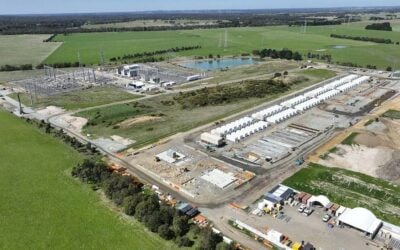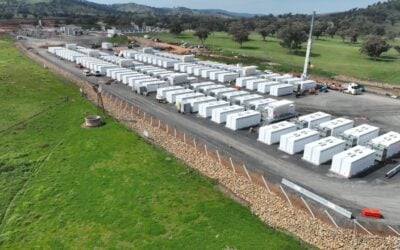
Blueleaf Energy and Universal Peak have closed financing for a 100MW/400MWh battery storage project, which was one of four winning bids in a Malaysian government tender.
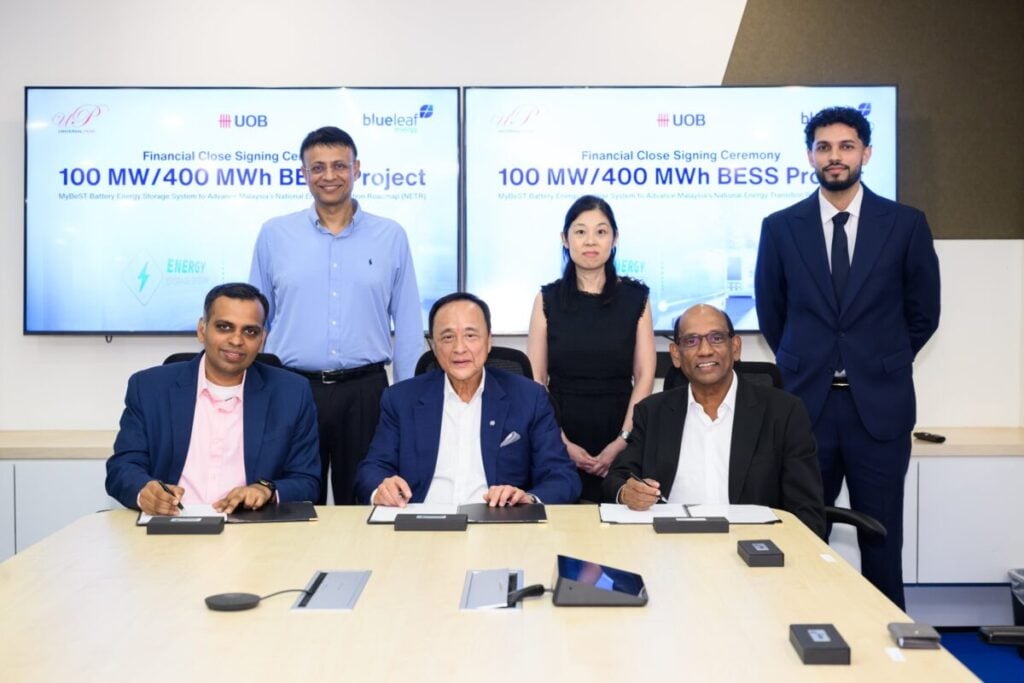
The joint venture (JV) partners announced the financial close of the utility-scale battery energy storage system (BESS) project at the beginning of this month (1 September), putting it on track for scheduled commissioning in mid-2027.
Financial terms of the transaction, which was closed with major Singaporean bank UOB, were not disclosed. The parties held a formal signing ceremony in Singapore.
The project was among a further three of equal size selected in the inaugural Malaysia Battery Energy Storage System (MyBeST) competitive solicitation, launched in November 2024 by the Southeast Asian country’s Energy Commission (Suruhanjaya Tenaga, ST).
Try Premium for just $1
- Full premium access for the first month at only $1
- Converts to an annual rate after 30 days unless cancelled
- Cancel anytime during the trial period
Premium Benefits
- Expert industry analysis and interviews
- Digital access to PV Tech Power journal
- Exclusive event discounts
Or get the full Premium subscription right away
Or continue reading this article for free
Shortlisted bidders for the total 400MW/1,600MWh of projects, to be deployed at strategic locations in Peninsular Malaysia, were announced in late 2025. MyBeST is aligned with Malaysia’s National Energy Transition Roadmap (NETRA), which targets 70% installed renewable energy capacity and net-zero emissions by 2050.
MyBeST contracts have been awarded under a build-own-operate (BOO) model.
Blueleaf Energy is a pan-Asian renewable energy development platform owned by a fund managed by Macquarie Asset Management, headquartered in Singapore. Universal Peak is a Malaysian company specialised in energy and power infrastructure engineering services.
The pair’s JV, BKHM BESS, signed battery energy storage system service agreement (BESSA) and connection agreement (CA) documents for their project with state-owned electricity company Tenaga Nasional Berhad (TNB) in June.
The BESSA establishes the principal commercial framework for TNB’s Single Buyer electricity supply and market settlements department as off-taker, governing capacity and related services in a similar way to a power purchase agreement (PPA). Required metrics include system availability, dispatch commitments and performance obligations.
Meanwhile, the CA defines the technical interface with the TNB grid system operator functions, covering interconnection compliance, protection systems, metering, SCADA integration and operational coordination with the TNB network.
Malaysia’s first-ever grid-scale BESS was only deployed in late 2025 in Sabah, one of two Malaysian states on the island of Borneo. The island has a much smaller grid and fewer dispatchable natural gas resources than Peninsular Malaysia, making the need for storage to stabilise the electricity network and ensure continuity of supply more acute.
In May, TNB inaugurated its first BESS project, holding a ceremony to mark the start of operation at the 100MW/400MWh Santong BESS. Equipped with grid-forming (GFM) inverters, the project aims to strengthen and increase the stability of electricity supply on the East Coast of Peninsular Malaysia.
In late July, the Malaysian government launched a solicitation for 2.5GW of solar PV co-located with 1.25GW of battery storage. The sixth round of the Ministry of Energy Transition and Water Transformation’s Large-scale Solar (LSS) programme seeks to deploy solar-plus-storage resources in the south of the Peninsula, which is experiencing high growth in demand for electricity.