Norwegian battery manufacturing startup FREYR Battery is looking to be involved in establishing gigawatt-scale production of lithium iron phosphate (LFP) cathodes.
The company has signed an agreement to pursue a joint venture (JV) with Aleees, a supplier of LFP cathodes with its current manufacturing facilities based in Taiwan.
The pair aim to establish the first giga-scale LFP cathode facility outside of mainland China, to be built somewhere in the Nordic region.
The plant would be up and running in 2024 with the initial capacity to produce 10,000 tonnes of LFP cathode material annually. FREYR is currently building its first 2GWh lithium-ion battery factory in the town of Mo i Rana, Norway, powered with hydro and wind.
Try Premium for just $1
- Full premium access for the first month at only $1
- Converts to an annual rate after 30 days unless cancelled
- Cancel anytime during the trial period
Premium Benefits
- Expert industry analysis and interviews
- Digital access to PV Tech Power journal
- Exclusive event discounts
Or get the full Premium subscription right away
Or continue reading this article for free
The LFP cathode plant’s output would be enough to supply that facility, FREYR said yesterday. Once established, the JV would be capable of ramping up output threefold to 30,000 tonnes per annum within a year, the company claimed.
NYSE-listed FREYR wants to build 43GWh of annual lithium-ion cell manufacturing capacity in total by 2025, then ramp that up to 83GWh by 2028.
Energy-Storage.news reported in December that the company had signed a five-year, 31GWh+ off-take deal to supply an undisclosed customer in the stationary energy storage system (ESS) sector with its mass-produced lithium battery cells.
The startup has in place a technology partnership with US-based advanced lithium-ion battery technology company 24M. 24M has developed a manufacturing platform called SemiSolid, which enables batteries to be made with thicker electrodes, creating higher energy density devices that are designed to be more robust and can be produced at lower cost than other lithium batteries.
Aleees is already a supplier of cathode materials to 24M, as well as to companies in Europe’s automotive sector.
“This agreement with Aleees, which calls for the construction of the first giga-scale LFP cathode plant outside mainland China, is another important step on our journey to localise and decarbonise battery cell production and their supply chains in the Nordic region,” FREYR CEO Tom Einar Jensen said.
“FREYR and Aleees intend to establish the plant as part of a broader localised supply chain strategy that will leverage the abundance of cost-advantaged, renewable energy in the Nordics and the growing availability of raw materials produced in the region. We will be examining a limited number of suitable locations in the Nordic region over the next months.”
LFP batteries are beginning to become more commonly used in stationary battery energy storage system (BESS) projects around the world. They offer less energy density and lower power than nickel manganese cobalt (NMC) and other cell types which have been more commonly used in the past, but can be produced at lower cost and may be slightly more difficult to put into thermal runaway through short circuits and physical abuse.
LFP is also starting to be used more commonly in automotive applications, particularly for shorter range, lower cost entry-level electric vehicles (EVs).
Aleees and FREYR want to create a supply chain in the Nordic region, with localised and decarbonised production, as well as transport of raw materials to the cell manufacturing facilities.
FREYR pointed out that it has other initiatives in place to support the production of LFP cathodes, in addition to the forthcoming JV.
Siting the LFP cathode facility in Norway rather than in Taiwan would lead to much lower carbon emissions impacts, equal to about 50,000 tonnes per year, according to findings by environmental impact consultancy Minviro, which FREYR Battery quoted in a press release.
In October, a strategic partnership was formed to develop an LFP battery factory in Serbia by EIT InnoEnergy, a European Union-supported investment vehicle, and ElevenEs, a startup spun out of an aluminium processing company called Al Pack Group.
That plant would be powered by renewable energy and built close to Serbia’s Jadar Valley, which is thought to be the largest lithium deposit in Europe. EIT InnoEnergy and ElevenEs are targeting annual production capacity of 300MWh by 2023, to be ramped up to 8GWh.
In related news, production of lithium battery cells has begun at Northvolt Ett, a gigafactory in Sweden opened by startup Northvolt, which is also targeting becoming a major player in Europe’s battery supply chain. Like FREYR, Northvolt will also supply the stationary battery storage sector as well as transport, with Northvolt notably in a partnership with energy storage system (ESS) industry leader Fluence.
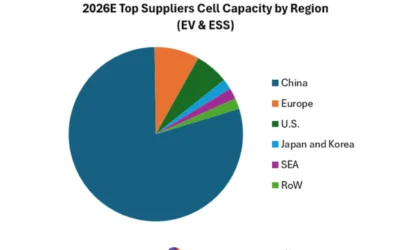
Europe is on course to become the world’s second biggest battery producing region, after China, by 2025, European Commission vice president Maroš Šefčovič said in March 2021 at a high-level ministerial meeting of the European Battery Alliance (EBA), formed to support the development of the continent’s industry.