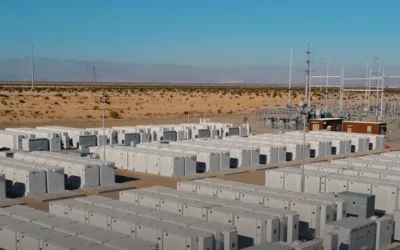
Fluence’s new Utah facility is part of a wider move by the company to regionalise its manufacturing closer to customer markets across the globe, the company has told Energy-Storage.news.
Peter Silveira, senior director of manufacturing for Fluence, explained that its new contracted manufacturing facility in Utah, US, will be a ‘value-add’ facility for BESS modules en route to US customers.
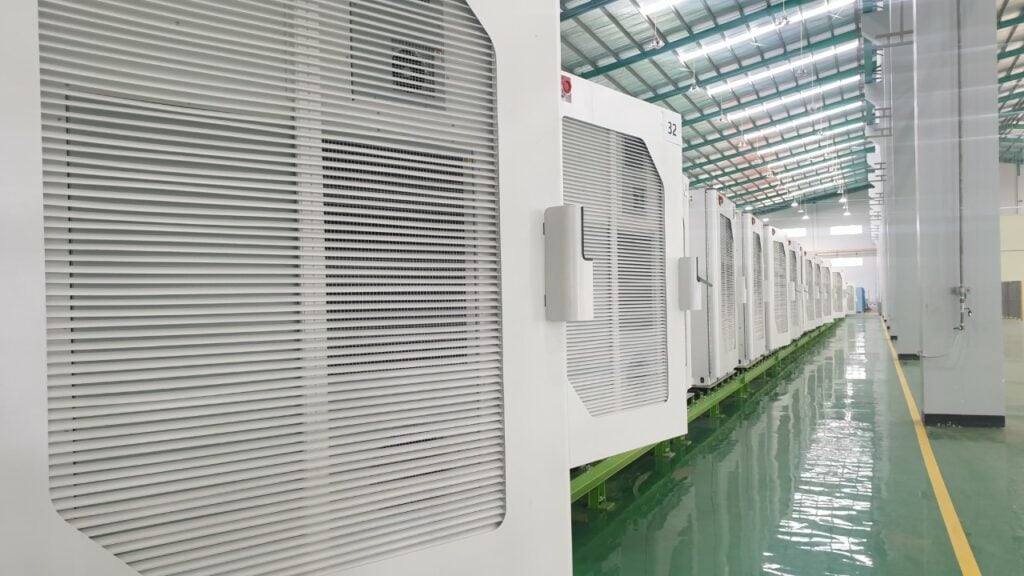
That means that its existing contracted manufacturing facility in Vietnam will continue to produce the base, modular 6th generation Cube units – the building block of all Fluence’s energy storage solutions – which will then be sent to the US site for customisation and configuration in line with the customer’s needs.
The Vietnam facility will continue to provide the full-build solutions for the Asia-Pacific and Europe markets, he said. Regionalising the final part of assembly to the US gives three main benefits for serving that market.
Try Premium for just $1
- Full premium access for the first month at only $1
- Converts to an annual rate after 30 days unless cancelled
- Cancel anytime during the trial period
Premium Benefits
- Expert industry analysis and interviews
- Digital access to PV Tech Power journal
- Exclusive event discounts
Or get the full Premium subscription right away
Or continue reading this article for free
One is a greater ability to customise BESS solutions within the same schedule. Two, it decreases the impact of supply chain disruptions by moving the final assembly closer to the market. Three, it gives the company more control over costs.
Sending the company’s base modular concept instead of fully-formed and customised BESS solutions to the US increases the company’s choice of charters, vessels and logistics companies for transportation, too. A large part of this is because a fully-formed system is classed as ‘dangerous goods’, unlike the base concept.
Silveria has been senior director of manufacturing for Fluence since August 2020 and reports directly to Fluence SVP & chief supply chain and manufacturing officer Carol Couch.
Fluence also recently announced its Fluence Spares Direct service through two spare parts hubs in Ireland and Utah, although Silveira said these have been operational for over a year, pre-dating its regional manufacturing initiative. The main aim of these is to reduce downtime for operational BESS projects, he said.
The hubs mainly stock components which the company can predict will be ‘troublesome’, and can ship these to sites in 24 hours, versus two weeks from Vietnam.
When asked about the company’s roadmap to regionalising its manufacturing to the European market, where it is very active, Silveira said the company plans to take a similar approach to what it’s done in the US in terms of Vietnam producing the base unit, which can then be customised closer to delivery.
“We’re actively pursuing partnerships there from a contract manufacturer perspective. Our goal is to complete that in the latter part of 2023, with expectations to go live in 2024. So following the same methodology that we have in Americas, we will carbon copy that for our European contract manufacturer,” he said.
He added that with Europe’s substantial gigafactory push, additional battery cell capacity will come online potentially allowing Fluence to move even more of its production there. There are pros and cons to having battery supply closer to markets, Silveira said, but “we see more pros”, he said. He cited the partnership the company has with Northvolt in Europe.
He reckons Fluence will be able to get to a situation where 70% of the commodities (by value) it procures to produce its solutions come from local markets – i.e. where its customers are – and 30% from elsewhere.