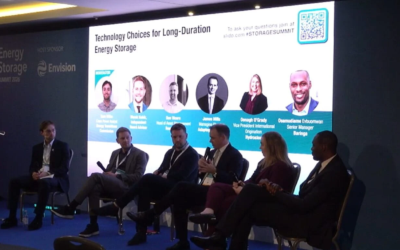
Frank Gordon, senior policy analyst at REA, addresses the final meeting of the Energy Storage100 Alliance. credit: Tom Kenning
Ending double charging, a clear definition for energy storage and hasty action were the three main recommendations for UK policy put forward at the last meeting of the Energy Storage100 Alliance today.
The group of key industry members met during a breakfast session at Clean Energy Live UK to discuss various recommendations to the UK’s Department for Business, Energy and Industrial Strategy (BEIS).
It was made clear that Brexit will only serve as a distraction to progress in the storage sector’s attempts to communicate with BEIS, a department that will have its hands full with preparations for the triggering of Brexit.
However, Solar Media will be writing a White Paper from the meeting to help the industry present its views to BEIS.
Try Premium for just $1
- Full premium access for the first month at only $1
- Converts to an annual rate after 30 days unless cancelled
- Cancel anytime during the trial period
Premium Benefits
- Expert industry analysis and interviews
- Digital access to PV Tech Power journal
- Exclusive event discounts
Or get the full Premium subscription right away
Or continue reading this article for free
At the end of the session various delegates cited key areas for BEIS to take action on.
Jill Cainey, director at Electricity Storage Network, said that the most critical issue to change is the double charging of the end-user, which is “totally unfair”, adding that it should not be taking so long to resolve this issue. Double charging results from electrical storage systems being subject to network usage charges on the same basis as generators.
Cainey said: “That has a material cost on all projects and has material cost to the end-consumer, because we are paying twice for electricity, just because storage wasn’t classified in the incentive regimes as not being an end-user.”
She also called for a clear definition for storage to give consistency across the industry, which will be discussed in the long-awaited call for evidence.
Martin Allman, country director for the UK at Sonnen, said that definition was not so much of any issue for the residential storage sector and he suggested that the industry can be innovative enough to find concepts that work.
For Allman, the number one issue was over grid connection and the G59 certification required. He said the storage industry is frustrated by battling between the movemnts of the DNOs and the IETs. However, he was confident that “sensible rules” will come into place in the near future.
However, he said: “I’ve got a feeling that we are moving in the right direction, but it feels that we are stumbling when the market is really primed and we really should be hitting this hard. That is a key frustration from my point of view.”
Frank Gordon, senior policy analyst, at the UK’s Renewable Energy Association (REA), said: “There is an increasing consensus about what we do need in the market, but different views about what should come first potentially.”
He agreed with Cainey that a definition is required for the larger-scale segment to “allow consistency for how the DNOs treat connections”. Referring to double charging, he said that DNOs again need to be consistent in how they treat and approach storage.
In any case, Gordon said there are actions that can be taken without the government’s purview including creating technical standards, setting out the business case and business models as well as educating investors and financiers.
Many of the delegates urged for speed in acting on their recommendations, but many felt that the Brexit negotiations will only slow down attempts to engage with BEIS.
In other areas, Alaa Mohd of Panasonic claimed that Germany can learn from the UK’s EFR tender, which he said put the UK at the forefront of utility-scale storage.
Meanwhile, Allman said that it was important to focus on the positive progress of the sector and “get on with it” rather than dwelling for too long on the challenges.