CO2 Battery company Energy Dome has won €17.5 million (US$18.5 million) in grant and equity financing from the European Innovation Council, the maximum amount available.
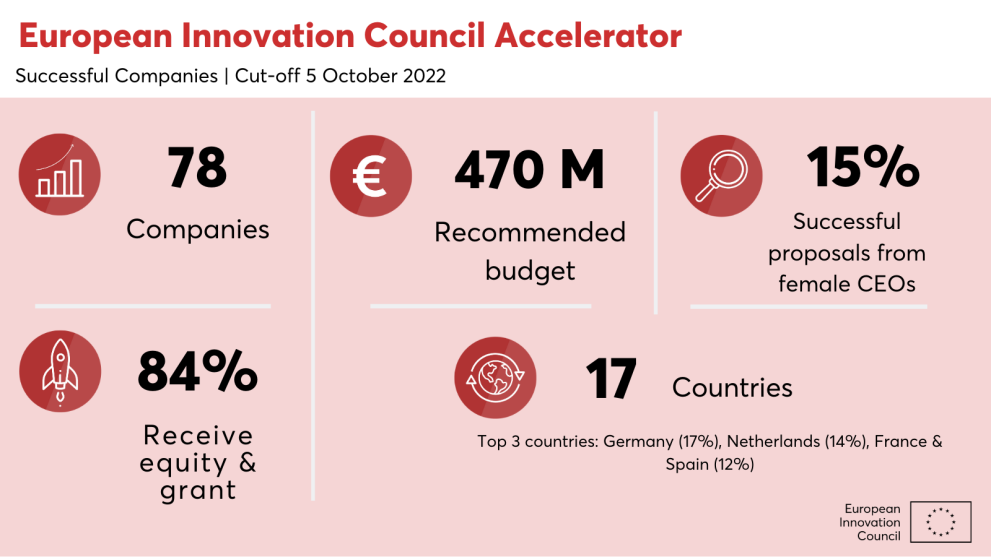
The Milan-headquartered firm was one of 78 companies to win the funds through the latest round of the European Innovation Council’s (EIC) Accelerator funding programme, which received applications from over 1000.
The EIC described the payout to Energy Dome as ‘blended finance’, meaning a mixture of equity or quasi-equity through a convertible loan, as well as a grant.
The body was founded in 2017 by the EU’s European Commission with the goal of supporting the commercialisation of high-risk, high-impact technologies in the bloc. Energy Dome’s funding in this round was nearly three times the €6 million average across the 78 companies.
Try Premium for just $1
- Full premium access for the first month at only $1
- Converts to an annual rate after 30 days unless cancelled
- Cancel anytime during the trial period
Premium Benefits
- Expert industry analysis and interviews
- Digital access to PV Tech Power journal
- Exclusive event discounts
Or get the full Premium subscription right away
Or continue reading this article for free
The EIC, through its EIC Fund, joins existing strategic investors Barclays, 360 Capital, CDP Venture Capital SGR and Novum Capital Partners. The latter have invested around US$25 million in Energy Dome while the equity portion of EIC’s participation has not been revealed.
“This strategic support by the European Commission will enable Energy Dome to accelerate the scale up of our business and the deployment of CO2 Batteries across global markets,” said Claudio Spadacini, founder and CEO of Energy Dome.
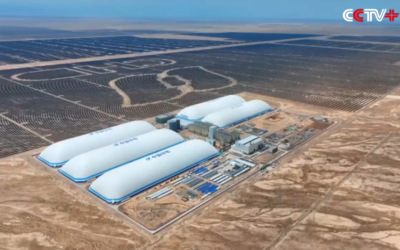
The company inaugurated the first large-scale demonstrator project for its CO2 Battery technology in June last year, a 2.5MW/4MWh facility in Sardinia, Italy.
Its technology is based on a thermodynamic cycle, which charges by drawing carbon dioxide from a ‘Dome’ gasholder, storing it under pressure, and dispatching by evaporating and expanding the gas through a turbine back into the gasholder.
Energy Dome’s technology uses a thermodynamic cycle to store and dispatch energy with a 4-24 hour duration. It ‘charges’ by drawing carbon dioxide from a large atmospheric gasholder (the Dome) and storing it under pressure at an ambient temperature, and dispatches by evaporating and expanding the gas into a turbine to generate electricity and return it back to the Dome.
A recently-signed memorandum of understanding (MOU) with Danish energy company Ørsted will see the pair run a feasibility study on a 10-hour, 20MW system.
The EIC’s funding was the second accelerator programme in which the company was successful last year. In early November, it received funding and networking support from San Francisco-based Elemental Excelerator, which was characterised at the time as an entry into the US market.
The EIC funded two other energy storage-related companies in the latest round. Spain-based lithium-ion battery recycling process solutions firm Circu Li-ion S.A received an undisclosed amount of blended finance, while Germany-based Reverion won a ‘grant first’ deal for its methane-based fuel cell.
Energy-Storage.news’ publisher Solar Media will host the eighth annual Energy Storage Summit EU in London, 22-23 February 2023. This year it is moving to a larger venue, bringing together Europe’s leading investors, policymakers, developers, utilities, energy buyers and service providers all in one place. Visit the official site for more info.