E-Storage, Canadian Solar’s energy storage subsidiary, and owner and operator Sunraycer Renewables have entered into agreements for the supply and long-term servicing of two battery energy storage systems (BESS) in Franklin County, Texas, US.
Totalling 503MWh, the projects are being collectively referred to as the Lupinus projects, and are being developed by Sunraycer.
Lupinus consists of the 202MWh Lupinus 1, which is expected to start construction in Q1 2027 and become operational by Q3 2027. It also includes Lupinus 2, a 301MWh facility scheduled to begin construction in Q3 2026 and reach commercial operation in Q2 2027.
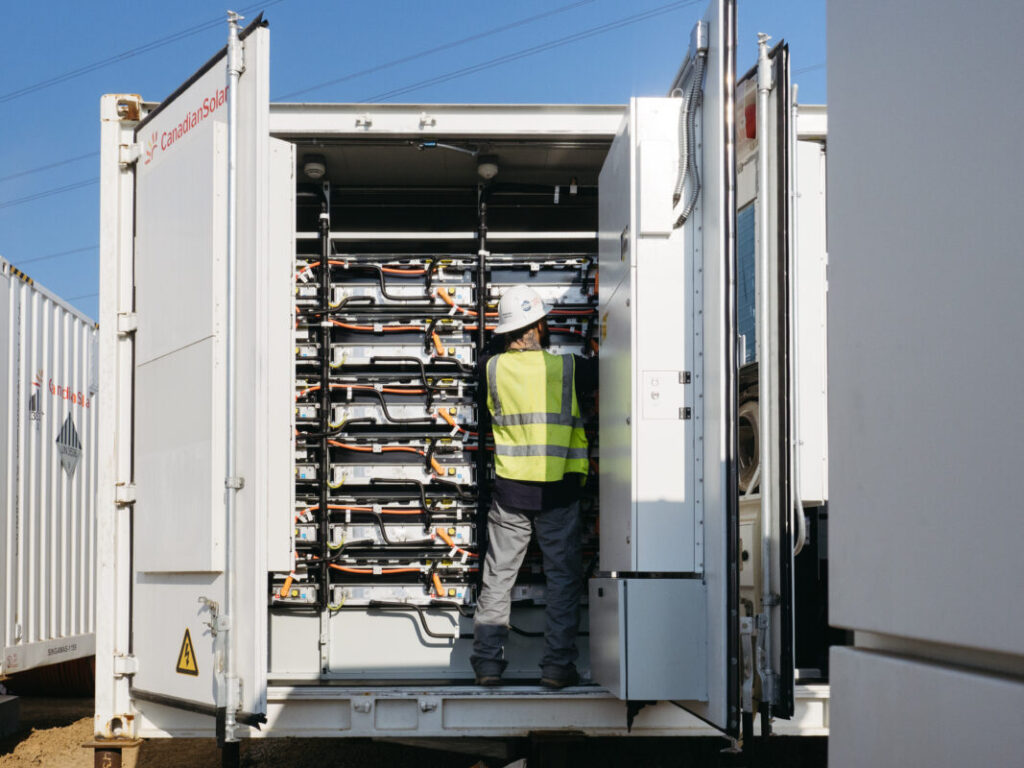
Under the agreements, e-Storage will supply its SolBank 3.0 BESS and offer 10 years of services, helping ensure system reliability, optimise performance, and maintain availability throughout the project lifecycle.
Try Premium for just $1
- Full premium access for the first month at only $1
- Converts to an annual rate after 30 days unless cancelled
- Cancel anytime during the trial period
Premium Benefits
- Expert industry analysis and interviews
- Digital access to PV Tech Power journal
- Exclusive event discounts
Or get the full Premium subscription right away
Or continue reading this article for free
In 2025, the company introduced an upgraded SolBank 3.0 BESS solution. The company states that it has improved its lithium iron phosphate (LFP) technology and provides a ‘near zero battery degradation curve’ during the first four years.
As part of the announcement for Lupinus, e-Storage claims the projects will play a vital role in supporting renewable energy integration and enhancing grid stability within the Electric Reliability Council of Texas (ERCOT) market, highlighting ERCOT’s importance to North America’s energy storage market overall.
Near the end of 2025, Canadian Solar announced that it would take direct control of its US solar PV and energy storage manufacturing facilities.
As reported by our colleagues at PV Tech, Canadian Solar will maintain a 75.1% ownership stake in the new venture, which will manage its US solar PV cell and module production as well as its planned energy storage system manufacturing activities.
The parent company will also acquire a majority 75.1% ownership of “certain overseas facilities that support US operations” from CSI Solar. It said the total consideration for these assets is expected to be around US$50 million.
Canadian Solar currently runs a module assembly plant in Mesquite, Texas, and intends to launch a solar cell plant in Indiana alongside a lithium battery factory in Kentucky by the end of this year. These are likely the facilities involved in this asset shift. However, it remains unclear which overseas facilities, such as solar PV and BESS factories in Southeast Asia, China, and Brazil, it plans to acquire.
Sunraycer was active in Texas last year, reaching a revenue swap agreement with the international utility and power firm Engie for two solar-plus-storage projects.
A revenue swap functions like a toll agreement, where an offtaker pays the project owner a fixed amount for rights to the project’s revenues, thereby assuming some risk from the owner. Engie acts as the swap provider through its subsidiary, Engie Energy Marketing North America (EEMNA).
The Energy Storage Summit USA will be held from 24-25 March 2026, in Dallas, TX. It features keynote speeches and panel discussions on topics like FEOC challenges, power demand forecasting, and managing the BESS supply chain. For complete information, visit the Energy Storage Summit USA website.