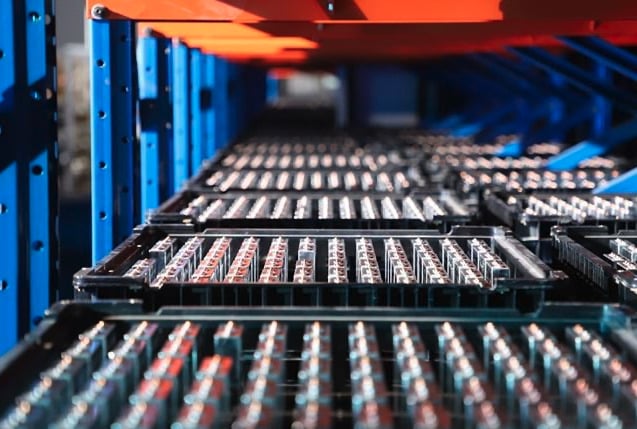
The fifth edition of the DNV Battery Scorecard takes a deep dive into the performance and safety metrics of electric vehicle (EV) and energy storage system (ESS) battery cells.
The independent testing and accreditation house launched the scorecard report today (24 April). It examines the questions that battery producers, buyers, and users must consider to best manage risk, DNV claimed.
“When somebody wants help to purchase a battery system, they can call us, and we can walk them through everything they need to know. This [Battery Scorecard] is sort of the free ‘starter kit’, where we give you a broader view of what’s important in the industry,” Jason Goodhand, global segment lead for energy storage at DNV, told Energy-Storage.news.
Goodhand said customers might want to look at things like balancing cell safety “versus degradation versus cost.”
Try Premium for just $1
- Full premium access for the first month at only $1
- Converts to an annual rate after 30 days unless cancelled
- Cancel anytime during the trial period
Premium Benefits
- Expert industry analysis and interviews
- Digital access to PV Tech Power journal
- Exclusive event discounts
Or get the full Premium subscription right away
Or continue reading this article for free
DNV tests a variety of cells from different vendors across the industry under different conditions. This gives a better understanding of how the devices respond to, for example, different charging rates, whereas if only going on data provided by the OEM, the customer may not be able to make like-for-like comparisons of different cell types.
While the individual cells aren’t named, the DNV storage lead said that the graphs in the report show the spread of performance and safety metrics between batteries from different manufacturers and of different chemistries and form factors can be quite broad.
“While this doesn’t inform you about a specific cell, it does something unique by showing how much they vary,” Goodhand said.
Back in 2019, then-DNV US energy storage lead Davion Hill, who now leads up an energy storage development company, wrote an article for our quarterly journal PV Tech Power on the scorecard and how it was aimed at easing the risks of battery investment.
The 2022 edition, the most recent one prior to the latest, DNV ranked some named cells and providers, finding that CATL and Narada’s cells were among top performers for stationary storage applications. The 2022 edition also carried rankings of manufacturers by production volume, putting CATL, LG Energy Solution, Panasonic, BYD and Samsung SDI in the top five.
According to the 2024 report, the key questions to ask are about technology readiness and bankability, degradation expectations and the sort of testing the cells have undergone, expected lifetime under a variety of use cases, and the battery’s safety profile.
DNV noted that within lithium-ion (Li-ion), the dominant battery on the market, there are some de facto standards of battery size and shape, with lithium iron phosphate (LFP), increasingly the sub chemistry of choice in stationary storage, commonly packaged as 1kWh prismatic cells weighing about 5kg each.
The scorecard also takes into account advances in battery technology, which include improvements to the incumbent lithium-ion batteries, such as anode and cathode advancements for Li-ion and solid-state Li-ion batteries, as well as different battery chemistries like sodium-ion and long-duration energy storage (LDES) technologies that could disrupt the market.
In an overview of the Li-ion market, DNV said that the early market for battery energy storage system (BESS) batteries was dominated by a small number of major players, most prominently Samsung, LG and Panasonic.
Over time, as Energy-Storage.news readers will likely know, major Chinese manufacturers including CATL and BYD have taken the lead in the market, spurred on by the manufacturing scale they’ve attained from EV battery production.
More recently, DNV recognised the wave of smaller Asian manufacturers, again mostly from China, that are gaining traction. The company warned that some new suppliers keen to gain market share are offering batteries at lower cost, but this could come at the expense of performance or safety.