
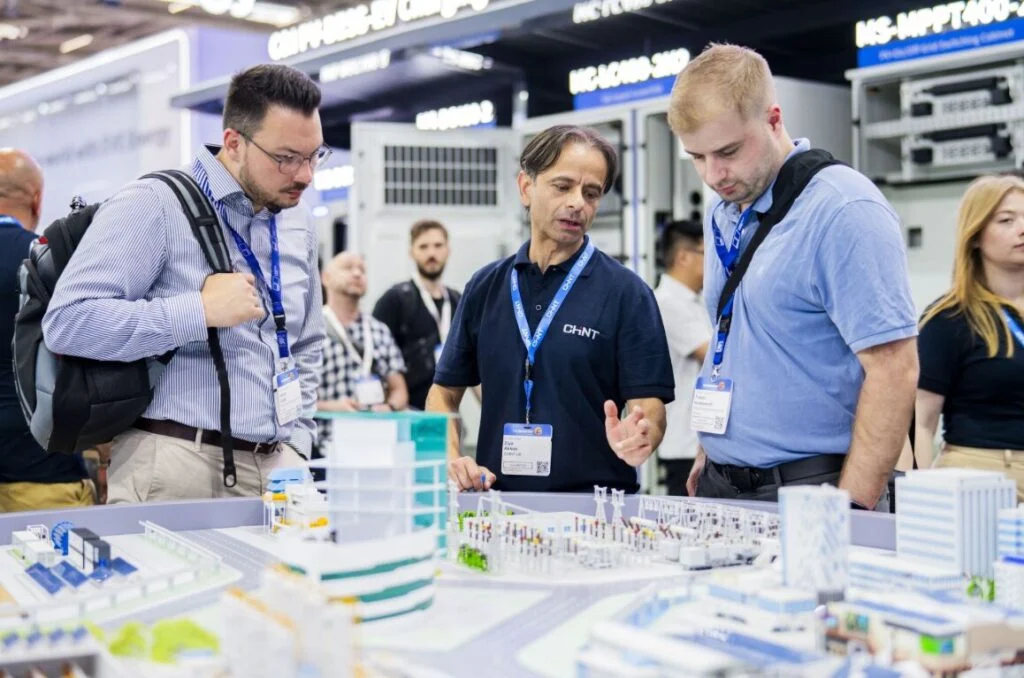
In this Q&A, CHINT Global’s Beibei Zheng discusses how the company is responding to Europe’s dual challenge of AI sovereignty and energy security—and why the next phase of growth will be defined by system integration expertise, local execution capabilities and lifecycle value rather than standalone products alone.
Energy-Storage.news: As AI drives rapid growth in data center capacity, how is Europe responding to the resulting increase in energy demand?
Beibei Zheng: The rapid growth of AI is transforming the data center industry. Global data center capacity is expected to nearly double by 2030, driven by hyperscale cloud expansion and accelerating AI demand. More importantly, this is no longer just a computing story—it is increasingly a power infrastructure story, where energy availability becomes a key constraint for growth.
Europe is shaping its own path for AI development, balancing security and competitiveness. AI sovereignty and digital sovereignty are now central to its strategy, as Europe aims to build a trusted and competitive AI ecosystem. The EU AI Act is a clear example of this approach, establishing a governance framework for responsible AI development at scale.
Try Premium for just $1
- Full premium access for the first month at only $1
- Converts to an annual rate after 30 days unless cancelled
- Cancel anytime during the trial period
Premium Benefits
- Expert industry analysis and interviews
- Digital access to PV Tech Power journal
- Exclusive event discounts
Or get the full Premium subscription right away
Or continue reading this article for free

At the same time, data center IT load in Europe is expected to grow from around 10GW today to approximately 35GW by 2030, with electricity demand potentially exceeding 150TWh. AI is therefore becoming a major driver of investment not only in digital infrastructure, but also in energy systems.
This is fundamentally reshaping the power landscape. Investment is accelerating across grid expansion, substations, power distribution, energy storage, and intelligent energy management. However, in Europe, power infrastructure is not developing at the same pace as AI demand, with grid congestion and connection delays becoming key constraints.
As Europe accelerates investment in AI, data centers and grid infrastructure, what capabilities are customers looking for from technology partners today?
As a result, customers are increasingly looking for partners that can deliver integrated, reliable, and future-ready power solutions rather than standalone products.
At CHINT, we see this transformation as an opportunity to drive innovation and create value for our customers. Leveraging our full-stack power value chain, we deliver integrated solutions that enable more reliable, efficient, and sustainable power and AI infrastructure across Europe. From next-generation technologies such as solid-state transformers and solid-state circuit breakers to cascading storage solutions, our focus is not only on delivering innovative products, but also on enabling customers to build resilient and future-ready infrastructure for the AI era.
As Europe’s energy transition enters a new phase, how is CHINT evolving its long-term strategy to support Europe’s changing energy landscape?
As one of the world’s leading regions for energy transition and grid modernisation, Europe is entering a new phase of its energy transition. The focus is no longer solely on expanding renewable generation capacity, but increasingly on building energy systems that are more efficient, intelligent and resilient. As electrification, digitalisation and AI-driven infrastructure continue to accelerate, demand is growing for integrated solutions that can support the evolving needs of the power system.
At the same time, energy security, supply chain resilience and industrial competitiveness have become increasingly important priorities across Europe. These priorities are reinforcing the need for more flexible, efficient and reliable energy infrastructure and encouraging closer collaboration across the entire energy ecosystem. Meanwhile, the growing convergence of energy and digital infrastructure is creating demand for solutions that can deliver greater flexibility, resilience and system visibility.
In line with Europe’s growing focus on supply chain resilience and industrial competitiveness, we are continuing to strengthen collaboration with local partners and enhance our ability to support customers through more resilient and responsive value chains.
In this context, we see our role not simply as a technology provider, but as a long-term partner in Europe’s evolving energy ecosystem. By working closely with customers, utilities, developers and industry partners, and by continuing to strengthen our local capabilities, we aim to deliver long-term value while supporting Europe’s goals around energy security, decarbonisation and industrial competitiveness.
Looking ahead, we will continue supporting customers across renewable energy, grid infrastructure, energy storage, data centres and advanced industrial applications. By combining global experience with local expertise, we aim to contribute to the development of more resilient and sustainable energy infrastructure and to support Europe’s long-term ambitions for a secure, affordable and low-carbon energy system.
As Europe’s energy system becomes more complex and interconnected, what do you see as CHINT’s key differentiators in the market?
Going forward, differentiation will increasingly come from system integration expertise, local execution capabilities, and the ability to support customers throughout the entire project lifecycle.
As energy systems become more interconnected and complex, customers are increasingly looking for partners that can bridge multiple technologies and help navigate increasingly complex energy systems. This requires not only technological innovation, but also deep industry understanding, strong local responsiveness and a long-term commitment to customer success.
Customers are also placing greater emphasis on lifecycle value and increasingly expect partners to support projects from design and integration through to long-term operation and optimisation.
Our goal is to help build a greener, smarter, and more resilient energy future. Moving forward, CHINT will continue strengthening collaboration in three key areas: customer and partner engagement, technology innovation, and stronger collaboration across regional supply chains. At the same time, we will continue to deepen collaboration between local operations and global strategy, ensuring that our solutions can effectively address the specific needs of different markets and applications.
We actively engage with local research institutions and industry partners to refine our solutions and strengthen collaboration across the regional energy ecosystem.
By gaining a deeper understanding of local regulations and legal frameworks across Europe, CHINT continues to combine industrial expertise with global business practices, while contributing to the development of intelligent and resilient energy systems capable of supporting the AI era and an increasingly electrified future.
Ultimately, we believe that the next stage of Europe’s energy transition will be defined by partnership, innovation and shared value creation. Building a more resilient energy system requires collaboration across technologies, industries and markets. It also requires continued innovation and close cooperation across the value chain to ensure that future energy systems remain secure and adaptable. In this environment, adaptability and the ability to respond to evolving technologies and regulatory requirements will become increasingly important.
We look forward to working alongside customers and industry stakeholders to help create energy systems that are cleaner, smarter, more secure and better prepared for the opportunities of the digital age.
