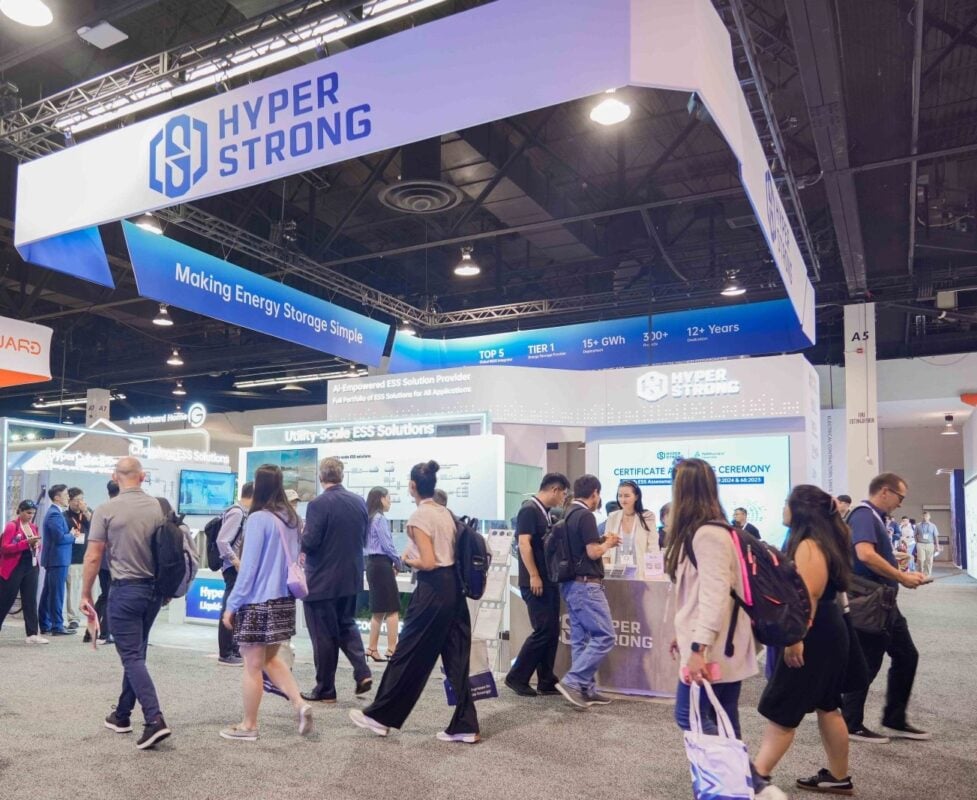
A number of Chinese energy storage companies have released their 2025 annual earnings results and forecasts, revealing divergent performance.
Among them, HyperStrong posted revenue of over RMB11 billion (US$1.6 billion), with net profit surging 46.49% year-on-year, achieving robust growth in both revenue and net profit; Pylontech and Tianneng Group delivered stable performance; Sinexcel recorded modest growth in both revenue and net profit; and GoodWe returned to profitability year-on-year.
In contrast, SolaxPower was caught in a dilemma of “revenue growth without profit growth”, with net profit plummeting nearly 50% year-on-year.
Overall, the energy storage segment has become a key growth driver for various companies. Whether engaged in system integration, battery manufacturing, or core component supply, these suppliers are stepping up their global expansion and optimising product portfolios.
Try Premium for just $1
- Full premium access for the first month at only $1
- Converts to an annual rate after 30 days unless cancelled
- Cancel anytime during the trial period
Premium Benefits
- Expert industry analysis and interviews
- Digital access to PV Tech Power journal
- Exclusive event discounts
Or get the full Premium subscription right away
Or continue reading this article for free
Key metrics, including energy storage shipment volumes and the share of overseas orders, have continued to improve, underscoring strong growth resilience.
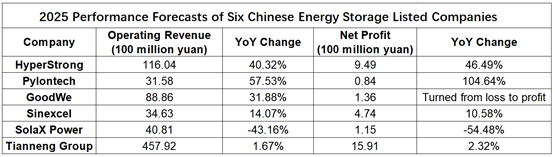
Data source: Announcements from the various listed companies.
HyperStrong’s revenue exceeds RMB11 billion, net profit up nearly 50%
On 27 February, HyperStrong released its 2025 Annual Performance Express Announcement. For the full year 2025, the company achieved operating revenue of RMB11.604 billion, up 40.32% year-on-year. Net profit attributable to shareholders of the parent company amounted to RMB949 million, representing a year-on-year increase of 46.49%.
Previously, HyperStrong unveiled its shipment targets for 2026–2028. Under the plan, the company aims for a combined shipment volume of 300GWh over the three-year period, with annual targets of 70GWh, 100GWh, and 130GWh, respectively.
Of this total, 200GWh is expected to come from standalone energy storage, data centres, and other application scenarios. Domestic shipments in 2026 are projected to reach 60GWh, accounting for 86% of the total.
Pylontech revenue grows 57.5%, company impacted by intensifying competition
On 27 February, Pylontech released its 2025 performance express report. The company posted operating revenue of RMB3.158 billion, up 57.53% year-on-year, while net profit attributable to shareholders of the parent company reached RMB84 million, surging 104.64% year-on-year.
During the reporting period, the company’s major financial data and indicators were revised upward by more than 30%.
Pylontech noted that such growth was mainly driven by the positive momentum in the energy storage sector: demand in the overseas energy storage market continued to recover, while demand in the domestic energy storage and light power markets grew steadily.
Notably, despite strong revenue and net profit growth, the company’s operating profit and total profit declined sharply year-on-year, by 76.59% and 75.25%, respectively.
Pylontech attributed the decline to increasingly fierce competition in the energy storage industry. As the market shifts from price-based competition to value-based competition, the company has faced pressure on product selling prices. In addition, adjustments to export tax rebate policies have further raised its costs. The combined impact of these two factors has weighed on the company’s profitability.
GoodWe returns to profitability with RMB136 million forecast
According to its 2025 annual performance express report, GoodWe posted operating revenue of RMB8.886 billion, up 31.88% year-on-year. Net profit attributable to shareholders of the parent company reached RMB136 million, representing a return to profitability compared with the previous year.
GoodWe noted that during the reporting period, the company benefited from strong PV installation demand in China, the introduction of residential energy storage subsidy policies in Australia, and the European market’s exit from inventory adjustment. As a result, sales volume and gross profit of the company’s inverters and energy storage batteries improved significantly.
Meanwhile, the company continued to increase R&D investment and optimise its global market layout. Despite a year-on-year rise in operating expenses, revenue growth and product mix optimisation effectively lifted the company’s overall profitability.
SolaX Power grows revenues without growing profit
SolaX Power faced the challenge of ‘revenue growth without profit growth’ in 2025. According to its performance forecast, the company recorded operating revenue of RMB4.082 billion in the reporting period, up 32.84% year-on-year.
In contrast, net profit attributable to shareholders of the parent company stood at just RMB116 million, down sharply by 43.16% year-on-year. Net profit excluding non-recurring gains and losses reached RMB64 million, a year-on-year drop of 54.48%.
The company explained that its aggressive expansion into emerging markets, including Asia, Africa, and Australia, effectively boosted overall operating revenue in 2025.
However, the generally lower gross margins in these emerging markets diluted overall profitability. Furthermore, the company ramped up R&D, sales, and administrative expenses to accelerate technological innovation and market expansion. Coupled with provisions for asset impairment losses, these factors collectively resulted in a notable year-on-year profit decline for the period.
Sinexcel sees moderate growth in revenue and profit
On 27 February, Sinexcel released its 2025 annual performance express report. For 2025, the company posted operating revenue of RMB3.463 billion, up 14.07% year-on-year. Net profit attributable to shareholders of the listed company reached RMB474 million, a year-on-year increase of 10.58%.
Discussing its energy storage business, Sinexcel noted that a key strategic focus in recent years has been to expand aggressively overseas, steadily raise the share of overseas revenue, and strengthen localised operations. Securing North American certification and market access for its commercial and industrial energy storage products also forms a key part of the company’s strategic layout.
Regarding the 2026 domestic energy storage market in China, Sinexcel previously highlighted three positive trends:
First, various energy storage projects including standalone energy storage have gradually achieved reasonable profitability, and market-oriented policies related to electricity trading will continue to advance in the medium to short term.
Second, the power spot market is moving toward trial operation of continuous settlements. With a higher share of new energy generation and greater market participation, spot price differentials and charging-discharging cycles have widened, creating more arbitrage opportunities for energy storage assets.
Third, capacity tariffs are being gradually rolled out across more Chinese provinces.
Collectively, these factors will help energy storage projects achieve stable baseline profitability, laying a solid policy foundation for the sound and orderly development of the energy storage market, Sinexcel said.
Energy-Storage.news recently reported that by the end of 2025, cumulative energy storage installations in China reached more than 213GW, a 54% year-over-year increase, according to CNESA DataLink, the market intelligence arm of the China Energy Storage Alliance (CNESA) trade group.
That figure includes all technologies, and China is currently targeting lithium-ion cumulative installs alone to hit 180GW by 2027, equivalent to the world’s total installed capacity as of the time the target was announced in 2025.
Tianneng Group: Steady revenue growth, stable performance in core business
On 27 February, Tianneng Group released its 2025 financial results, with overall performance remaining stable. During the reporting period, the company posted total operating revenue of RMB45.792 billion, up 1.67% year-on-year. Net profit attributable to shareholders of the listed company reached RMB1.591 billion, rising 2.32% year-on-year. Net profit excluding non-recurring gains and losses stood at RMB1.099 billion, edging up 0.09% year-on-year.
The company stated that its steady performance growth was driven by the continued strategic development of its lithium battery business. Supported by technological innovation, capacity optimisation and supply chain coordination, the production and sales scale of the lithium battery business expanded steadily, lifting the company’s overall operational quality and profitability.