Chile, China and Australia drove global BESS deployments in April, a month which saw nearly 9GWh of grid-scale capacity enter commercial operations.
That’s according to market intelligence firm Rho Motion’s Battery Energy Stationary Storage Monthly Database, which shows that global deployments were more evenly distributed than during the first three months of the year.
A total of 3,333MW/8,890MWh of grid-scale battery energy storage system (BESS) projects came online in April 2025. That is 13% higher than in the same period last year, but the lowest month in 2025 so far by some distance, possibly reflecting some seasonality in the industry.
China in particular had its least busy month for project commissioning in 2025 so far, resulting in it accounting for a much smaller proportion than in January, February or March, when it was 60-65% of global deployments. The world’s largest energy storage market saw 1,498MW/3,561MWh of BESS enter operations in April, having seen more than double that in each of the previous months. That leaves it with 106.9GW/240.3GW of cumulative BESS installations as of the start of May.
Try Premium for just $1
- Full premium access for the first month at only $1
- Converts to an annual rate after 30 days unless cancelled
- Cancel anytime during the trial period
Premium Benefits
- Expert industry analysis and interviews
- Digital access to PV Tech Power journal
- Exclusive event discounts
Or get the full Premium subscription right away
Or continue reading this article for free
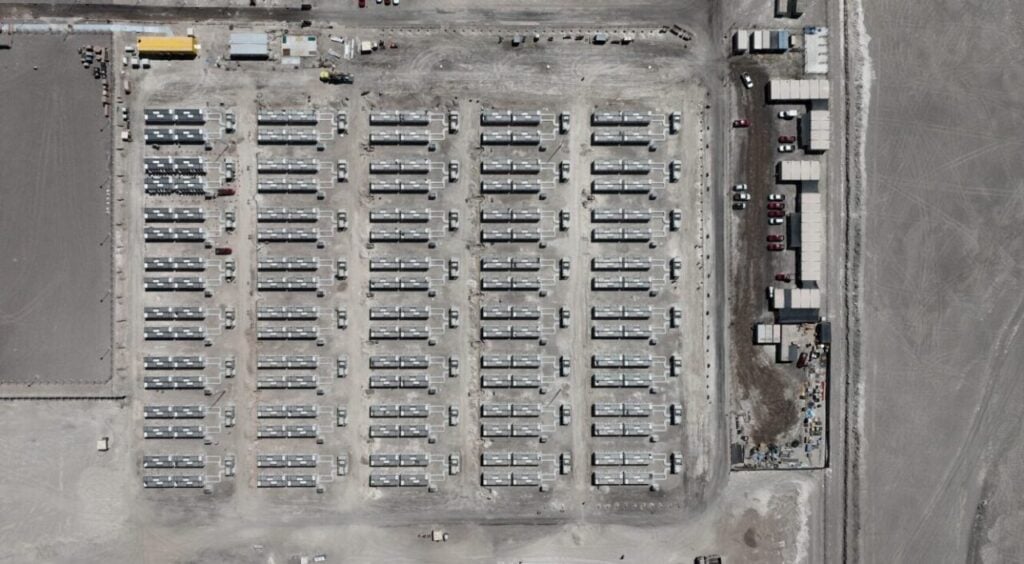
The South and Central America region meanwhile saw 489MW/2,157MWh, primarily driven by projects in Chile. April saw developer Grenergy and investor CountourGlobal bring online the second phase of Grenergy’s huge Oasis de Atacama solar-plus-storage project while independent power producer (IPP) Atlas Renewable Energy commissioned its BESS Del Desierto project.
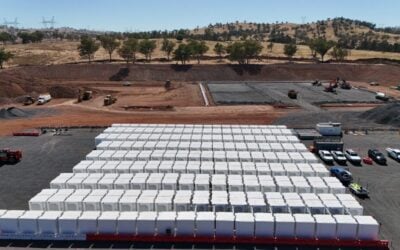
The Oceania region (in Rho Motion’s data) also had its best month of 2025, deploying 494MW/1,097MWh, primarily in Australia, including the Cunderdin solar-plus-storage project with a 55MW/220MWh BESS.
North America saw 609MW/1,613MWh come online, having seen three times that amount in March.
Europe saw 224MW/421MWh of new capacity enter operations in April.
Rho Motion said that 42GWh of BESS has been deployed in the first four months of the year, up 62% year-on-year. A total planned capacity for the full-year has grown to 440GWh, but project delays and even cancellations in light of US-China tariff uncertainty is likely to bring this number down, according to the firm.
The market intelligence firm, the downstream arm of Benchmark Mineral Intelligence, also pointed to a flurry of large-scale projects entering the long-term pipeline.
“11 projects over 1GWh entered the project pipeline this month, the largest of which being a 6GWh six-hour LFP project in Xingjiang, China, called the Juhui Wulanchabu Chayouzhongqi Grid Side Storage Project,” said senior analyst Peter Tillotson.
“Two projects in Australia totalling 4.8GWh have been proposed in South Australia – the Nonowie Lincoln Highway Wind + BESS Projects, as well as four other projects of over 2GWh or more from the same country.”
“A further two projects in Saudi Arabia have selected technology partner Hithium for a total of 4GWh/1GW due to come online by next summer – the Ha’il and Tubuk BESS projects, with Alfanar providing EPC services.”
Saudi Arabia has come out of nowhere to be one of the largest BESS markets in the world with a handful of mega-projects, including some covered by Energy-Storage.news recently.
This article as updated after publication with slightly revised data from Rho Motion.