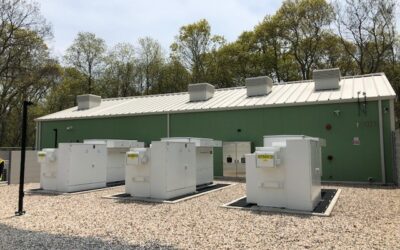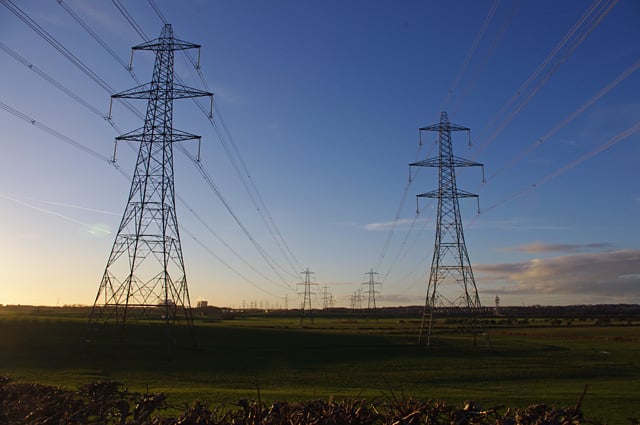
Energy storage provided a gigawatt of power to the grid in California during a wildfire in July last year, helping to keep the lights on.
It was part of a “fabulous moment” for the technology, according to California Independent System Operator (CAISO) President & CEO Elliot Mainzer. Meanwhile energy storage deployments in 2021 on the CAISO grid grew twelve-fold to 2,359MW, according to figures released by the grid and wholesale market operator.
“This summer (of 2021) has been a really fabulous moment for energy storage. There’s been some bumps along the way. It’s a new technology. There’s some lessons learned, but in general, the resources performed really, really well. And we’re really quite optimistic about its future on our grid,” said Elliot Mainzer in a CAISO explainer video on energy storage released last week.
The Bootleg wildfire in Southern Oregon on 9 July he referred to limited power being imported into CAISO’s grid from the Pacific Northwest by disabling three transmission lines connecting the regions. The incident led the operator to declare an emergency alert signifying insufficient power to meet demand.
Try Premium for just $1
- Full premium access for the first month at only $1
- Converts to an annual rate after 30 days unless cancelled
- Cancel anytime during the trial period
Premium Benefits
- Expert industry analysis and interviews
- Digital access to PV Tech Power journal
- Exclusive event discounts
Or get the full Premium subscription right away
Or continue reading this article for free
The energy storage system connected to the grid was able to quickly dispatch about 1,000 megawatts of new battery power to help keep the lights on, CAISO has now revealed.
“July 9 was a very, very stressed day for the California grid. This was the summer when we really saw what the new wildfire risks could mean for our bulk electric system,” said Mainzer.
Gabe Murtaugh, the CAISO’s storage sector manager, stressed just how close the system was to breaking point: “If one more thing would have gone wrong, we could have really been in some serious trouble and we might’ve had to shed load.”
Mainzer had said two months before the Bootleg wildfire that he was “cautiously optimistic” about the grid’s reliability in the approaching summer and storage’s part to play in that, but had added there were still “remaining risks to reliability”. Investor-owned utility PG&E echoed this a month later.
“Stunning” growth in CAISO grid-connected storage deployments
The six months either side of the Bootleg wildfire saw a gigantic deployment of energy storage in the state, which aims to have a carbon-free electricity system by 2045, one of the most ambitious deadlines in the US.
Some 2,359GW of utility-scale battery storage was added to the its network over the course of the year, a twelve-fold increase which the operator has called “stunning” and “meteoric”. The figure confirms California’s role as the majority participant and driver of the energy storage market in the US.
CAISO’s annual figure is 90% of the total utility-scale energy storage installed in the US last year according to separate figures from the American Clean Power Association (ACP), as reported by Energy-storage.news. Including all forms of battery storage, it accounts for 62% of the 4.2GW installed last year, according to BloombergNEF.
By the end of January 2022, total installed battery storage capacity on its network had increased to 2,607MW, CAISO said in its monthly report.
Broader renewable records set but path to net-zero still a long one
Last year saw several records set on renewable power generation more broadly on CAISO’s system. There was record peak solar power output of 13,205 MW on May 27, peak wind output of 5,754MW on May 29, and a peak renewables serving load for a few seconds of 94.5% on April 24, at 2.28pm.
But there is still a long way to go. The highest proportion of peak electricity demand served by renewables over a whole day was 43.5%, on August 18, not a record.
And the two aforementioned peak power outputs for solar and wind, which made up 85% of the peak renewables serving load on April 24, would still only cover 43% of the year’s peak demand of 43,982MW on September 8 at 5.50 pm local time. Battery storage provided around 600GW or 1.36% of that peak power demand.
CAISO covers 80% of California’s population. Eight others including the Los Angeles Department of Water and Power (LADWP) and Berkshire Hathaway portfolio company Pacificorp’s multi-state grid cover the rest.