BYD readies residential storage launch in the US

LinkedIn
Twitter
Reddit
Facebook
Email
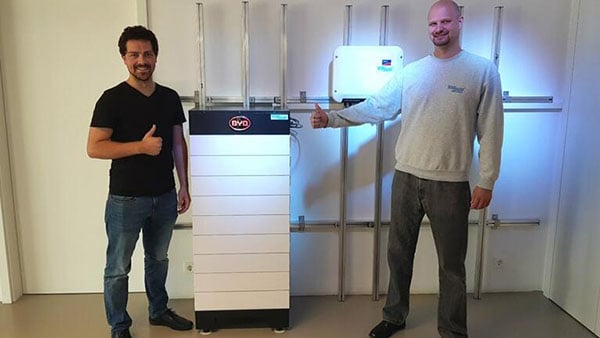
BYD’s B-BOX system dsiplayed at SPI. Credit: BYD

China-based technology giant BYD has installed the first of its residential high-voltage B-Box energy storage systems in Germany and is aiming to launch the system into the US later this year.

The German installation included nine modules with a combined capacity of 11.52kWh. Utilising its modular design, the storage system can have up to five systems connected in parallel in one location.

The firm will target east and west coast states inthe US, as well as Hawaii, where electricity prices are high, and grid constraints make storage applications attractive. The firm launched the B-Box in the UK 12 months ago.

In July, BYD also announced a tie-up with the inverter manufacturing division of Kostal, where the former’s latest high voltage energy storage systems would be paired with the latter’s PIKO brand inverters.

This article requires Premium SubscriptionBasic (FREE) Subscription

Try Premium for just $1

  • Full premium access for the first month at only $1
  • Converts to an annual rate after 30 days unless cancelled
  • Cancel anytime during the trial period

Premium Benefits

  • Expert industry analysis and interviews
  • Digital access to PV Tech Power journal
  • Exclusive event discounts

Or get the full Premium subscription right away

Or continue reading this article for free

The company claimed to have a 25% market share in energy storage in the US.

BYD bags 170MW solar module supply deal

BYD has also won its largest ever solar module supply contract for 170MW of NextEra Energy solar projects in the US.

Tom Zhao, managing director, BYD Solar Division, said that the firm’s reputation from commissioning a 60MWh integrated PV and energy storage project in the UK had helped it break into the US market. He also noted that BYD is exploring opportunities in wind power.

Zhao added that BYD is in discussions with several international companies about introducing EV-charging infrastructure and other clean energy solutions. Indeed, this week the company also signed an agreement with the United Nations Environment Programme (UNEP) to promote electric mobility.

15 September 2026
San Diego, USA
You can expect to meet and network with all the key industry players again in 2025 from major US asset owners, operators, RTOs and ISOs, optimizers, software and analytics providers, technical consultancies, O&M technology providers and more.
15 September 2026
Berlin, Germany
Launching September 2026 in Berlin, Energy Storage Summit Germany is a new standalone event dedicated to Germany’s energy storage market. Bringing together investors, developers, policymakers, TSOs, manufacturers and optimisation specialists, the Summit explores the regulatory shifts, revenue models, financing strategies and technology innovations shaping large-scale deployment. With Germany targeting 80% renewables by 2030, it offers a focused platform to connect with the decision-makers driving the Energiewende and the future of utility-scale storage.

Read Next

May 26, 2026
While Germany is often described as the ‘hottest’ energy storage market in Europe, growing uncertainty on multiple policy and regulatory topics has led to a ‘cooling’ of investor interest.
May 25, 2026
The US installed 9.7GWh of new battery energy storage system (BESS) capacity, according to the US trade association group, the Solar Energy Industries Association (SEIA).
May 22, 2026
Battery storage developer and operator Spearmint Energy has closed a US$450 million financing to support its 300MW/600MWh Red Egret battery energy storage system (BESS) project.
May 22, 2026
Long-duration energy storage (LDES) development and investment company Frontier Power USA (FPUSA) has acquired a 480MWh battery energy storage system (BESS) portfolio from developer-operator Bimergen Energy.
Premium
May 22, 2026
The situation and uncertainty around grid connections and grid fees in Germany is evolving, possibly enabling market participants to look beyond the August 2029 grid fee exemption cut-off date – although uncertainty is still very high.