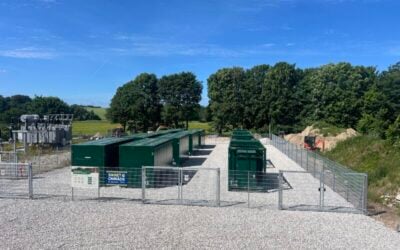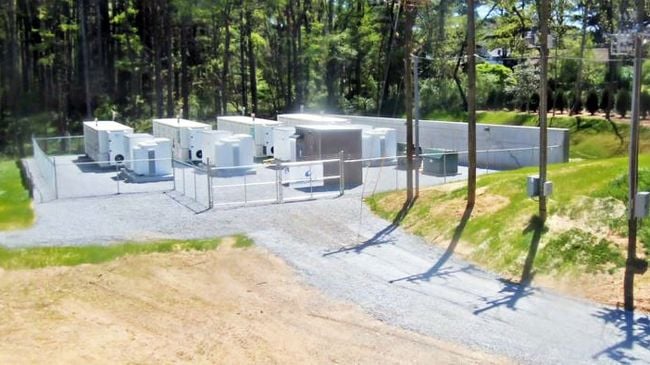
US utility Duke Energy has brought online a 11MW/11MWh battery storage project which despite its modest size is thought to currently be the largest project of its type in North Carolina.
The company announced the start of commercial operation of the battery energy storage system (BESS) last week, on land leased within Marine Corps Base Camp Lejeune in North Carolina’s Onslow County.
Using lithium iron phosphate (LFP) chemistry battery cells, the system is co-located with an existing 13MW solar PV plant with which it shares a connection point to the grid via a Duke Energy substation.
OCI, a subsidiary of the global construction and engineering firm Black & Veatch, was primary engineering, construction and procurement (EPC) contractor.
Try Premium for just $1
- Full premium access for the first month at only $1
- Converts to an annual rate after 30 days unless cancelled
- Cancel anytime during the trial period
Premium Benefits
- Expert industry analysis and interviews
- Digital access to PV Tech Power journal
- Exclusive event discounts
Or get the full Premium subscription right away
Or continue reading this article for free
Details of how the system will be operated were not shared in the statement, but North Carolina state president for Duke Energy Kendal Bowman said pairing the BESS with the solar PV system – which has been in operation since 2015 – “helps strengthen the reliability of our energy grid and makes better use of our existing solar generation”.
Director of public works at the Marine Corps Base Navy Commander Ross Campbell said the base had been able to make “an important investment in the pursuit of energy security inside the fence-line”, through an enhanced use lease (EUL) for the 1 acre plot of land the battery system occupies.
“Integration of the solar plant with a battery energy storage system, unthinkable a decade ago, presents the installation with a number of opportunities to achieve energy resilience objectives,” Campbell said.
“These systems are part of the ongoing collaboration with the Department of Defense and its utility providers to ensure energy security at federal facilities.”
Duke has long way to go to meet 2029 goal
Duke Energy has been criticised by some industry sources in the past for being slower to embrace battery energy storage than many other large utility companies in the US, although it completed its first megawatt-scale plot project, a 36MW/24MWh BESS using lead acid batteries, back in 2012 at a wind farm in Notrees, Texas.
Built with costs shared 50:50 with the US Department of Energy to test the use of batteries for delivering ancillary services, energy shifting and reducing curtailment of the wind farm’s output, that project has since been repowered with lithium-ion batteries.
Duke also built North Carolina’s previous holder of the largest BESS title, a 9MW project in the city of Asheville switched on in 2020. The group, comprising various utilities in its holdings, has about 90MW of battery storage in operation in three US states, most notably in Florida, where it has now switched on a 50MW portfolio, including three projects totalling 34MW/58MWh that came online just over a year ago, as reported by Energy-Storage.news.
Going forward, the company said it plans to have 1,900MW of BESS online in all territories by 2029. This could include 1,000MW of standalone battery storage as well as 600MW of batteries at solar-plus-storage plants in the Carolinas, 1,700MW of pumped hydro energy storage (PHES) and a mix of other resources like 3,400MW of peak demand reduction through energy efficiency and demand response, announced as part of the company’s proposed carbon reduction plan for North and South Carolina in May 2022.
Duke Energy said the carbon reduction plan, which called for the deployment of 5.9GW of renewable and clean energy technologies, could enable a 70% reduction in carbon dioxide emissions by 2030 and set a path to carbon neutrality by 2050. The company also said it would retire all of its coal plants in the neighbouring southern US states by 2035.
North Carolina governor Roy Cooper signed an executive order in January 2022 setting a 50% emissions reduction target by 2030 against 2005 emissions levels, and net zero greenhouse gas (GHG) emissions by 2050, with Duke Energy claiming its Carolinas Carbon Reduction Plan would be aligned with that goal.
According to North Carolina-based non-profit consulting firm Advanced Energy, in 2022 coal still accounted for 13% of that state’s utility generation mix, with 41% coming from natural gas, 32% from nuclear and just 14% from combined hydro, wind and solar renewable generation.
The larger battery storage sites it did already have in 2022 comprised 15 utility-scale installations and 13 microgrids, mostly for municipal utilities and cooperatives, although Duke Energy completed a solar-plus-storage microgrid with 4.4MW of BESS technology capable of powering the entire town of Hot Springs in Charlotte, North Carolina, earlier this year.
In December, system integrator FlexGen said it had completed the first project in a 40MW BESS buildout across various locations for NC Electric Cooperatives, which collectively represents non-profit utilities serving around 2.5 million people in the state. The new fleet adds battery capacity to the group’s portfolio of 14 solar-plus-storage sites which total 23MW of solar PV and 53MWh of BESS, as well as a number of smaller microgrids.
This article has been amended to reflect that North Carolina governor Roy Cooper’s executive order mandates 50% emissions reduction by 2030 and net zero GHG emissions by 2050, not a 50% reduction by 2050, as was originally stated.