Battery storage can be a significantly cheaper and more effective technology than natural gas in providing peaking capacity, according to a new study released by the Clean Energy Council, the industry group which represents Australia’s clean energy sector.
Grids around the world rely on open cycle gas turbine (OCGT) technology at times when demand for electricity is at its highest. OCGTs often only run for a few hours at a time and a few times per year but are among the most polluting assets in the grid operator’s toolkit for balancing energy supply with demand.
While OCGTs were state-of-the-art decades ago, offering the ability to start generating power within 15 minutes of starting up, lithium-ion battery energy storage can respond to grid signals in fractions of a second and can be charged with renewable energy sources like solar and wind.
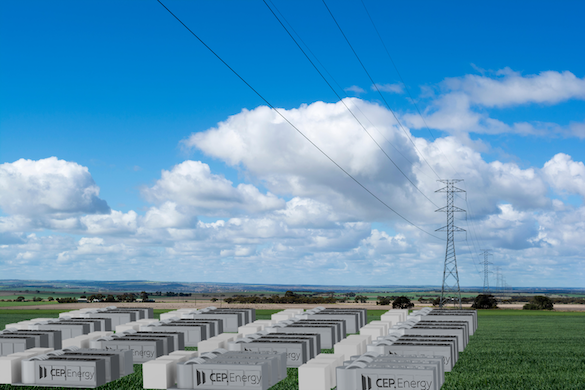
The authors of CEC’s new paper, ‘Battery storage: the new, clean peaker,’ found that a 250MW, four-hour (1,000MWh) battery system in New South Wales would be a cheaper option for meeting peak demand than a 250MW new-build OCGT from both levelised cost of energy (LCOE) and levelised cost of capacity (LCOC) perspectives.
Try Premium for just $1
- Full premium access for the first month at only $1
- Converts to an annual rate after 30 days unless cancelled
- Cancel anytime during the trial period
Premium Benefits
- Expert industry analysis and interviews
- Digital access to PV Tech Power journal
- Exclusive event discounts
Or get the full Premium subscription right away
Or continue reading this article for free
The National Electricity Market (NEM), which covers six Australian states including New South Wales, generally sees peaker plants called into use for about three or four hours each night from 6pm as solar production tails off and evening demand goes up.
Batteries can cover this period, CEC said, and even before factoring in the falling cost of charging the batteries with solar and wind energy resources that continue to get cheaper as well as the falling costs and rising efficiencies of the batteries themselves, neither the economic rationale or necessity to build new gas plants exists anymore in Australia.
In addition to being faster and more accurate in providing peaking services and frequency response, battery storage can also provide a wide range of other services to the network: including inertia and voltage support, which are not only needed for integrating rising shares of renewable energy but also give asset operators the options to earn other revenues which can help recover the cost of investment.
The Australian Energy Market Operator (AEMO) modelled various long-term (20-year scenarios) facing the NEM in its Integrated System Plan, published last year. Among other things, it found that at least 26GW of new large-scale renewable capacity will be needed to retire 63% of coal power stations in the NEM by 2040 and perhaps as much as 50GW to meet more ambitious goals.
This will require some 6GW to 19GW of dispatchable resources to balance the network and AEMO said it that will comprise a combination of different things from pumped hydro and large-scale batteries to distributed storage and virtual power plants. A more significant change to the NEM’s dynamics in the short-term is the market’s migration to five-minute settlement periods, down from half an hour — presenting a risk to natural gas power plant owners’ ability to compete.
The study found that the total levelised cost of capacity for a two-hour battery storage plant including capital cost, fixed costs of operations and maintenance (O&M) and various O&M costs comes in at about AU$119 (US$90.61) /kW/year, a four-hour battery system at AU$197 / kW/year and an open cycle gas turbine at AU$203 / kW/year. Meanwhile in levelised cost of energy (LCOE) terms, a two-hour battery system pans out at AU$195 /kW/year, a four-hour battery system at AU$156 / kW/year and an OCGT at AU$234 /kW/year.
Elsewhere in the world, as early as 2019, Tom Buttgenbach, CEO of solar developer 8minute Solar Energy told this site that his company could build solar-plus-storage peaker plants at “half the cost” of gas peakers in key US markets, while a recent study found that New York City’s entire 6GW fleet of peaker plants could be cost-effectively retired by 2030 using a combination of renewable energy, energy efficiency and energy storage. Similarly, figures released last year by analysis and research group BloombergNEF found that new-build batteries could be competitive on cost with gas peaker plants. A global benchmark value of US$150 per MWh for four-hour duration projects was found by BloombergNEF analysts, although once you need to go much beyond that four-hour duration, OCGTs continue to be quite competitive.
This, however, is changing with renewable energy and storage costs only expected to fall while gas prices fluctuate at best and more likely rise over time. Clean Energy Council noted also that in Australia at least it expected four hours to be largely adequate, while much rarer, longer periods of peak demand and low renewable generation could be covered by other longer-duration energy storage technologies in future.